In the 1960s, an unknown Italian director named Gualtiero Jacopetti disturbed the world with the film Mondo Cane. Loosely translated as “A Dog’s World,” the 1962 documentary comprises a sequence of travelogue vignettes from all over the world, each featuring strange and bizarre cultural and religious practices. While outdated and, in places, even fabricated, it established a new genre known as the “Shockumentary.”
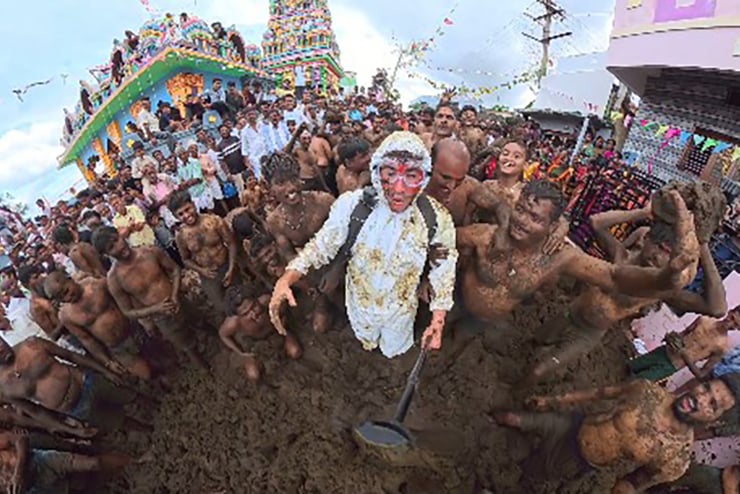
In many ways, the American YouTuber Tyler Oliveira has become the modern day Jacopetti. Oliveira offended the entire country of India after filming himself participating in a traditional cow dung-throwing celebration there. The video, titled “Inside India’s poop-throwing Festival,” captures the annual Gorehabba festival in the remote village of Gumatapura in southwestern India, where local villagers engage in the tradition of hurling cow dung at one another to mark the end of Diwali. Oliveira uploaded the video to X, where it went viral.
The post sparked outrage on social media, where he was criticized for being racist, had calls for his arrest, and had the video mass-reported in an attempt to have it censored. He has recently claimed that his family has been threatened.
Known for his controversial style, Oliveira is part of a new genre of content creator: the travel vlogger/grifter. His schtick is rage-farming and sensationalized content created for attracting subscribers, online engagement, and monetization. His 8 million subscribers epitomize the state of culture today. Audience capture has meant that his subscribers will demand ever more controversial content which he will provide in order to grow his followers—this is one of the most important things in an attention economy.
While in principle I detest this type of slop, Oliveira (at least in the case of the Gorehabba festival) has done nothing wrong. It’s not like he urinated in the Trevi fountain or scribbled “I love Hamas” on the Wailing Wall.
His detractors use the age-old canard of racism to smear an otherwise normal 25-year-old edgelord from California. They link race with culture—much as the British definition of Islamophobia conflates race with religion. What they advocate is a form of cultural relativism: a fashionable liberal shibboleth that holds all cultural practices, customs, and traditions to be morally equivalent.
Contrary to popular belief, not all cultures are equal. Some promote things that are reprehensible, such as cousin marriage, female genital mutilation, and honor killings. Earlier this year, Spanish authorities arrested 19 Senegalese migrants for allegedly killing more than 50 other passengers aboard a migrant vessel, accusing them of witchcraft after blaming them for engine failures and storms.
In India, Hindus assign cows sacred status. The Gorehabba festival is a ritual believed to honor the village’s Hindu deity Beereshwara Swamy, who is said to have been born from cow dung. In Indian culture, the animal’s waste materials are regarded as possessing life-enhancing qualities. Followers of Ayuverda, an alternative holistic medicine rooted in Hindu scriptures, assert that cow urine is a remedy for a wide range of health conditions including diabetes, leprosy, and cancer. During COVID, doctors and health officials in India had to warn people about using cow dung as medicine after reports that people were smearing manure on their faces and drinking potions prepared from excrement in rural areas.
Animal waste has many legitimate uses, such as fertilizer. But, given the choice between chemotherapy and a manure party, I know which one I’d prefer. When it comes to battling colds and flu—call me an old-fashioned Western chauvinist—but I put lemon and honey in my mug, not cow urine.
Criticizing the unsanitary conditions prevalent in certain regions of India has been viewed as perpetuating a racist stereotype, purposefully crafted by tourists who visit poor, unhygienic locations. Although I can only speculate about Oliveira’s motivations for creating his video, let’s be honest: India is not known for cleanliness and sanitation.
A rotting stench of trash towers over Delhi. The capital produces 11,000 tons of garbage every day, most of which gets dumped into a 200-foot-high trash mountain—the rest is just chucked anywhere. There is minimal civic pride in India. In March, more than 1,300 tons of trash were hauled from the Yamuna River in just 10 days. When the authorities constructed barriers to prevent people from throwing garbage into the river, they dumped it along the side of the road instead.
The Yamuna River is regarded as an open sewer, due in part to the cultural tradition of immersing cremated human remains and open public defecation, which results in the disposal of raw sewage. Hindus believe toilets are unclean. In spite of UNICEF’s 2013 social media campaign urging Indians to use toilets, millions of Indians continue to eschew them.
Cultural relativism forbids modern people from being critical of another country’s customs or traditions. Consequently, legitimate discussion and criticism are seemingly impossible. Contrary to this worldview, some cultures simply are superior to others. The fact that it took an audacious young American to point this out says more about us than it did about India.
Leave a Reply