Readers of Chronicles don’t need a primer on what’s wrong with neoconservative ideologues. For decades, they have wielded institutional power in order to purge and silence their rivals, often advancing baseless (or grossly inflated) smears and imposing arbitrary purity tests—though only on the right. The left, meanwhile was allowed to shove the Overton Window ever further in its direction, unmolested by the so-called “principled” right.
Remember when David Frum, writing on behalf of National Review, excommunicated a long list of conservative Iraq War skeptics as “unpatriotic”? He announced, “We turn our backs on them,” but it wouldn’t be long before Frum turned his back on the conservative movement, too—reinventing himself as the poor man’s David Brock.
Under George W. Bush, the United States turned its back on Iraqi Christians, three-quarters of whom were ethnically cleansed right under our troops’ noses and with no interference on our part. We finally turned our backs on Iraq itself, letting it fall into place as a puppet of Iran—an outcome, ironically, which the Israeli government had warned was likely to happen in 2003.
Ruthless practitioners of realpolitik when it came to their own colleagues and allies, the neocons wear the mask of high-minded idealists in public, pretending that they’re shocked, shocked, by the most basic facts of political existence—such as interethnic conflict, religious divisions, and the clashing material interests of different social groups.
Our movement, they tell us, must be above considering any such questions. Instead, we must be grounded entirely on abstract philosophical principles that could apply anywhere to anyone, and benefit no one in particular—such as, heaven forbid, our fellow citizens whose votes we claim to seek. It’s as if the Marquis de Sade insisted on giving public readings from Rousseau, to painted ladies who nodded and smiled, while passing the bourdaloue.
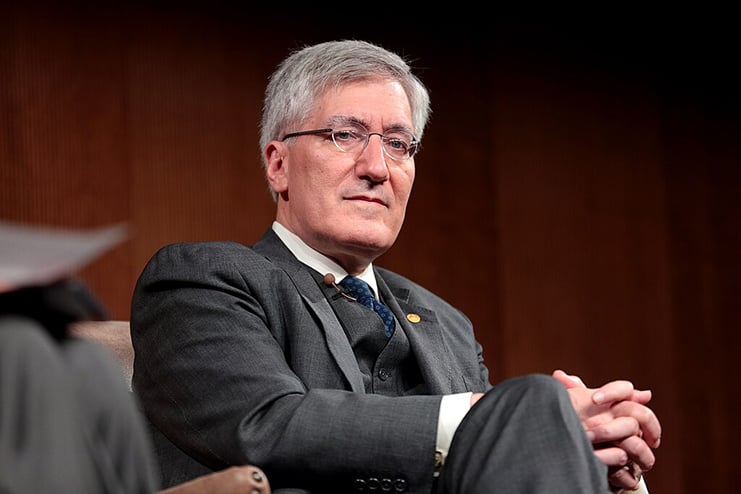
A recent statement from Princeton University Catholic philosopher Robert George, occasioned by Tucker Carlson’s rather softball interview of the Jew-obsessed Groyper hero Nick Fuentes, illustrates the problem perfectly. Or almost perfectly, because unlike Frum and his ilk, George is entirely sincere. He really does believe that the conservative movement exists only to conserve a narrow, partial, and highly abstract set of principles—instead of a people, their country, their churches, institutions, and best interests.
Of course, we must conserve both. We must not, in our grim struggle for survival, betray or abandon our moral code. The Natural Law that God wrote on the human heart is binding in every situation, however dire. That is why we must reject genuine bigots and fanatical tribalists who urge us toward genuine evils. George’s problem—and it’s a fundamental, fatal one—is that he mistakes and conflates the Natural Law with certain post-World War II bromides, the practical implications of which have already proven nearly fatal to Western nations. (Non-Western nations, of course, from Beijing to Islamabad, flout both these post-war norms and the Natural Law, sneering behind their hands at us all the while.)
Imagine some member of a cargo cult in the South Pacific who had read both the Holy Bible and Emily Post’s 101 Common Mistakes in Etiquette and How to Avoid Them, and accorded them equal weight and authority in his current life circumstances. Terrified of committing some ungracious social faux pas, he abandons both hunting and gathering and begins to starve to death.
For all his vast learning and magisterial manner, that’s pretty much what Prof. George does in his statement, which he posted to all his social media. Permit me to quote the central passages. George points to
the foundational principle of all sound morality: the profound, inherent, and equal dignity of each and every member of the human family. Everything else I believe about ethics and politics in one way or another stands upon or presupposes that principle. Any form of “conservatism” (or “liberalism”) that denies it in principle or transgresses it in practice is alien to me. …
It is incumbent upon those of us who maintain the “ancient faith” (to borrow a phrase from Lincoln) to make clear to friend and foe alike that we will not permit the integrity of our movement and its institutions to be compromised. We will not treat its foundational principle of inherent and equal human dignity as optional. On the contrary, we will insist on it, defending and advancing it with renewed dedication.
So far, so good. Such human universalism is true and necessary but very far from sufficient. And it’s certainly not exhaustive. It’s one element, and an important one, in any principled conservatism. But such principles do and must stand in perpetual, creative tension with the particulars of Western civilization and the concrete needs of peoples, unless conservatism is to be a notional, orphan creed—a kind of political Buddhism.
Western nations are now inundated with millions of foreigners more religiously zealous than virtually any Westerner, whose creed obliges them to attempt religious conquest. Elites from the United Nations to the Vatican insist these people are entitled to an open-handed welcome, limitless public support, and even “reparations.” Priests in Catholic Spain are prosecuted for “hate speech” when they give accurate criticisms of Islamic doctrine.
In such a real-world context, how helpful is it for the right to claim that all it really wants to “conserve” are principles such as human equality before God? It’s all too easy for the left to spin such principles as demanding equal treatment, equal benefits, and even equal privileges for foreigners as for citizens. That spells the end of Christian-dominated societies in a generation or two—which George ought to find bitterly ironic, since “equal dignity,” as a principle, can only be deduced from a single source: Christian doctrine. It’s not the verdict of science, and Islam rejects it explicitly, demanding as part of divinely revealed sharia law the “subjugation” and “humiliation” of non-Muslims.
Back in early 2003, when the GOP was delirious from smoking such high-minded hopium, uncut by prudence and the healthy pessimism which the right has long been known for, I wrote a long piece, “America the Abstraction,” offering a critique of the unbalanced attachment conservative intellectuals seem to have for systems over societies, principles over peoples. Here’s the key takeaway:
If you are trying to boil down citizenship to its philosophically respectable components, and if ideology is all you are interested in, then it does not really matter where you were born. Or who your parents were. Or whom you love. Or the hymns you know by heart, the folk tales you treasure, the God you worship. None of these merely human matters measures up, ideologically speaking. None of them can be enshrined in a manifesto, or beamed across the world via Voice of America, or exported in music videos. They do not raise the GDP, or lower the interest rate, or increase our command of oil reserves. They cannot be harnessed to drive the engine of globalization. Therefore, to some people, these things do not matter. Such pieties can be harnessed in the run-up to a war, can form part of the Army recruitment ads and propaganda campaigns, and may even find their way into presidential speeches. But essentially there is no difference between a fourth-generation American and an Afghan refugee who just landed at JFK—so long as they both accept the same ideology.
I’d like to think that conservatives have learned something in the intervening 22 years of incessant defeats and imported chaos. Alas, I fear that Prof. George and those who listen to him may have skipped those lessons.
Leave a Reply