On Aug. 8, the D.C. Court of Appeals handed down a stinging defeat for the lawfare movement that has thwarted President Trump’s agenda. In one of the most significant separation of powers cases, the judicial branch limited its own authority to interfere with the executive branch’s duty to protect the security of the United States from foreign criminal gangs.
The story began in the early evening of March 15, as federal agents escorted more than 100 suspected members of the criminal gang Tren de Aragua (TdA) aboard two planes bound for El Salvador’s controversial Centro de Confinamiento del Terrorismo (CECOT) prison. Shortly after assuming office, Secretary of State Marco Rubio designated TdA a terrorist organization “that threaten(s) the security of United States nationals.” Shortly after the planes were airborne, the American Civil Liberties Union and other social justice attorneys filed a class action petition on behalf of five of the suspected gang members, igniting a landmark constitutional showdown between the executive and the judicial branches of government.
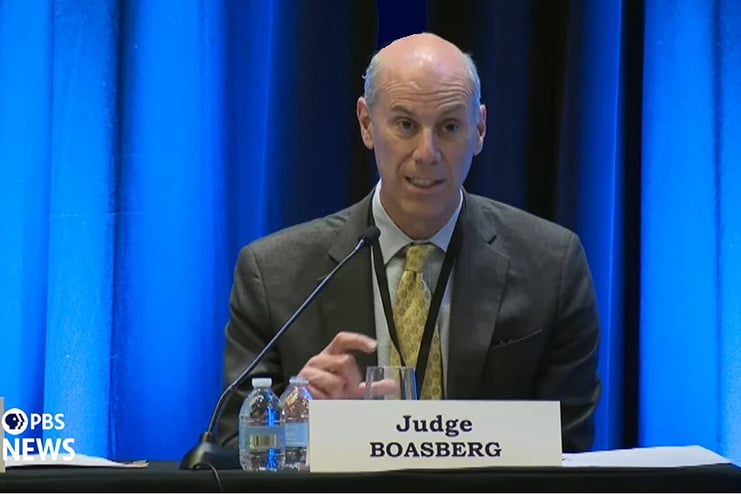
Even as the aircraft folded their landing gear and climbed into the airspace south of the U.S.-Mexico border, attorneys in Washington, D.C. rushed to obtain temporary orders from D.C. District Judge James Boasberg to stop the removal of the suspected gang members. “J.G.G.,” identified only by his initials in the complaint, was allegedly erroneously detained by federal agents. He was a professional “tattoo artist,” in no way associated with the TdA gang, according to the complaint.
As the sun set and the planes continued through the darkness, Judge Boasberg issued a verbal temporary restraining order to the government. He later summarized the order in docket notes that read, “The Government is ENJOINED from removing members of [the] class (not otherwise subject to removal) pursuant to the Proclamation for 14 days or until further Order of the Court.”
Justice Department attorney Christina Greer filed a notice of appeal that same night. The planes landed in Honduras and then flew to El Salvador, where U.S. federal agents transferred custody of the prisoners to a contingent of armed El Salvadorian Security forces.
The planes left American airspace before the judge entered his restraining order. But by the time the prisoner transfer was made, the federal government had actual knowledge of the order. Thus, Judge Boasberg found probable cause that the government committed criminal contempt of court by making the custody transfer, and he threatened to criminally prosecute any individual official who failed to prevent the prisoners from leaving U.S. custody.
TdA prides itself on committing horrifying acts of violence. According to the recent Court of Appeals decision, federal officials worried that introducing the gang’s members into the general U.S. prison population would lead to more recruiting and expansion of the gang’s power from within the prison system. “Some of them recently barricaded themselves in a housing unit for several hours and threatened to take hostages and harm ICE officers,” Footnote 1 of the decision noted. “And transferring them to other facilities creates ongoing risks of prison recruitment and expansion of [TdA gang activities within the United States].” Given these facts, it is unsurprising that the government moved expeditiously.
But why did the anti-Trump attorneys file this case in Washington, D.C.? Shouldn’t the plaintiffs have filed their cases in a court in Texas where they were last located in the United States? D.C. judges can be quite friendly to anti-Trump lawyers and it’s well-known that anti-Trump litigation receives a warm reception in Washington. But, in June, the Supreme Court put an end to this practice, ruling that the D.C. Court had no jurisdiction to enter an order concerning something that was happening in Texas.
Nevertheless, the D.C. case persisted, and Judge Boasberg insisted the government “purge” its contempt by pressuring El Salvador to return the prisoners. This was too much for the D.C. Court of Appeals. It ruled that Boasberg’s court could not enforce a contempt citation on a case over which it lacked jurisdiction. Further, they noted that order Boasberg sent was so ambiguous that it could not be read to require the government to turn the planes around. It prohibited the government from “removing” the plaintiffs from the U.S., which happened shortly after the planes took off and before the judge issued his order.
Attorney General Pam Bondi’s Justice Department deserves credit for the historic victory curtailing the politicized lawfare against the Trump administration. No longer will district court judges in Washington have the authority to control policy throughout the 50 states. Vague orders will not be read in deference to the anti-Trump resistance. And most importantly, the president is free to continue combatting the foreign criminal gangs that threaten the safety of Americans.
Leave a Reply