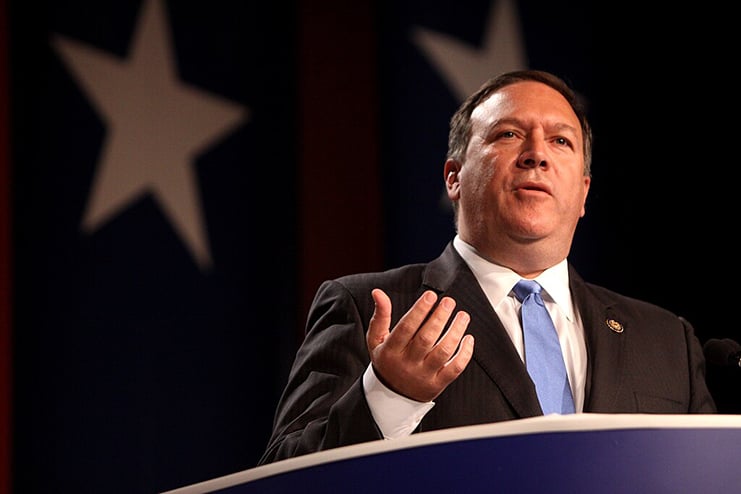
Former U.S. Secretary of State Mike Pompeo started the week with an editorial in the reliably neoconservative New York Post defending the Trump administration’s actions in Venezuela this way:
Supporting democratic transitions in Venezuela and Iran isn’t some sentimental gambit; it’s a means of advancing America’s deep strategic interests. Illegitimate, undemocratic governments are fundamentally less reliable and prone to the types of unrest and extremist takeover that threaten America.
In contrast, democratic governments make more reliable partners because they are accountable to their people and must therefore pursue policies that lead to outcomes better aligned with America’s goals.
Genuine democratic reform, while by no means easy to achieve, is the only way that Venezuela will set itself up for success in the future and become a reliable partner for the United States. The same is true for the Iranian government, which may be about to face a similar reckoning. In both cases, the U.S. should put itself in the best possible position to reap the benefits that would derive from the emergence of free and democratic governments in Caracas and Tehran.
Pompeo’s attempt to justify Trump’s authorized seizure of the narco-trafficking Venezuelan dictator Nicolás Maduro and his wife, who seems thoroughly implicated in his crimes, is given here a familiar neocon twist. This military action is presented as a prelude to Venezuela’s joining the “free world” as a full-fledged “democratic” partner. Such global democratic talk is often a form of what the philosopher Martin Heidegger characterized as “Gerede”—mere babble. The babble, in this case, is intended to serve as ideological glue for building and holding together an American empire.
To unify this imperial project, we’ve invented something called the “free world.” Although this designation made some sense in describing those countries that huddled together under the American aegis to forestall Soviet aggression during the Cold War, the term has now taken on a more conversionary, missionary meaning.
It refers to all members of the global democratic communion. As accredited members, these countries, like our European “democratic” coreligionists, are allowed to arrest those who dare to question—even on the Internet!—the arrival of millions of often violent, invariably impecunious Muslim migrants. Consider that the English government, particularly under far-left Prime Minister Keir Starmer, has become a pro at this kind of repression. But as an authorized “democracy,” it is allowed to trample on its citizens’ liberties without losing its status as part of the “free world.” European countries, like “democratic” Germany, may even remain in the fold after canceling election results they don’t like if it means preventing non-leftist parties from taking political office.
These countries don’t lose their “democratic” monikers by becoming enthusiastically and even repressively “antifascist.” As long as these professing democrats follow the wishes of our State Department and have friends in our legacy media, they remain “democracies,” by which we really mean that they are legitimate vassals of the United States. Our former secretary of state is now welcoming a future Venezuela into this ideologically unified community, under our ecclesiastical auspices.
Other Republican politicians are doing the same. I just heard the Republican senator from Idaho, James Risch, explain that Venezuela is not undergoing “regime change” but will receive American assistance as it embraces democracy and the observance of human rights. Risch claims that he’s not calling for either a prolonged American presence in Venezuela to guide the country’s transition back to the “free world” or for anything like “regime change.” He just wants to make sure that Venezuela adopts the political practices that our political elites require of their subordinates.
Wishing that a post-Maduro Venezuelan regime remains “stable” is in the American interest, which is not the same as pushing that country into anarcho-tyranny, which may be the emerging Western model of what was once constitutional government. It is in the interest of the United States (and yes, our country does have legitimate interests) that a new Venezuelan regime enjoys widespread popular support and that it does not collapse under the impact of warring factions. Calling elections may help legitimize whatever regime the Venezuelans choose to live under. Moreover, it’s our business to ensure that the new government does not damage our interests: for example, by engaging in drug trafficking or creating a base of operations for our enemies. Those are entirely practical concerns, not ideological demands.
Although I recoil from Pompeo’s Gerede, neither do I buy the libertarian view that the U.S. should never take military actions beyond its borders. Why not? Doesn’t a world power like the U.S. (and we are inevitably just that) face dangers outside its continental confines? We needn’t exaggerate those dangers, but they do exist. I’ve no idea why some imagine Trump’s action in Venezuela involved an excessive use of force or could not be justified in terms of protecting this country against the poisonous drugs and dangerous migrants with which Maduro was flooding the United States, or as an action to prevent him from allowing his land to become a base for powers that are hostile to the U.S.
Trump captured Maduro and his wife while engaging in law enforcement against a drug trafficker found guilty in an American court of law. American troops are not occupying Venezuela, and officials who formerly worked under Maduro, much to the horror of the New York Post, were left at least for now running the government machinery.
Although I find Trump’s actions in Venezuela entirely commendable, I trust that his plan to oversee the restoration of stable government in Venezuela will take place without consulting enthusiasts for the spread of democracy or “American values” across the globe. A plan to stabilize the Venezuelan government and keep it generally friendly to us while its oil industry is revitalized is justified and seems to extend our long-established understanding that the Western Hemisphere (per the Monroe Doctrine) is within America’s legitimate sphere of interest. Doing more than that to fashion a future Venezuelan regime around liberal democratic principles (should it permit public sector strikes or require universal suffrage?) is obviously none of our business.
Even less should we welcome any further incursion into this South American country to impose our own “woke” anti-discrimination regime, which has not been totally defeated, despite reports to the contrary. Although I was hoping that neoconservative obsessions were a thing of the past, it seems they’re still very much alive within the GOP. If our neoconservatives are intent on overseeing the “democracy” quotient of other countries, perhaps they should start their investigation in the “free world.”
Leave a Reply