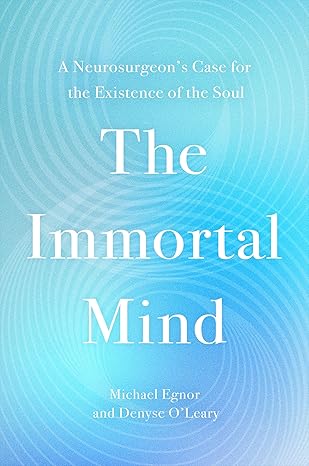
by Michael Egnor and Denyse O’Leary
Worthy Books
272 pp., $21.59
As I’ve argued here in the past, Darwinian materialism is the (unwanted) gift that keeps on giving. Christians and conservatives keep getting mauled by fresh heads of this Hydra, which seems to sprout two new replacements whenever we hack one off. One monstrously novel social evil after another appears first in academia, then festers in our media, infects our institutions, and finally co-opts the steel fist of the State—which forces it on us, often to the applause of cowardly, and similarly co-opted churches.
The most destructive implication of materialism is the simplest: that human beings don’t have souls. Our rational minds, our sense of self, our moral intuitions, our loves and hates and loyalties are finally fictions in this view—side-effects, illusions, the shadows cast by what is only really real: mere chemistry and physics. Your sense of “you,” my own experience of “me,” the “love” between two people … all of that is all just smoke and mirrors, produced as epiphenomena of what’s actually happening: neurons in our brains shooting sparks through the meat, driven by iron laws of deterministic causation or the blind whims of random chance. Free will is an illusion and our “selves” wink out at death.
This, our children are taught, is the verdict of Science, and it forms the silent assumption of every science program we stream.
The present evils enabled by the dogma of soul denial are many. If we believed that human beings are animated by souls, of supernatural origin with eternal destinies, we would not tolerate any of the following:
- The abortion of 1.74 billion children since 1980 for our sexual convenience.
- The stockpiling of hundreds of thousands of frozen human embryos in technological Limbo as unwanted externalities of the IVF industry.
- The rise of euthanasia as a cost-saving strategy in nations with socialized medicine such as Canada. (Assisted suicide now accounts for 4.7 percent of deaths there, and is pressed by bureaucrats on traumatized veterans, chronically ill adults, and teens with mental illness.)
- The premature harvesting of usable human organs for transplant from patients who are still capable of consciousness, which Health and Human Services Secretary Robert F. Kennedy, Jr. recently exposed as widespread. He said: “Our findings show that hospitals allowed the organ procurement process to begin when patients showed signs of life, and this is horrifying.”
But the implications of soullessness go far beyond beginning and end-of-life ethics.
If the State claims to follow the verdict of Science, and Science has determined that souls do not exist, then wide swaths of what has traditionally been protected under the free exercise of religion can be restricted or forbidden, should a compelling State interest be claimed.
Christians oppose or engage in a long list of activities because we believe they affect a soul’s health and salvation. If the State is not merely neutral about these activities but actively opposed to efforts to protect souls, because they rest on discredited, non-scientific assertions of a fictitious entity, the State will make laws and policies designed to suppress religious freedom.
The government, for example, will forbid counselors from helping people with same-sex attractions who wish to try to diminish them, as California does. (See the upcoming Supreme Court case on a similar law in Colorado.) Such governments will likewise ban therapy that tries to heal gender dysphoria, rather than hack and dose the body to match the mind’s delusions. Children too young to consent to sexual activity will be subject to experimental and sterilizing “treatments” more grotesque than lobotomies—as thousands of children across the West have already experienced. Parents who try to interfere will find themselves stripped of custody.
Federal laws will decree (and courts will agree) that orders of Catholic religious sisters are obliged to provide abortifacient contraceptives to their employees. The material “wellness” of these employees will be said to override arbitrary claims made concerning imaginary entities, such as souls.
The cultural ripples of the death of the soul extend much further than these cases, however. The grim utilitarianism of hookup culture, the explosion of pornography, the waning of marriage and our world’s plummeting birthrates would all be impossible to imagine if our citizens still possessed a firm faith in the reality of the human soul—and of sex as the means to creating embodied souls. That faith gets eroded a little more each day by our science teachers, pop science pundits, and shallow media coverage of complex biological realities.
Transhumanist fantasies of artificial intelligence developing real consciousness, daydreams of uploading our personalities into “the Cloud” so we need never die, and other implications of equating our brains with computers are all the fruit of materialism’s poison tree.
But what if the present consensus about the soul is simply false, itself not the finding of science, but rather the fruit of a priori commitments to materialism on the part of science practitioners—who ignore evidence to the contrary, embrace incoherent ideas, and brazenly commit what amounts to intellectual fraud by invoking their cultural prestige? What if the misleading epiphenomenon here is not the human soul, but its blithe denial?
That’s the thesis of a beautifully written and compelling new book by SUNY Stonybrook professor and neurosurgeon Michael Egnor, and science writer Denyse O’Leary, The Immortal Mind. The book recounts Egnor’s exodus from the arid plains of brain materialism, led by the evidence he kept encountering both in his medical practice and neuroscience research that suggests something quite striking: there is something about human consciousness that can’t be dismissed as sparks shooting through meat. The mind interacts with the brain but cannot be fully explained by it. There is something, which thinkers for thousands of years have called the “soul,” which has no material explanation.
What led this one-time atheist and materialist to reach this conclusion? First, his work with patients, which sometimes included the unsettling procedure called “awake brain surgery,” where a patient is fully conscious and talks to the surgeon as troubled parts of the brain are probed and unhealthy tissue is removed. Egnor was taken aback at how normal, functional, and fully rational many patients remained, even after losing large sections of the brain—which materialists had assumed generated personality and consciousness. That work led Egnor to delve deep into research on the relationship between the brain and the mind. It was there that he found one anomaly after another—phenomena brain materialism couldn’t explain and that ought to have been impossible if reductionism were true.
Egnor points to the work of pioneering neurosurgeon and neuroscientist Wilder Penfield who, like Egnor, began as a materialist but was converted by the evidence. Penfield noted that many attributes of human consciousness can be induced by electrical seizures in the brain: memories (real or false), perceptions, and emotions. But nowhere in brain science has anyone ever documented an intellectual seizure. In other words, no shock to the system or stimulus from a surgeon has ever sent someone’s mind racing through mathematical equations, logical arguments, or spiritual experiences. The reasoning part of the brain—and the part that seems to contain a person’s the sense of selfhood—is not reducible to biology and physics.
Egnor also points to the reality of split-brain operations, which cure serious conditions such as crippling epilepsy by cutting the links between the left and the right sides of the brain. If materialism were the exhaustive truth of human existence, then such a surgery ought to have powerful implications for the patient’s ability to reason and his sense of a unitary self. But, apart from some minor perceptual problems which can be overcome, no such effects appear. Again, the mind and the soul are somehow transcendent.
This claim is suggested even more strikingly by Near-Death Experiences (NDEs). Egnor delved into some of the tens of thousands of cases—reported by patients and analyzed in depth by scientists—and found common threads that ought to unsettle anyone’s faith in materialism.
People reporting NDEs commonly feel that they are floating above their bodies. Some witness aspects of procedures they are enduring that couldn’t possibly have been seen or heard by them—with ears plugged, eyes covered, and little or even zero brain activity. Some even report accurately and in detail about what the surgeons were saying and doing.
Many NDE survivors report meeting dead friends and relations (even some they hadn’t known were dead before the procedure). Astonishingly, nowhere in the literature has anyone reported meeting someone who was still alive. Not once. What’s the reductionist biological explanation for that?
Finally, most people report that NDEs were deeply spiritual experiences, which transformed their lives, and removed their fear of death.
None of these phenomena can be accounted for by factors like deprivation of oxygen to the brain, electrical impulses, or any of the other crude “just so” stories that materialists reach for, as Egnor’s work goes on to show.
Based on his experiences with patients, his research, and a renewal of his childhood Catholic faith, Egnor began to look more critically at the arguments of brain materialists, and discovered that their attempts to rationally debunk rationality, to consciously claim that consciousness is an illusion, were self-refuting and incoherent. Turning away from his roots in such “scientific” explanations, he began to look to traditional philosophical accounts of the soul, for instance those of Thomas Aquinas.
There, he found a schema for exploring the commonalities and differences between human beings and other animals that better fit the genuine evidence piling up in neuroscience articles. This evidence does not shoehorn into the materialist explanation for life but presents a complex, multidimensional reality of man’s conscious experience.
The mind, Egnor realized, transcends both body and brain. It survives physical death. Its horizons go far beyond the things of this earth, and our average threescore and 10 years spent here. It looks beyond and Above.
Leave a Reply