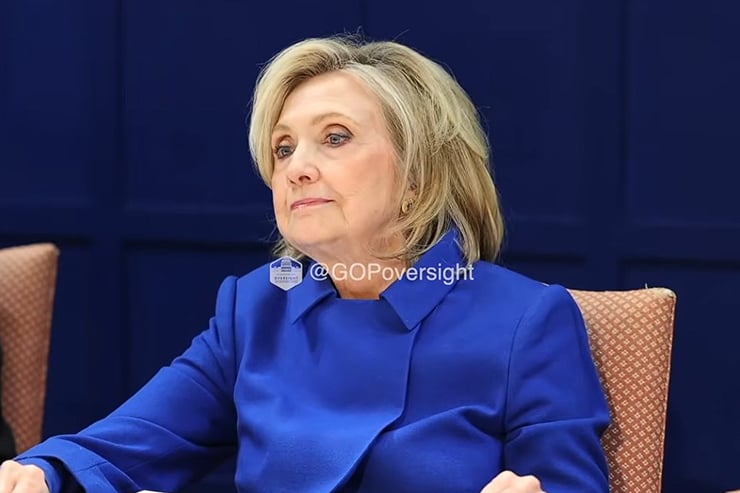
Hillary Clinton’s appearance before the House Oversight Committee on Monday, where she—along with her husband and former president, Bill Clinton, testified for four hours about their relationship with Jeffrey Epstein—set off fireworks, but also revealed something interesting about the political savvy of this Democratic dynamic duo.
Of course, I’m no fan of Hillary Clinton’s, but to adopt the lingo of Gen Z: she absolutely mogged Rep. Lauren Boebert and caused the congresswoman’s cortisol to spike.
In a rare moment of vituperative authenticity, Clinton lost her temper and went off script. It’s the type of gaffe that every D.C. communications team cautions against, but to the typical social media user, it’s the most likable she’s ever been.
It’s worth considering: Might Clinton have won in 2016 if she had comported herself like this more consistently? More importantly, could other over-produced Democratic candidates be watching and learning from her mistakes to make use of these lessons in 2028?
“There are many files where Jeffrey Epstein seems to speak as though he does know you personally,” said Boebert. “‘Hey, Hillary Clinton is much prettier in person,’” Boebert then read from the Epstein transcript.
“I’m not going to object to that,” Clinton responded drily, with a shrug and an eye roll.
However, CNN reported that after Boebert publicly released a photo of Clinton from the deposition, which is against House rules, the former Secretary of State visibly lost her temper.
“I’m done with this. If you guys are doing that, I am done. You can hold me in contempt from now until the cows come home. This is just typical behavior,” Clinton said, slamming her hands on the table before walking out.
“I’ll take that down …” the congresswoman stuttered meekly.
It’s telling that, even on the conservative side of X, these are the clips from the hearing that have gone viral. Even more telling, these clips won Clinton some begrudging respect in unlikely corners. Right-wing firebrand Milo Yiannopoulos summed up the online right’s sentiments with his tweet: “The b-tch has her moments.”
When Clinton ran for president in 2016, America wasn’t just going through political upheaval, but a recalibration of the art of politics. The country, and especially its political classes, just didn’t quite know it yet. On the one hand, political messaging had never been more professionalized; on the other, the new media ecosystem was beginning to elevate and reward transgressive authenticity.
In the 2016 cycle, every outfit, speech, and campaign stop was filtered through a class of consultants equipped with personal data and research technologies that had been unthinkable only a few decades earlier. Cell phone video and social media were already ubiquitous, meaning candidates had to be “on” at every moment to avoid a viral flub on the dominant platform (then named Twitter). Legacy media still maintained much of its former prestige, with journalists ruthlessly upholding the prudish and over-produced norms of civility in politics to keep candidates in line. As a result, the 2016 candidates were a collection of folks who had never been more polished—and Americans vehemently rejected all of them because of it.
What the consultant class failed to see, and still appears unable to see, is that social media trends arise too organically to be harnessed for effectively tricking voters. Voters, especially those in younger generations, are too media-savvy and cynical to take traditional politicking at face value. Social media was already a powerful tool for outreach 10 years ago, but it amplified the messiness of human interactions—as both Donald Trump and Bernie Sanders demonstrated—rather than what politicians wanted people to see.
Clinton’s viral clips worked in this instance because it’s obvious to the viewer that they are real. They give us a glimpse of how this powerful person, both hated and revered as a caricature in the media for decades, thinks, feels, and behaves behind closed doors. Such unintended humanization is captivating, if nothing else, but in Clinton’s case, it shows she knows how to command a room and has a short fuse for inept questioning, which is something few really knew about her before. Voters can respect that more than a scripted trip to the Iowa State Fair. Had Clinton understood this before the 2016 election and simply acted like herself, she probably would have performed better. Republicans ought to hope that Democrats do not wake up to this realization and instead continue with their attempts to peddle phony optics.
Gavin Newsom is currently busy on the podcast circuit, trying to relate to black people and average Joes. He’ll never be able to do that. But what if he revealed to us what he really is: a handsome jock with a hot wife who grew up around the Gatsby-esque elites of San Francisco? What if he embraced the effortless, arrogant coolness such an upbringing favors? He is the exact caricature of white men that Democrats love to hate, but his archetype is obviously aspirational if not relatable. And that could easily be enough for him.
Similarly, but probably less salient given her record of failure, what if Kamala Harris showed herself to be the energetic floozy she obviously was before being thrust into national politics because of DEI? Perhaps we’re already so deep into the enmeshing of American politics with pop culture that Americans would not mind voting for someone they genuinely felt would be fun to hang around with at a party.
That’s not to say Republicans don’t have the same issue. There is no major Republican currently on the political scene who comes close to Trump’s level of authenticity; the more they try, the more awkward they appear. The problem is that Republicans keep trying to mirror Trump’s own character instead of their own. This will never work as Trump is one of a kind. Instead, GOP politicians should follow the useful advice of just being themselves. It’ll be a shame for America if 2028 returns to the old model of one fake candidate facing off against another.
Leave a Reply