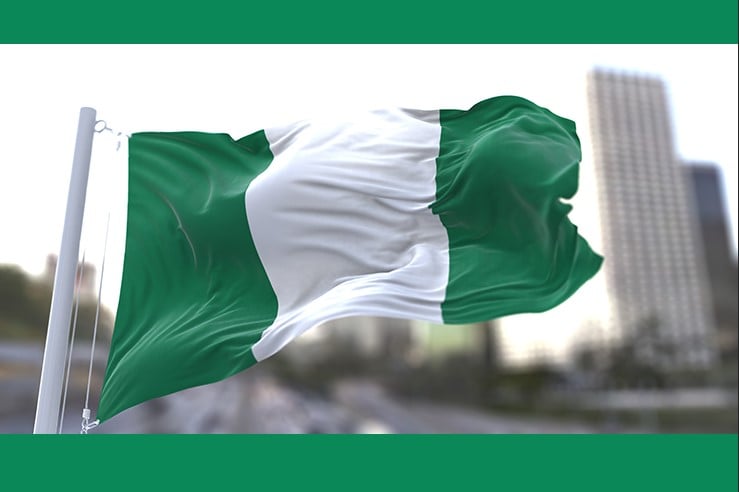
Nigeria, a country where I traveled extensively between 2010 and 2012, has a public relations problem. For over a decade, we have heard of nothing but marauders pillaging farms and kidnapping young girls. Yet the underlying problem in Nigeria may be constitutional: that is, the lack of an unwritten constitution.
Orestes Brownson in the 19th century and Russell Kirk in the 20th emphasized that wondrous convergence of providential “givens” that confronted the framers of our Constitution: the tradition of British common law, the neglect of the colonies by the British King and Parliament, the 13 experiments with self-government for over a century, the commitment to religious freedom, the political compromises, and the sense of personal freedom in the formation of our national character. We can be grateful that our framers were faithful to this unwritten constitution and constructed the most practical form of government possible.
As Robert Moffit recently put it:
Throughout the entire course of human history, the world never witnessed the adoption of a plan of self-government quite like the debate and deliberation leading to the adoption and ratification of the Federal Constitution. The Philadelphia Convention of 1787 was unique and the subsequent debates were historic. The U.S. Constitution was the product of an extended debate behind closed doors on constitutional details in Philadelphia by American society’s most august citizens who then humbly subjected their work to an even more intense, extensive, and often raucous popular debate that lasted for months and left the final decision in the hands of our citizens, specifically, State ratifying conventions. So that great debate started top down but it ended bottom up.
Nigeria’s misfortune is that its constitution did not go through such a process of vetting and compromise. Its borders are not natural but drawn by negotiation in the 19th century by the competing European nations. In 1960, a group of Nigerians, exclusively groomed for this purpose, were brought to London to pay the price for independence: their signatures on a document that reflected the socialist, centralized British government of that time.
Russell Kirk warned that a constitution that does not match the sentiments of its people will not survive. Sure enough, Nigeria’s constitution was discarded six years later in a coup by military officers from the North. The new government replaced the civil servants carefully cultivated by the British with inexperienced, uneducated partisans.
Nigeria is now on its fourth constitution, allegedly modeled on the U.S. Constitution, but with as little harmony between the Nigerian people and the written document as the first. Nigeria’s greatest challenge is to have a coherent unwritten constitution.
President Trump has declared Nigeria a “Country of Particular Interest,” and indeed it is an extraordinarily interesting country, bubbling with human vitality and rich in natural resources. In simplistic terms, one might understand it by dividing it into the North, that region north of the Niger and Benue Rivers, the Middle Belt, just south of those rivers, and the Southwest and Southeast. It is amazingly complex, with a population rivaling ours, crammed into the area of Texas.
The most significant divide there is religion. The country is evenly divided between Muslims and Christians, with a substantial number of Christians in the North and Muslims in the South. Is there an appetite to live in harmony without violence? A Pew Research study from 2007 found that most of the country’s Muslims believe the government should take steps to make Nigeria an Islamic country. Imagine, 25 percent of the population seeks the radical imposition of their religion. The process is well underway.
Fourteen of Nigeria’s 34 states have now adopted some form of Sharia law, but with limited rights of adjudication. Death sentences for blasphemy by infidels are extra-judicial and rare, but the non-Muslim population in almost 40 percent of the country lives precariously. There can be no doubt that aggressive domination is a fundamental interpretation of Islam for a portion of its adherents. In Nigeria, Islamization has been in the works for many years. The country has been a member of the Organization of Islamic Cooperation since 1985, and the Muslim population benefits from the OIC’s extensions, such as the Islamic Development Bank and the Islamic Educational, Scientific, and Cultural Organization.
Formation, a 2021 history of Nigeria, underlines the difficulty of finding a unifying unwritten constitution. The authors go back two centuries to the jihadist conquest of the north by the Hausa-Fulani tribes, the formation of the Sokoto Caliphate, and the subjugation of the other Muslim and non-Muslim communities in the North and Middle Belt to tributes of crops, cattle, and bodies. During their years of rule, the British passed on their culture to the peoples of the South. Still, in the North, they merely sanitized the caliphate system, abolished slavery, and transformed tribute into taxes—leaving the ruling Muslims in place, where they stayed even after independence from Britain. Muhammadu Sa’ad Abubakar, the current Sultan of Sokoto and a former brigadier general in the Nigerian Army, remains one of the most influential figures in the country. The sense that the North and the Middle Belt are fiefdoms of the caliphate perdures in the minds of many, particularly those doing the marauding and killing.
We here in the U.S. cannot begin to grasp the complexities of Nigerian society, and we are in no position to intervene and stop the violence. One of the features of our constitution that Brownson so admired was its territorial character, respecting the traditions of the local population while maintaining a central government robust enough to keep order. Nigeria, with its 371 tribes speaking just as many languages, might consider such a territorial arrangement. What is clear is that until Nigerians agree on what it means to be Nigerian—until they can determine their own unwritten constitution—we can expect little change in the headlines.
Leave a Reply