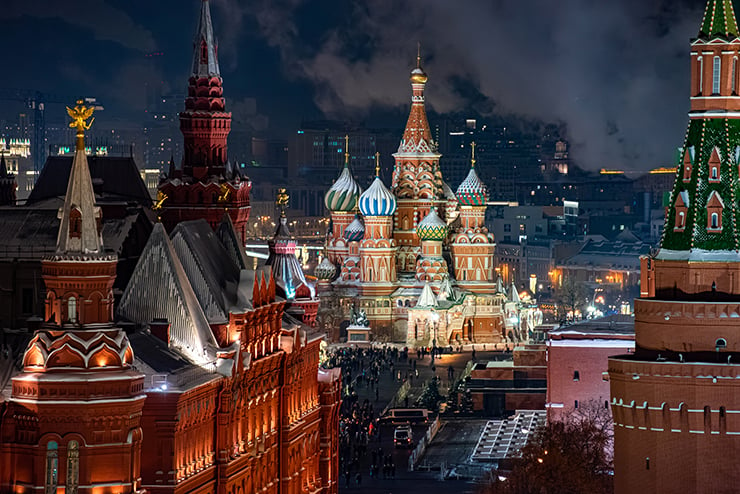
On Saturday, May 9, Red Square was the scene of the traditional Victory Day parade to mark the most important date in recent Russian history. The “Great Fatherland War” (Великая Отечественная война, also translated as the “Great Patriotic War”) is the saga of heroism, sacrifice, survival, and renewal that provides today‘s post-Soviet Russia with the basis of its identity and unity. It is the one narrative that is capable of transcending old ideological divides. It alone can bring together anticommunist nationalists and diehard Soviet nostalgists.
It also provides an opportunity to demonstrate Russia’s military might. Not this year, however. The parade was devoid of tanks, trucks with missiles, and other lethal hardware. Russia’s Ministry of Defense said the reason was the “current operational situation,” while President Vladimir Putin’s press secretary, Dmitry Peskov, admitted that the decision was owing to the “terrorist threat” from Ukraine. In some regions of Russia, especially those more potentially vulnerable to drone attacks, the festivities have been canceled completely.
This is a remarkable and, for many Russians, sobering experience. Well into the fifth year of the“Special Military Operation” (Специальная военная операция), the country was forced to scale back its Victory Day commemoration—a clear sign that no victory is in sight. This was indirectly confirmed by Putin’s somewhat cryptic statement, after the parade, that “this matter” (the war in Ukraine) was “coming to an end.” It can only come to an end if Ukraine gives up—which is unlikely—or if Putin decides to end it, on terms which will fall far short of the originally stated goal of Ukraine’s disarmament and regime change in Kyiv.
If this is the case, it is almost certain that Putin will be rebuked by the government in Kyiv, and—far more importantly—by its chief backers in Western Europe, reflecting what historian John Mearshimer has called “the profound Russophobia that now pervades the West.” Ukraine backers are now prone to interpret any Russian conciliatory move as a sign of weakness, which demands refusal to normalize relations and ever greater firmness in pursuing the war until the big, bad bear is effectively defeated and declawed.
In London, Berlin, and Warsaw in particular, but also in Paris and Brussels, it is now widely believed that Putin’s withdrawal from so many putative or formally announced red lines over the past four years means that he is bluffing in principle due to Russia’s overall weakness, and that he will continue doing so in the future. Russian early warning radars, essential to antimissile defense, oil refineries, and military airports housing nuclear-capable bombers have been successfully attacked by Ukrainian drones, which were likely provided their target coordinates by Western satellites—and there was no serious Russian response. Parts of their homeland were attacked and temporarily occupied (in the southwestern Kursk region) with British and U.S. encouragement—nothing. Putin’s personal residence was allegedly targeted—again nothing.
It is a dangerous and potentially fatal miscalculation to continue rejecting a diplomatic solution on the assumption that the above pattern promises a risk-free roadmap for the future. The Europeans are acting as if Russia is a declining power devoid of nuclear weapons. It sounds insane, but it’s true: Talk of the coming war with Russia has been normalized in some important European circles, to the point that warnings of its still intact nuclear arsenal are dismissed either because most believe Russia will not dare be the first to use nuclear weapons, or that the Russians are held back by the awareness that they would suffer a devastating retaliatory strike if they do.
In short, they argue, there is not much to worry about: the Russians will be as loath to use their nukes as the Germans were reluctant to use poison gas, even as the Reich was crumbling in 1945. This parallel is never openly stated. It is nevertheless implicit in news items, op-eds, and academic papers on both sides of the Atlantic.
A vastly different possible scenario for the Eurohawks was outlined over the weekend by Sergey Karaganov, a highly influential Russian foreign policy scholar and former advisor to Soviet and Russian leaders. In a comprehensive interview with Glenn Diesen, a lucid and always well-prepared podcast host, Karaganov argued that he believes Russia should restore deterrence through the escalation of its nuclear doctrine, including the “limited” use of nuclear weapons.
Russia, Karaganov said, must escalate and punish its European enemies for conducting an all-out war against it—drawing a parallel with the Napoleonic War, when 25 nations of Europe invaded Russia. He recommends escalation, first by conventional attacks on “certain symbolic or logistical points on the European soil” and then, “if they do not succumb, we should follow with nuclear strikes, ” preceded by some kind of ultimatum:
That is my suggestion, though I pray God, and I’m a believer, that wouldn’t happen. But I believe that these people have lost their minds, lost a sense of history. These elites are totally irresponsible and they should be punished… The European elites… should suffer first, not the European peoples. But we are debating this issue, and sooner or later this debate will come to fruition.
When he first launched these ideas three years ago, Karaganov continued, his voice was in the minority, but now he claims to be a “voice of the overwhelming majority, both in the military, in the political circles, and in the society”:
When a president of France calls for extending deterrence… to other countries, he’s not only a blatant stupid liar—he should be treated by the French as a traitor, because that means that he wants to sacrifice, or is ready to sacrifice, Paris or Lyon for the sake of, say, Berlin or Poznań. These idiots, which have lost the sense of history… should be either punished or eliminated.
There are British strategic analysts, German pundits, and Polish intelligence officers who will dismiss Karaganov as an eccentric who is no longer taken seriously in the Kremlin. In a similar spirit, Hitler’s ambassador in London, Joachim von Ribbentrop, dismissed Winston Churchill’s anti-appeasement warnings in his 1938 reports as “warmongering,” adding that the people and top decision-makers wanted peace and knew that fighting for Poland would be futile.
It is unclear what vital national interest should drive any country in the EU to risk its very existence for the sake of humiliating and dismembering Russia (and that is the final objective of those who advocate war). It is an irrational urge for which the Teutonic Knights, the Poles, the Swedes, the French, and the Germans have paid a huge price over the past eight centuries.
In 1962, Field Marshal Bernard Montgomery told the House of Lords that “rule one, on page one of the book of war, is: ‘Do not march on Moscow.’ Various people have tried it, Napoleon and Hitler, and it is no good.”
Montgomery was an unpleasant man, notoriously difficult to deal with, and arguably less than a brilliant field commander, but he was certainly not stupid.
Leave a Reply