“Most of the people we had in mind are dead,” President Trump said earlier this month of possible candidates to lead Iran if the Islamic Republic falls under the weight of American and allied attacks, and also—he hopes—internal pressure. Having expressed a notional preference for “somebody from within” to take over, as happened in Venezuela after Nicolás Maduro’s dramatic ouster by U.S. forces in January, Trump confessed, “we haven’t been thinking too much about” who would take over in Iran. Since then, Iran has chosen the deceased Supreme Leader Ayatollah Khamenei’s son Mojtaba, whom Trump has called “unacceptable,” to lead, while Trump has said that he would accept only the Iranian regime’s “unconditional surrender.”
Installing a preferred candidate to take over Iran—or even expressing support for one—would almost certainly invite allegations of “colonialism” and taint any explicitly backed new leader’s image as a U.S. puppet. Hoping to avoid the failed “nation-building” experiment, which bedeviled his predecessors, Trump has consistently maintained that the future of Iran is for its people to decide and refrained from endorsing any new candidates for the country’s national leadership.
So far, only one name has emerged to the exclusion of all others within Iran and in the large-scale anti-regime demonstrations outside the country: Crown Prince Reza Pahlavi, the 65-year old son of the deposed Shah, who left Iran in 1979 amid the civil unrest that turned the country over to Ayatollah Khomeini’s Islamist regime. Pahlavi, who was a teenager studying in America at the time, stayed abroad and has steadily developed an opposition movement that has broadly interfaced with other Iranian diaspora groups and with representatives of ethnic and religious minorities, who make up just under half of Iran’s population.
During the recent unrest in Iran, the crowds responded to his calls for mass demonstrations by risking their lives in the streets and almost uniformly adopted the lion-and-sword flag of the monarchy Pahlavi represents.
Chants of “Javid Shah,” Persian for “Vive le Roi” have resounded on Iran’s streets alongside other expressions of support, hopes that he will return, and frequently displayed images of Pahlavi. For his part, Pahlavi has elaborated a detailed 170-page plan for a transitional government that he is willing to lead as the country decides Iran’s future, not as a monarch but as an interim presence in what he envisions as a democratic process.
In frequent media appearances, including on Fox News, CBS’s 60 Minutes, and on the opinion page of the Washington Post, Pahlavi has put himself forward to lead a population that has yet to name any other candidate. He also promises a non-nuclear policy, immediate recognition of Israel, a peaceful foreign policy, and over $1 trillion in potential U.S. investment deals.
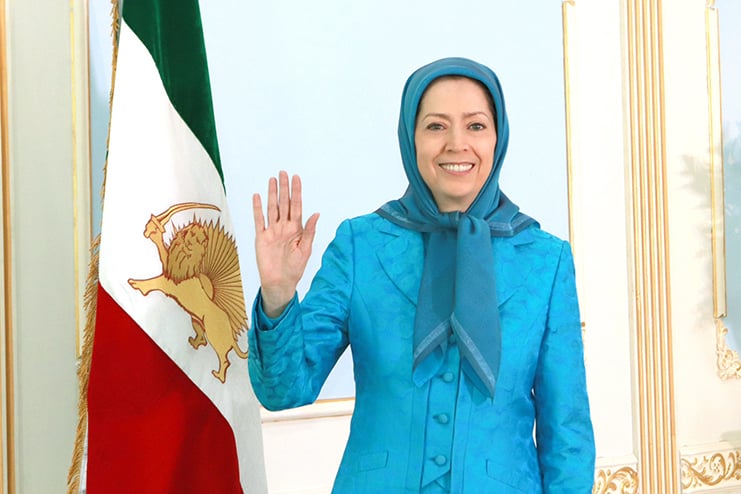
While Pahlavi’s popularity among the people of Iran is obvious and should be taken seriously by the Trump administration, especially given the president’s indication that there does not appear to be any internal figure who could reliably take over, another group has tried to seize the mantle of Iran’s future leadership. The so-called “National Council of Resistance of Iran,” an amorphous group run by the Mojahedin-e Khalq (MEK), a Marxist-inspired Islamist organization that the U.S. designated a terrorist organization until 2012, has declared itself Iran’s “provisional government” and named a previously unknown veiled women’s rights activist, the 72-year old Maryam Rajavi, as its “president-elect.”
No organ of Iran’s state and society recognizes the National Council, and no one has elected Rajavi to anything since she took up MEK’s leadership in 1993. Her public engagement revolves around a shallow 10-point pro-democracy program that reads like it was written by ChatGPT but sounds remarkably like the same program of democratic liberties that MEK’s one-time ally, Ayatollah Khomeini, advanced before ruthlessly consolidating power under an Islamic theocracy in 1979. It is unclear where MEK stands on Israel, but it appears closely aligned with the anti-American international left and will likely try to rebuild Iran as a flaccid social democracy.
Rajavi’s supporters, whom video recordings suggest can only produce crowds numbering in the dozens in exclusively foreign demonstrations (as opposed to the millions who are rallying to Pahlavi within and outside of Iran), chant “No2ShahsNo2Mullahs.” The group claims to have forces on the ground within Iran, but virtually no evidence of that claim has emerged.
The National Council leadership is evidently concerned about its image, dogged as it is by a past in which the MEK attacked U.S. targets and killed Americans in Iran, worked with Khomeini against the Shah, and later, after falling out with the Islamic Republic, defected to Saddam Hussein and fought for him against their own country in the Iran-Iraq War and beyond. Its reputation is also clouded by the MEK’s Marxist political beliefs and allegations of cult-like practices in its training facilities. As a scathing article in Politico recently reported, it has been worried enough to pay at least $2.7 million to boost its image among American politicians whom it believes—misguidedly, in most cases—to be prestigious and influential.
Their investment has included $400,000 in speaking fees for former Vice President Mike Pence, which was documented in financial statements associated with Pence’s abortive 2024 presidential campaign. Former New York City mayor Rudolph Giuliani, another vocal supporter who also criticizes Pahlavi, admits to having accepted cash from the National Council in the past and has hosted its representatives on his radio show. Former Secretary of State Mike Pompeo, who has called the National Council the “best alternative to the clerics ruling Iran,” spoke at one of its meetings as recently as last November.
Former National Security Advisor John Bolton addressed a dinner the National Council hosted in Paris in 2017, reportedly in exchange for $40,000, and has participated in Council-sponsored events that have advanced it as a credible opposition force. House Democratic Minority Leader Hakeem Jeffries has also addressed the group, along with lesser and mostly former U.S. officials who have made statements supportive of the National Council, but these figures are decidedly on the outs in Trump’s Washington.
National Council representatives have had some success making their case to U.S. conservative media outlets, usually to hosts who would probably blanch in embarrassment if they knew anything about the MEK’s history. Council representatives have also tried to publicize Rajavi and her 10 points in the New York Times, resorting to print-edition paid advertising that they then attempt to pass off on social media as favorable independent coverage. But in yet another testament to the National Council’s unpopularity, virtually every social media post favorable to them quickly explodes with comments about the MEK’s terrorist past and the general movement’s stone-cold unpopularity within Iran.
“Who are you going to believe—me or your own eyes?” Groucho Marx shamelessly asked a shrewd interlocutor who could clearly see the truth behind his character’s shenanigans. For anyone who can see what is happening on the ground, Pahlavi has the popularity and momentum to build a new Iran. The National Council is, in more than one sense, a Marxist chimera. The Trump administration is wise not to choose a new leader for Iran, but it would do well to realize that Pahlavi is the more credible candidate and the one most favored by Iranians.
Leave a Reply