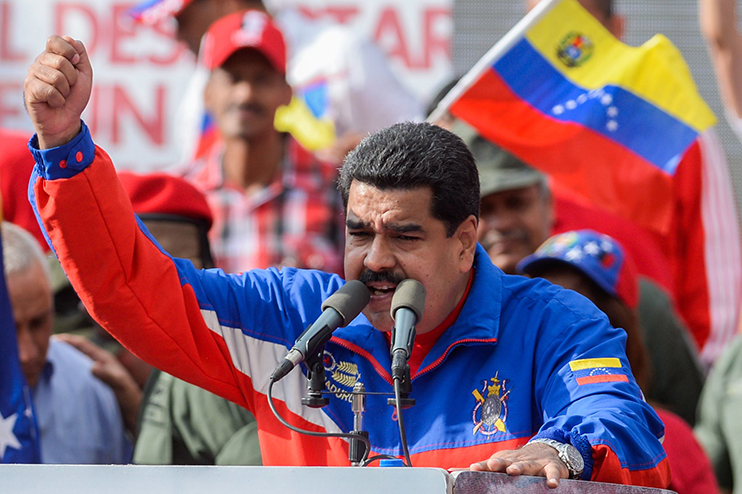
The doomers who like to say that nothing ever happens in the Trump administration have some crow to eat this week. With the Trump administration’s capture of the Marxist narco-dictator of Venezuela, Nicolás Maduro, in a midnight bombing raid on the country, something certainly did happen.
Wonks and scholars can debate the constitutionality of the administration’s actions. Maduro was a foreign head of state, after all, and a good-faith debate over the legality of such a move is warranted. Wherever the consensus falls, however, an empirical precedent has already been set, and what will matter most is the political narrative moving forward.
Toppling Maduro isn’t about Venezuela, per se. It isn’t about that country’s human rights, economy, sovereignty, or democratic institutions; that’s the old establishment way of framing such actions, a dated conception of regime change that puts American interests at risk. Instead, it’s about securing America’s great power dominance within our own hemisphere from any foe who dares to challenge it.
Trump calls it the “Donroe Doctrine,” an obvious play on the 19th century’s Monroe Doctrine, which held that the United States must oppose all European expansion in the Americas. Today, the threat to hemispheric control does not come from European colonialism, but from China—which is imposing a new sort of colonialism around the world—and from the rise of third-world communist ideologies, such as the “Bolivarian Revolutionary Movement” that Maduro represents.
China is the most obvious threat, one that even the conservative establishment can agree is a problem. China has not become a friendly peer competitor, as the post-Cold War liberal fantasy would have us believe, but a revisionist adversary. Through regional expansion, the undermining of Western norms and market dominance, and the quasi-colonialist infrastructure push of the Belt and Road Initiative in our hemisphere, China aims to shift the unipolar U.S.-led order toward a multipolar order. If American interests are to remain dominant and a fundamental part of the international order, this must be thwarted.
The rise of the Third World is a longer-term threat, coinciding with China’s rise as the leader of a new politically empowered bloc. However, this is a much more delicate issue to address within the conservative establishment. It raises some uncomfortable questions that, in America’s post-civil rights regime, undermine the common self-understanding shared by most people on the American right and left. If all nations deserve sovereignty and self-determination, if all people are fundamentally equal, then how do we justify not treating the entire Third World as equal partners and stakeholders within the “global community”? Obviously, no one on the right really wants to see a world where tin-pot dictatorships are accorded the same respect as other world powers. But at the same time, it’s much harder in our current political climate to articulate the reason why without inviting charges of bigotry.
Yet resisting the rise of the Third World is not about race, ethnicity, or even religion. It is more about resisting the hostile displacement we’re already beginning to see in the West, and especially here in America (see Minneapolis for a great example). The Third World far outpaces the West in population growth and commands considerable territory and resources, which historically have never been fully leveraged. But a politically conscious Third World, aided financially and technologically by China, and folded into the international order by leftist saboteurs throughout the West, is far more dangerous than any anti-colonialist power that emerged during the Cold War. Call Maduro a dictator or authoritarian, quibble over the definitions of socialism or communism; None of that matters. What Maduro’s Venezuela and all third-world “liberation” movements share is a visceral resentment against the West for its history, culture, and prosperity. And that resentment cascades into bloodlust at any given opportunity.
These are the notions the right must keep in mind in its discussions of Trump’s actions in Venezuela: beating back a revisionist China and suppressing the political ascendance of the Third World that liberal globalists treat as an inevitability. Nothing outside this scope can truly be America First.
Unfortunately, we are now conditioned to talk about American intervention and regime change using the buzzwords establishment conservatives have long been used to justify such actions: Maduro must go because he is not democratically elected, he tanked their economy, and he violates the human rights of his citizens. Rhetorically, this all sounds nice and can be helpful when leveraged strategically to balance out the left’s histrionics about Trump’s supposedly illegal actions. But when taken too much to heart, the logical conclusion for our foreign policy is to create a moral obligation to Venezuela that does not exist. America is not morally obligated to safeguard the sovereignty, democracy, or humanitarian interests of any foreign state. If we do involve ourselves to any degree, it is only justifiable to the extent that it serves the two foreign policy aims outlined above. Thus, the problem with announcing a moral, rather than practical, commitment to those aims in one place is that it becomes expected everywhere else. The foreign policy failures of the Clinton-Bush-Obama era show this all too well.
For his part, Trump seems correctly to intuit what regime change in Venezuela does and does not entail. “We’re in charge,” he asserted while insisting Venezuela’s interim president must cooperate with U.S. interests or face “probably worse” than Maduro. Trump spoke plainly without ever falling back on the moral language of obligation.
But the Republican Party as a whole is still beholden to the neoconservative ideology that proved such a disaster in the post-Cold War era. Neither have they broken out of the liberal conditioning that makes concrete American interests so hard for them to see and, more importantly, defend without shame. It is those whom the administration must be most concerned with counter-signaling and reining in.
Leave a Reply