In ranking the most famous pardons of all time, with apologies to President Richard Nixon, I put one above all others: the one given to the Good Thief by Christ on the Cross.
Crucified for crimes he did, in fact, commit, the Good Thief nevertheless saw Christ next to him and asked for mercy. And Christ gave it to him. It was an act of grace, for sure, but it was also a humble request for pardon.
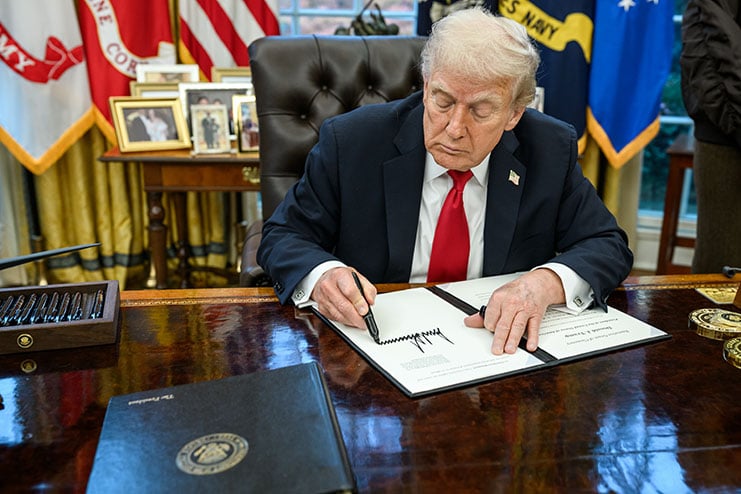
It is with this perspective I do my job as the U.S. pardon attorney, a singular honor in the Trump era. No other president in modern times has approached the unique clemency power with such solemnity and seriousness. Through the breadth and depth of his pardons, President Donald J. Trump shows mercy unlike any other president. In this, he is changing how Americans perceive mercy.
Intentionally written into the Constitution by our Founders, the pardon power is awesome by design: it is absolute and plenary. The president can forgive debts against the U.S. for any reason or no reason. Because of this, most presidents use the power sparingly and wait to apply it until the end of their terms in office, so they won’t be attacked or distracted.
President Trump, as is so often true, does not act like a standard, run-of-the-mill politician. He uses the pardon power almost every month. He uses it to give second chances and to protect those whom he sees as wronged. He exercises this power without fear.
In 2025, a year I called the Year of Trump Mercy, President Trump performed thousands of acts of mercy through pardons. He did this for people whom he had met and thousands that he never personally knew. He pardoned cops, freed life-long and rehabilitated prisoners, and forgave debts.
The pardon power can appear to cut against the grain of justice in our modern world. Justice calls for equal treatment and accountability for wrongdoing, just deserts for our crimes. Americans know we have a legal system with due process designed to deliver justice for all.
Mercy and the pardon power appear to upend this system: the president can effectively end the delivery of justice. This may rightly be called the scandal of the pardon—it is a power “above the law.”
Harkening back to Christ, any American president who, transcending the system of justice, reaches down to extend mercy, performs a Christ-like act. He upends the established order of retributive justice.
In the American political context, this awesome power of pardon may seem opposed to the republican form of government, which balances power between branches and individuals. But the Founders were intentional in their design of this power.
In fact, the American pardon power is derived from the monarchical “royal prerogative of mercy.” The king is known literally as God on earth. Pardons were especially essential to the administration of justice during the rule of Catholic monarchs of Spain Ferdinand II of Aragon and Isabella I of Castile, the Bourbon kings of France, and the Tudor dynasty of England. The sovereign’s authority was an extension and expression of the rule of Christ the King. The royal pardon took on a nearly sacramental quality and was included in religious observance. Early modern European monarchs prominently issued pardons on Good Friday.
Which brings us back to the Good Thief, who sought mercy and found it from Christ. Much more than a legal contrivance, pardoning has a theological quality: the king, in imitatio Christi, extended God’s pardoning mercy to his subjects.
Though some call out acts of mercy like pardons as unjust, outside of the regular order of justice, there is something deeply restorative and healthy for the society that gives and receives pardon. The government that seasons its justice with mercy inspires transcendence and shapes the community. Recall what Shakespeare in Merchant of Venice says of Portia, on a mission of mercy: “It is twice blest; It blesseth him that gives and him that takes.”
But what is the origin of the objection that justice is denied if pardon is granted? It’s an Enlightenment idea that leans on two aspects. First, that justice is only concerned with earthly actions, not a divine future. Second, it limits justice to empirical measures, not miracles.
But looking back further in history, St. Thomas Aquinas had a different view. In the Summa Theologiae, Aquinas holds that mercy is “especially to be attributed to God.” Inasmuch as mercy is a divine quality, it reveals something “more than justice.” Mercy, maintains Aquinas, expresses the “fullness of justice”—a transcendent, heavenly reality.
Mercy is preeminently a divine quality because of its two defining features: power and charity. Mercy, according to Aquinas, is the display of charity by the powerful. The “movement” of mercy is always downward. It is the relief of the inferior by the superior. Mercy, writes Aquinas, aims “to succor others in their wants, which pertains chiefly to one who stands above.” The preeminent expression of mercy is, therefore, that of the Creator to the creature: “Hence mercy is accounted as being proper to God: and therein his omnipotence is declared to be chiefly manifested.” Mercy is first and foremost a divine quality that uniquely reveals divinity.
Human acts of mercy are, likewise, a manifestation of both power and charity.
Pope John Paul II made the notion of divine mercy the cornerstone of his pontificate. In his encyclical on divine mercy, Dives in Misericordia, John Paul II remarked that the very notion of mercy evokes an “uneasiness” in contemporary society.
Mercy, he insisted, is the core of God’s self-identity and all God’s dealings with his creatures are built on the dynamism of mercy.
The “Pope of the People” did much to promote Divine Mercy devotions. He introduced a new major feast in Church’s calendar for the Sunday after Easter: Divine Mercy Sunday. After the rosary, the Divine Mercy Chaplet became the most recited prayer, and the Divine Mercy image became a ubiquitous feature in Catholic parishes all over the world. The pope’s emphasis on the Divine Mercy was not simply to atone for the heartless lack of mercy that defined so much of the bloody 20th century, but also, on the cusp of a new millennium, to bring to the forefront of humanity’s consciousness the image of the merciful Father.
The second essential truth about mercy is that it surpasses justice because it transforms the beneficiary. Those pardoned are not simply restored to their previous condition but come into a dignity they did not enjoy even before their lapse. This truth lies at the heart of the Christian gospel and our Good Thief. We sinners who receive God’s pardon are not simply restored to our status quo ante. Rather, the gift of redemption is the beginning of our divinization—the elevation of our nature to a state infinitely surpassing the original justice in which we were created.
At the Easter vigil, the triumphant Church exclaims O felix culpa: “O happy fault that won for us so great, so glorious a Redeemer!” It is a shocking phrase. Humanity’s treason and treachery—the first and primal evil by which we were banished from the bliss of paradise—is praised as blessed? But from the vantage of our subsequent redemption it is so. Our pardon does not simply restore us to Eden but unlocks Heaven. Our pardon raises us incomparably beyond our created nature. What Christ is by nature—the eternal Son of God—now becomes ours by grace.
So the divine pardon of the Good Thief is not only forgiving, but transformative. God’s mercy transcends justice and bestows transcendence in heaven. The same logic is at work on the natural level with the use of the pardon power by American presidents. Beneficiaries of a pardon tend to have a new and deepened sense of gratitude and responsibility—gratitude for this gift from above and responsibility to be worthy of it. We can say they have become more alive, more human. They have a new chance, a first step on a second chance.
The promise of a pardon is a promise of a new life, one brighter and more generous, than the one that was lived before the failure. Executive pardons allow us to see a glimmer of the theological drama of human redemption here below. Mercy, writes Aquinas, is “in itself the greatest of the virtues.” The beneficiary of human mercy is made more human and the beneficiary of God’s mercy is made divine. Pardon lies at heart of the Christian gospel. In the words of St. Paul in his letter to the Ephesians, “God, who is rich in mercy, out of the great love with which he loved us, even when we were dead through our trespasses, made us alive together with Christ.”
This Good Friday as Christians fast, pray and reflect, we will be brought face to face with Christ, like the Good Thief. We were justly condemned, sentenced to death, and yet God granted us his mercy. In this Easter season and through Divine Mercy Sunday, there is true societal value in recognizing President Trump’s perspective on the pardon power—and our very human desire for more.
Leave a Reply