Despite Stephen King’s long and prolific writing career, today he is perhaps better known for moonlighting as a political lunatic on the social media platform X. Once considered a brilliant author, he’s now lost his mind—and his creative spark—to the throes of Trump Derangement Syndrome.
However, his latest film adaption, The Long Walk, clearly demonstrates that King went off the rails long before Trump took his famous trip down the golden escalator. In its delusionally dated view of totalitarianism, the film shows just how deep the foundations of TDS run. The national psyche was already geared to see their political opponents as Nazis or Communists when King first wrote the story, all the way back in 1979.
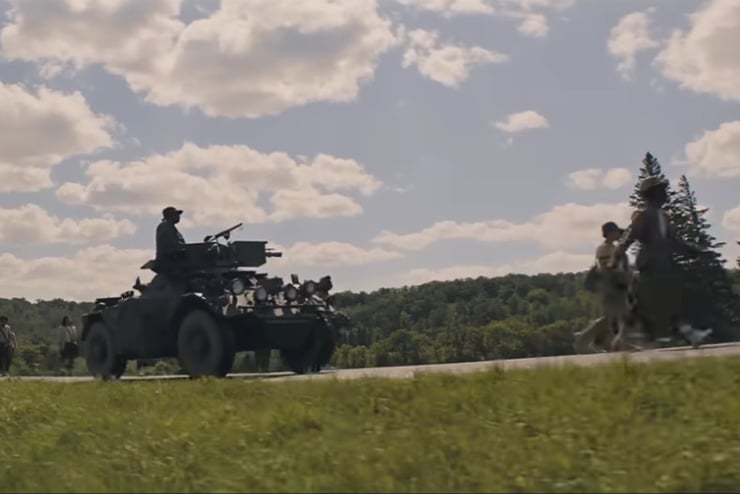
Although the original story predates Squid Game and The Hunger Games, like them The Long Walk is yet another totalitarian thriller centered around a sadistic game. Fifty boys volunteer to walk without rest through a desolate landscape until there’s only one left standing. If they fall behind, each of the boys gets three warnings before the soldiers trailing them in a Humvee “punch his ticket”—a shot to the head—all while the nation watches this unfold on live television.
Why the boys do it, let alone why the regime puts on such a spectacle or why the nation would enjoy watching it, is never explained. It’s really anyone’s guess. We get some cursory nods to an explanation: the boy who wins gets a cash prize and a single wish, and each has his own half-baked motivation. Yet the viewer must suspend disbelief entirely to accept that watching 49 boys have their heads blown off on live TV would inspire the nation to “boost productivity.”
There’s no clarity offered as to why this dystopian America has emerged. What put the nation in such dire straits and how is this game supposed to help? As with other films like it, one is left to simply accept that those in power delight in cruelty for its own sake.
For a certain kind of mid-century liberal, raised on post-war triumphalism and Cold War generalities, this conception of reality may seem like a perfectly natural worldview. Before and especially after the war, Germany played the role of evil incarnate—this narrative encouraged victory and served as a justification for the liberal international order that emerged afterwards. Hitler himself became a stand-in for Satan in a rapidly secularizing world. Later, the Cold War intensified the West’s uncomplicated understanding of good vs. evil in international affairs. As Ronald Reagan simplistically, if powerfully, put it in his “Evil Empire” speech, the Soviets weren’t so much committed ideologues in their own right, but indulged evildoing because they hated the freedom and prosperity we enjoyed in America. George W. Bush reiterated that point, to much ridicule, when he said the 9/11 terrorists did what they did because they “hate our freedoms.”
Rather than confronting these ideologies on their own terms, it was easier to simply call them evil and be done with it. Any attempt to grapple with nuance might have exposed our own shortcomings, after all.
Of course, Soviet Communism espoused high ideals about human flourishing, not so different from those of liberalism itself. But in practice, they were shrewd manipulators, intent only on the consolidation and expansion of Politburo power. Their grip depended on crushing the material and spiritual basis of human prosperity. It was, in short, singularly evil—just as Reagan had described it.
But the totalitarianism of today is very different, and much more complex. Rather than cracking down on their populations through sheer cruelty, fear, and physical might, like Soviet regimes, Western nations now rule their populations through emotional manipulation and the pretense of democratic processes. China, meanwhile, uses a high-tech social credit system to carefully keep its billions in line without the need of high-profile political violence.
Despite the changed nature of totalitarianism, the totalitarian thriller genre is stuck in the past. In totalitarian genre films like The Long Walk, evil comes marching into our cities wearing matching uniforms, bringing material agony while laughing at our pain. These dated caricatures make it hard for the average person to realize that totalitarianism today will not look like the brutality of the past, but more like a passive-aggressive HR seminar, a shadow ban on social media, or a visit from the police for online political speech (as is now common in Britain and Western Europe).
These aren’t just petty annoyances—as so many are pleased to characterize them and thus write them off—but the inevitable and soul-erasing result of a totalizing ideology with its own aims and nuances. The government may or may not have a direct hand in it, and it probably won’t be enacted through violence, but the incentives for those in control to consolidate power all flow in the same direction.
King has spent a lifetime conjuring a Nazi-like boogeyman in his fiction, so he naturally finds one in Trump. His entire moral self-conception is on the line, after all. But what irritates King about Trump isn’t real totalitarian behavior, rather, it’s Trump’s rejection of the ossified post-war order: free trade absolutism, open borders, NATO-skepticism—the entire America First program.
To King, and others like him or influenced by him, only one side—the status quo—has claim to absolute good. Anything that questions or complicates the pattern recognition program becomes evil by default. The symptoms of latent TDS have been festering for decades in this country, searching for a chance to weaponize moral purity against a new foe. And when Trump came down the escalator, they breathed a sigh of relief: finally, a new monster to vanquish.
Leave a Reply