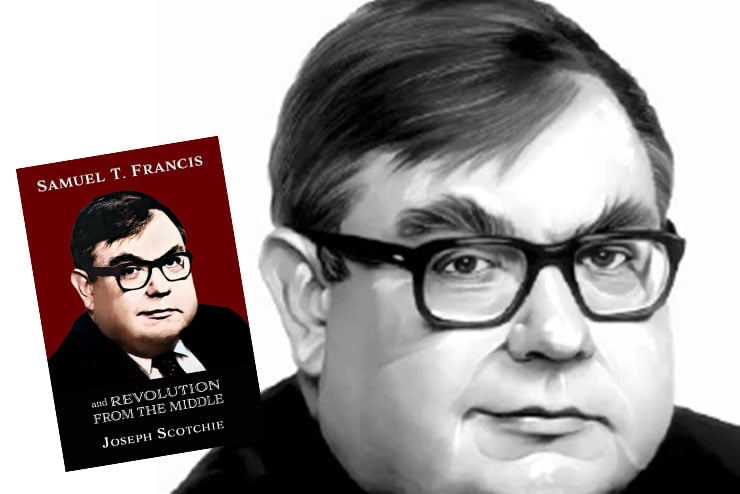
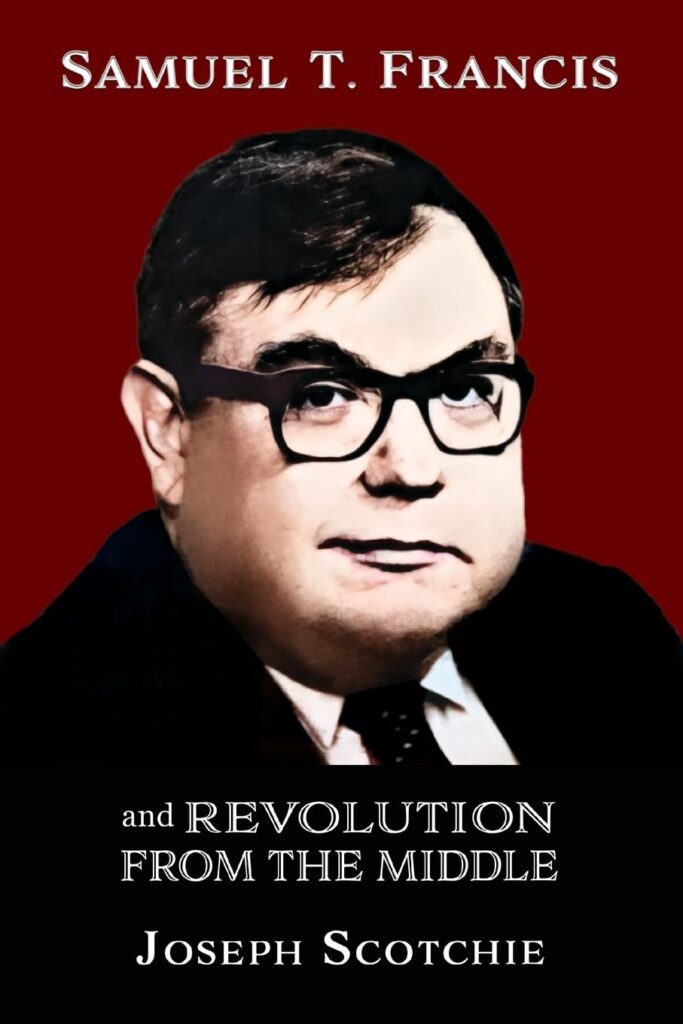
Samuel T. Francis and Revolution From the Middle
by Joseph Scotchie
Shotwell Publishing
201 pp., $24.95
Joseph Scotchie, a paleoconservative, an enthusiastic contributor to this magazine, and a longtime friend of his subject, has written a very readable biography of Sam Francis. This book is highly recommended to anyone who admires the work of that extraordinary figure whom Scotchie celebrates in his monograph.
Although this book deals with Francis’s penetrating thought as a social and political commentator and provides ample examples of his rhetorical brilliance, there are two aspects of the biography that stand out. One is its deeply personal nature. The author was a close friend of his subject and writes empathetically about his undeserved professional setbacks and few triumphs in life.
Some of Francis’s columns and speeches, for example, those leading to his dismissal from the Washington Times in 1995, dealt with hot issues that members of Conservatism Inc. now typically avoid and, even then, studiously shunned. Whether he was mocking the Southern Baptist Convention for apologizing for their ancestors’ ownership of slaves (which Francis correctly pointed out is not explicitly treated as a sin in the Bible), noting biological differences between the races at an American Renaissance conference, or treating feminists and other social progressives with irreverence, Scotchie’ s subject never truckled to any establishment.
Francis’s contributions to original thought on the right are worth far more than all the gibberish pumped out on GOP TV.
As he became the Times’s most talented and exciting columnist, he achieved his (all too brief) fame by stating his positions boldly and, often, sarcastically. Francis certainly didn’t build his reputation by sounding like a go-along conservative establishmentarian, a type that he famously parodied. Scotchie depicts his friend as someone who took pleasure in shocking unimaginative party-liners right and left. A very private person who lived in a bachelor’s apartment near Washington, D.C., in a heavily black neighborhood in Prince George’s County, Maryland, Francis never aspired to wealth. Moreover, his social world, as Scotchie shows, consisted of the company of a few good friends, among whom was Pat Buchanan, someone who frequently solicited Sam’s insights and advice, particularly during Buchanan’s run for the presidency.
The second aspect of this book that made a deep impression on me is the veritable gulf between Sam Francis’s achievements and the relative obscurity to which he’s been condemned, even in death. In my book Encounters, I note that of all the thinkers on the right who influenced my thought, Sam Francis was perhaps the most important. I didn’t make that statement because he judged my work kindly, which, in fact, he didn’t always do. It wasn’t Francis’s praise from which I benefited, but his original thinking and his expressive, biting style. He was without doubt the greatest social thinker produced by the American right during the last century. The quotations from Francis’s work with which Scotchie fills his book testify to his formidable gifts.
Although Francis worked for a time at the Heritage Foundation and was the aide to John East, a conservative Republican senator from North Carolina, he was never a team player. He found the mindless parroting of cliches in conservative foundations to be laughable and never hid that view from any of his friends. Although he stood on what young Republican staffers might consider the “far, far right,” he was heavily influenced by Antonio Gramsci, one of the fathers of the Italian Communist Party. Significantly, Francis was never a devotee of the South’s “Lost Cause,” though his ancestors fought for Southern Independence and, before that, in the American Revolution.
His view of the neo-Confederate cult was that it held on to what was not going to come back, and so those who represented it made themselves historically irrelevant. Grim political realism characterized Francis’s thought; those thinkers who pioneered that perspective, from Machiavelli to James Burnham, were his go-to sources. Francis’s problem with traditionalist conservatives of what he called “the archaic right” was their attachment to a vision of order that was no longer viable. Since those who invoked such an order could no longer exercise political influence, they were condemned to try to revive what was already gone. But archaic conservatives often gave no offense to the triumphant left precisely because they were irrelevant.

Francis’s stance on that matter did not mean he regarded classic thinkers who saw into the future, who warned against revolutionary change, and who understood human nature to be necessarily “archaic.” Some of them were his heroes, and he quoted them with great respect. Therefore, this critic of archaic conservatives filled his work with quotations from sources going back to Plutarch and the Bible, a book that he revered since his days in a Presbyterian Sunday school in Chattanooga, Tennessee.
Despite his prodigious accomplishments, which include formulating a strategy for a populist right that found expression in the presidential campaigns of Donald Trump, Francis has remained either a nonperson or a synonym for racial intolerance. Although he spoke out perhaps too bluntly on racial issues from the right, I doubt that’s the only reason he’s not in good odor with official conservatism. Francis was just too grim in his rejection of the progressive common ground shared by the entire American political establishment, both left and right.
Moreover, Francis held no brief for what were thought to be the forces of social progress, including the ones that were seen as such even by the conservative establishment. In the end, Scotchie’s subject believed that the political and ideological confrontation of the present age would pit advocates of right- and left-wing managerial states against each other.
The Middle American revolution that he supported seemed to be the best hope for pushing back the long-triumphant left, even though that development would likely not return us to an older, communally based American society. That all belonged to the past, Francis stressed. But he took comfort from the fact that Middle Americans were, to their credit, anti-globalists and (to use a term that came into use after his death) anti-woke.
Scotchie tells us near the beginning of his narrative that Sam Francis attended the very tony Baylor School, a private boarding school in Chattanooga, Tennessee. Although this school proudly lists its distinguished graduates, it predictably omits Francis’s name from its honor roll. That is the case even though Francis was precociously intelligent, went on to college at Johns Hopkins, and became a notable journalist and social critic. He was also descended from Southern aristocracy and was closely related to the Kentuckian Mary Todd Lincoln, whose maiden name he bore as his middle name.
Unlike many conservative and neoconservative personalities, there is no biography of Francis other than this one, published now 20 years after Francis’s death. We may assume that a conservative movement that now celebrates Martin Luther King, Jr. as a conservative hero and, far more shockingly, features transgendered Republicans, would want no association with Scotchie’s subject.
What we might say with some certainty, however, is that the multitude of young members of the online right will someday elevate Sam Francis to his proper place as one of the most influential social and political thinkers on the right. Moreover, just as Trump’s tariff policies have brought Pat Buchanan and the Buchanan Brigades of 1992 back into the public eye, a similar fate may be awaiting the now shamelessly scorned figure from whose ideas Buchanan benefited. Any single one of Francis’s contributions to original thought on the right is worth far more than all the gibberish pumped out on GOP TV.
Leave a Reply