Directed by Steven Spielberg ◆ Written by David Koepp and Steven Spielberg ◆ Produced by Amblin Entertainment ◆ Distributed by Universal Pictures.
After making films about space aliens for decades, Steven Spielberg’s most recent thriller makes them all seem merely preludes. From 1977’s Close Encounters of the Third Kind to 2005’s War of the Worlds—and, most famously, 1982’s E.T. the Extra-Terrestrial—things from outer space have long been mainstays of the Spielberg canon. But Disclosure Day is not just another sci-fi flick with little misshapen men.
It’s true that Disclosure Day is, once again, a Spielberg story about aliens. But rather than simply replaying the greatest hits, the movie surprises by taking a very different angle on the matter: what would happen to us—to human beings—if the world suddenly learned that alien life was real? Forget explosions, invasions, or cuddly creatures hiding in closets. Wouldn’t the sheer fact of disclosure be an earth-shattering moment for the human species?
The result is a standout political thriller laced with sci-fi elements, one that plays out à la Close Encounters crossed with The Bourne Identity. As such, Disclosure Day is one of Spielberg’s most thematically interesting and challenging films yet.
Disclosure Day thrusts viewers straight into the action, as sweaty young scientist Daniel Kellner (Josh O’Connor) flees a top-secret installation with mysterious cargo in hand. As they’re hunted by a mysterious umbrella organization known as Wardex, Kellner and his long-suffering girlfriend Jane (Eve Hewson) flee through rural America, guided only by intuition and a strange sense that they’re part of something larger than themselves.
From the start, Spielberg doesn’t do much to hide the ball: Daniel is carrying incontrovertible proof of alien visitations spanning much of the 20th century, which he aims to reveal to the world. For decades, these facts have been deliberately suppressed. Through a series of ultra-top-secret public-private partnerships, intelligence leaders and titans of industry have worked hand in hand to recover and reverse-engineer alien technologies, without ever disclosing their otherworldly origins. Even presidents haven’t been permitted to know the real truth: after all, presidents turn into civilians after their terms are up.
Why this cloak-and-dagger approach? As Wardex leader Noah Scanlon (an uncommonly sinister Colin Firth) muses, the public revelation of alien life would simply change too much. Human beings’ sense of their place in the universe—and by extension, the stability of the global order—would be upended. Even Jane—a former Catholic novitiate—fears apocalyptic results. Though she doesn’t really believe in God anymore, she still trusts in religion’s social utility—and the disclosure of alien life might undo all that.
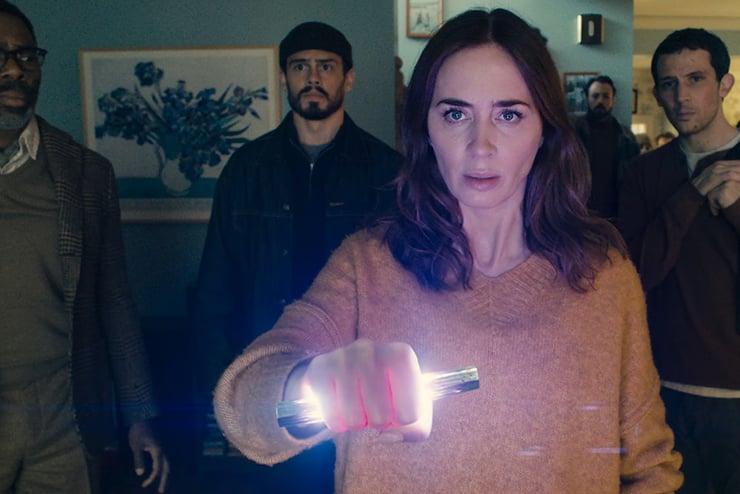
But events are already in motion, and they can’t be stopped. Across the country, Kansas City meteorologist Maggie Fairchild (Emily Blunt) is abruptly manifesting strange new powers. Following an interaction with a mysteriously friendly cardinal (the bird, not the cleric), Maggie finds herself capable of speaking in multiple languages, from Russian to Korean to an unfathomable alien dialect. And that’s not all: she discovers telepathic abilities that allow her to speak to the deepest needs of those she meets, almost as if some ineffable force is speaking through her.
As Scanlon and his black ops forces close in, Daniel’s and Maggie’s journeys intertwine, while the purpose of their mysterious gifts slowly becomes clearer. The eventual outcome of their journey is never all that much in doubt—this is a movie called Disclosure Day, after all—but everything culminates in a climax that’s arresting for all the best reasons: not because it’s surprising or shocking, but because of how well Spielberg assembles it (aided in no small part by John Williams’s superb score.
On paper, so many of the beats are familiar. We have heroes and heroines with special powers fleeing black-clad bureaucrats through an Americana landscape, as inexplicable alien forces lurk behind the scenes. We have dueling secret organizations, mysterious metal devices, and glowing lights in the sky. On and on it all goes—and yet somehow, Spielberg makes it feel fresh. The film abounds with twists or variations on traditional action sequences, from tautly shot train battles to a standoff involving a giant invisible ambulance (yes, really). Despite its lengthy runtime, Disclosure Day is always interesting and never quite predictable.
But ultimately, what elevates Disclosure Day to the upper echelons of Spielberg flicks is that—despite its themes of extraterrestrial life, government conspiracy, and metahuman powers—it’s not really a science fiction film at all. Instead, it’s fundamentally a film about science and faith—though perhaps not in the way many will interpret it.
At the level of text, certain religious concerns are overt. Disclosure Day’s characters openly debate the effect that a discovery of extraterrestrial life would have on established belief systems. Though she remains theologically conflicted, Jane’s worries are, for the most part, utilitarian: how would the world’s belief in a Supreme Being be affected by a discovery of real “Supreme Beings?” Her old mother superior, though, thinks otherwise: “Why would God create an entire universe but save it only for us?”
That particular framing of the religious question isn’t particularly novel. Indeed, it evokes C. S. Lewis’s famous openness to the possibility of extraterrestrial life as part of the divine plan, coupled with his fear that human sin would damage “unfallen” life. (Not that this fear isn’t well taken: in Disclosure Day, we catch glimpses of fiendishly cruel interrogations of surviving alien beings, scenes that wouldn’t be out of place in Lewis’s Space Trilogy). But ultimately, this seems to be a rather perfunctory treatment of the matter: religion is framed as just one more sphere of human concern, among others, that stands to be transformed by the revelation of alien life. Religions can and must adapt to new scientific data, as they always do.
This is the point where many readings of Disclosure Day’s theology will likely leave off, because it’s where the explicit religious musings end. But the subtext of this film, as in so many of Spielberg’s prior works, tells a much deeper and more interesting story.
In Spielberg films, aliens are never just aliens. In virtually every case, they stand for something beyond simply themselves. The rampaging walkers in War of the Worlds evoke the terroristic horror of a post-9/11 moment (or, maybe, the threat of terrorist scheming as fundamentally unknowable). In Indiana Jones and the Kingdom of the Crystal Skull, aliens are “interdimensional beings” bearing forbidden knowledge beyond mortal ken. Close Encounters turns its protagonist into an obsessive desert mystic who seeks communion with interstellar voyagers at Devil’s Tower. And who can forget the dying-and-resurrecting-and-ascending E.T., who heals with a touch?
Disclosure Day is no exception to this pattern. Quite the contrary: in many ways, it draws together all these notions into a single thesis. This is a story about the terror and wonder of transcendence itself—of the possibility of a genuinely spiritual reality that breaks through the crust of the mundane. Indeed, Disclosure Day reframes many of Spielberg’s other tales, casting them as approximations or anticipations of the theme that comes to full expression here. (Notably, Spielberg almost always depicts his aliens in a standard, almost stereotypical way—lean and spindly creatures with enormous eyes and heads. Perhaps that’s because they are all expressions of the same phenomenon, apprehended in different ways.)
In a sense, Disclosure Day’s explicit arguments about religion are misdirection: one must look beyond what the film says about the supernatural to what it shows. Here, the biblical references come thick and fast. After a special bird descends upon her, Maggie speaks in tongues and accesses unknown knowledge to uplift those around her. Daniel grasps the hidden mathematical structure of the cosmos. Both are offered “crowns,” of a sort, by mysterious visitors. And early on, Scanlon weaponizes a fragment of alien tech to possess one of the protagonists, in quasi-demonic fashion. Throughout the film, Spielberg’s “aliens” are simply a stand-in for spiritual reality in its terrifying and awe-inspiring aspect—what Rudolf Otto famously called “the numinous” and “the idea of the holy.”
That is the true threat to the status quo that so galvanizes Scanlon and Wardex: the possibility of a transcendent moral judgment on the sins of the settled order. They have committed their lives to defending what philosopher Charles Taylor describes as “the immanent frame”—the idea of the secular world as a closed and self-contained system, operating purely according to its own internal logic, with no “breakthrough” from anything beyond. And in service of that end, they have done terrible things.
Shattering this immanent frame, and recognizing the possibility of a transcendent purpose into which humanity is interwoven, is a terrifying prospect. In the wake of revelation, old concerns are trivialized and old priorities cast aside. But—as Disclosure Day never lets its characters or audience forget—this comes with a fierce and exultant joy.
Close Encounters famously ends with its protagonist’s abandonment of Earth—and his family—as he departs for unknown realms alongside a band of extraterrestrial visitors. It is a dark ending. And it testifies to the tragedy of a quest for transcendent meaning pursued alone, as a matter of sheer spiritual will: the supreme truth of the cosmos lies beyond the grasp of those unwilling to abandon what they love.
But where Close Encounters demands renunciation, Disclosure Day extends a sort of grace. Perhaps transcendence need not mean this solitary journey into the void. Perhaps it means accepting one’s place in a providential order that exceeds hopes, unsettles expectations, and offers forgiveness in the face of wrongdoing. Perhaps one needs only listen for the call of the real.
And that breakthrough makes Disclosure Day a far better and more memorable film than it needs to be.
Leave a Reply