
Racial revenge films have become the toast of Tinseltown. Leftists have dominated Hollywood for a long time, but today’s La La Land lefties are more anti-white than ever. The 2026 Academy Awards attest to this. If you want to hold that little golden Oscar up, you had better be willing to push the white man down because anti-white politics, far from being in retreat, is more ascendant than ever in the film industry.
Sinners, a horror film set in Jim Crow-era Mississippi, earned 16 Oscar nominations and took home four, including Best Actor and Best Original Screenplay.
No other film has received as many nominations, indicative of the fact that Sinners captured the zeitgeist of today’s Hollywood elite. It did well at the box office as well, taking in $370 million worldwide, with 76 percent of that coming from North American audiences, making it the seventh-highest-grossing domestic film of 2025. Whatever Sinners was selling, American audiences were buying. At the box office, demography is destiny.
Sinners’ box office performance is shocking, considering that the film arguably traffics in more racial stereotypes and invective than The Birth of a Nation, the 1915 D. W. Griffith film that set box office records, but was controversial even at its debut for its glorification of the original Ku Klux Klan. If that seems like an extreme statement, it simply echoes that of conservative African-American commentator and Blaze TV host Jason Whitlock, who called Sinners “The most nakedly racist movie that I have ever seen.… akin to Birth of a Nation.”
How could such a racist film find such an appreciative American audience, and such enthusiastic critics (97 percent approval from hundreds of reviews on the popular Rotten Tomatoes film site) in the enlightened days of 2026? For some background, it is useful to look a bit at the previous oeuvre of its writer, director, and producer, Ryan Coogler.
Coogler made his directorial debut in the 2013 anti-white film Fruitvale Station, which valorized Oscar Grant, a man who was accidentally killed by an Oakland, California, transit cop while resisting arrest in 2009. Grant’s death started riots in Oakland—one of the earliest instances of what would become the Black Lives Matter movement. (Interestingly, white anarchists, not African Americans, were responsible for much of the most severe riot-related damage, according to the San Francisco Chronicle, in a preview of the Antifa riots that would become commonplace over the next decades.)
Coogler would go on to direct the commercially and critically successful Creed boxing movie series (which notably inverts the hero’s arc of the Rocky movies by having the African-American character assume the main hero’s role, while Rocky is relegated to the part of an elderly sidekick) and the Black Panther films (prototypical examples of anti-white mainstream filmmaking). It should be noted that Coogler is a reasonably talented writer and filmmaker and, as a result, his work has been popular with audiences. As Sinners shows, the issue is not that Coogler is talentless—the problem is the cause of anti-white racism to which he’s chosen to contribute his talents.
Set in and around a “juke joint” in a small town in 1930s Mississippi, Sinners features white vampires (very clever!) who descend on the town to literally suck the life out of the local black talent and culture. Sinners links the vampires symbolically at various points in the film to European colonialism, forced adoption of Christianity from more “authentic” African religions, and generalized African-American cultural erasure. The white vampires—the film’s primary antagonists—all have ties to the KKK or other racist groups. There are virtually no sympathetic white characters. Indeed, the film portrays whiteness as inherently parasitic and demonic.
These anti-white themes did not escape the notice of even nonconservative African Americans. On the popular comedy podcast Your Mom’s House, one of the African American producers declared, “Anyone who likes that movie is a f**king racist and they just might not know it.” Or, as the idiosyncratic African-American film critic Armond White put it in National Review,
It’s critical race theory stuff, a Black Studies curriculum by way of Hollywood. … This reverse-racist showpiece is a counterpoint to the KKK vampires waiting outside the juke joint—indulging in red-eyed drooling and jig-dancing to the Irish-Scottish folk tune ‘Wild Mountain Thyme.’ …Likely, it’s a simple-minded rebuke of the Coen brothers’ folk music thesis in O Brother Where Art Thou?
White understands the broader cultural context, noting that “It’s no surprise in this era of white apologetics that Warner Bros. would finance a movie that promotes its own corporate villainy.” Anti-whiteness still sells, and Warner Brothers is ultimately interested in the bottom line—not what’s good for society.
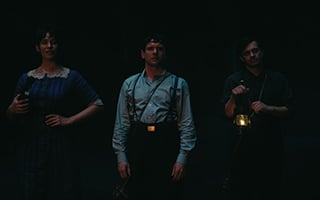
play culture-sucking white vampires in Sinners. (Warner Brothers)
Some black women didn’t find that to be a problem. The film criticism site Blackgirlnerds.com called Sinners “an introspection on white devilry.” They note that “The pale white demonic figures are ready to unleash their wrath on this town’s Black residents.” For the self-styled black girl nerds, the film is about “The destruction of Black entrepreneurship. You can easily draw this parallel to the destruction of Black business from white supremacists during the 1921 Tulsa race massacre.” (In reality, that was a race riot involving both black and white perpetrators and victims).
The black girl nerds further opine:
Then there is cultural appropriation. The fact that the idea of a vampire in and of itself is a metaphor for how historically white people have appropriated Black culture is kind of genius. The act of sucking the life and livelihood of our culture, music, our trends, and our ways for their own profit and gain.
Coogler’s anti-white message is not exactly subtle and was blatantly obvious to both critics who raved about his film and those who panned it. The film also contained a slightly more subtle attack on mixed-race blacks as potential race-traitors, through the character of Mary, a mixed-race girl who passes for white. Mary initially seems to have positive traits before being turned into a vampire and, in turn, corrupting her black boyfriend, one of the film’s principal protagonists. As the online film criticism channel Type2Productions put it, the point of Mary’s character is to show that “even the most well-intentioned race-mixed people will come and corrupt black culture. If whiteness exists in you it will corrupt.” That is Sinners’ message in a nutshell, and it is one that is popular in today’s Hollywood.

Sinners was not even the most anti-white film honored at this year’s Oscars. Indeed, despite its record-breaking nominations, Sinners lost the Best Picture award to a film that may have matched it for anti-white invective, though it is less obviously about race.
One Battle After Another, from the respected director Paul Thomas Anderson (who is in a long-term relationship with mixed-race actress Maya Rudolph, with whom he has four children), is replete with anti-white themes. One Battle After Another doesn’t mystify where it stands; the film takes its title from a 1969 statement issued by the violent leftist group the Weather Underground:
From here on out, it’s one battle after another—with white youth joining in the fight and taking the necessary risks. Pig Amerika [sic] beware. There’s an army growing in your guts and it’s going to bring you down.
In other words, radical whites can save America only by destroying the white society that birthed and nurtured them—all other whites are damned. Defenders of the film’s politics will point to its ambiguous ending and not entirely sympathetic treatment of its left-wing protagonists—they say that it shows the long-term costs of political radicalism for those who engage in it. But this surface-level revisionism is easily lost amidst the gloss of high-speed chases, glamorized left-wing radicals, and a mercilessly savage political establishment that is portrayed as far-right in an essentially cartoonish fashion.
The film’s principal villain is the unsubtly named Steven Lockjaw, a white supremacist obsessed with anti-immigration efforts, who coerces a black radical woman into a sexual relationship from which it is implied (though not firmly stated) that a child is born. Many years and complicated plot twists later, Lockjaw (leveraging his anti-immigration efforts) has risen to the rank of colonel in the military and intelligence services and been asked to join a white supremacist secret society, the Christmas Adventurers Club. Fearing disqualification from membership, Lockjaw tries to hide his interracial sexual past by murdering his possible mixed-race daughter. If this sounds like a realistic portrayal of modern American politics to you, we need to talk.
The film’s left-wing heroes are seen freeing illegal immigrants from captivity or otherwise shielding them from arrest. Its political sympathies for illegals are obvious. Perfidia, one of the central protagonists, announces that “Free borders” is a central element of the political platform for French 75, the radical political group that first brings the film’s major protagonists and antagonists together.
Perhaps no critic understood the film better than Sasha Stone, proprietor of the film review site Awards Daily, once one of the industry’s most influential until Stone made a political right turn by opposing Hollywood’s relentlessly anti-white bias:
It was depressing for me to watch the phantasmagoria spill over into art and become nothing more than propaganda for the Democrats and the social justice fundamentalism that has overtaken the party.
“One Battle After Another is a cartoon version of White Supremacists in America,” Stone continued.
If you share that view, like Paul Thomas Anderson and so many on the Left do, you will feel seen. You will feel this vindicates and validates your mass delusion: yes, all white men (except the one ineffectual flaccid stoner dad) are racists and all people of color are victims of an oppressive system.
Stone pointed out the fundamental unbelievability of the film’s right-wing villain, Col. Lockjaw, played by far-left-wing actor Sean Penn, who won best supporting actor for his portrayal. “Penn’s character has no real person inside,” she wrote. “We’re just supposed to assume WHITE GUY BAD. … One Battle After Another complies with the doctrine of the Left in every way imaginable.”
Stone correctly sees the characters in the movie not as complex three-dimensional portrayals but as shallow archetypes:
But people at the top and on the Left don’t see people of color as actual people. They are symbols of virtue and thus, trapped in the cage of “goodness.” They could never see migrants as potentially criminal—that would be racist. No Black woman or person of color is allowed to really be a bad guy in a movie, without the quick fix of redemption by the end.
And Stone understands that the film has a fundamentally political purpose—to elevate the elite left and bash the deplorables, their most hated enemy:
The Academy might love it and will celebrate the wealthy white man calling the working-class voters who want a secure border as racists. Those “good white men of the Left” need to be seen as the only good ones in a corrupt white supremacist empire.
One Battle After Another has appealed to the wokest of the woke. A transgender Latino critic wrote a review for Electric Literature titled “One Battle After Another Reminds me of what I want from White Art.” The reviewer sees the film as “symbolizing a Latino escape from the violence of borders.” And she approves of the fact that the film’s protagonists are “smuggling migrants to safety and quietly resisting oppression in the borderlands.” Yet this same reviewer acknowledges that many black reviewers disliked the sensationalistic portrayals of black characters. This is not an unreasonable accusation, since, as Stone also noted, the film’s characters are ultimately moral symbols and plot devices rather than real human beings.
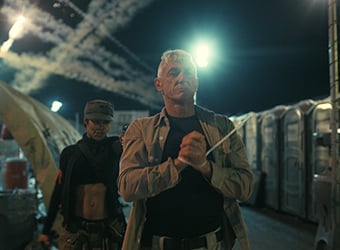
“Colonel Steven Lockjaw” in One Battle After Another
(Warner Brothers)
Joseph Holmes, a conservative cultural critic writing for Aaron Renn’s popular Substack, said the film “fuels political hate.” It “glamorizes political violence and vilifies conservatives, twisting empathy into a weapon that deepens America’s divide.” He notes that one of the film’s protagonists refers to the smuggling of illegal immigrants into America as a “modern underground railroad” and that “The villains are all open white supremacists who oppose such measures because they want to keep America racially pure.”
Holmes says that One Battle After Another’s contemptuous treatment of the political “other” has “become all too common in Hollywood. But rarely as baldly as this.”
Of course, what we see in Sinners and One Battle After Another is neither new nor surprising. I documented the same anti-white racism in earlier films, TV shows, and other entertainment products in my 2024 book, The Unprotected Class: How Anti-White Racism Is Tearing America Apart. Wokeness was supposed to have subsided after the conservative landslide in the 2024 election, which sent a clear message that the left’s woke agenda is unpopular with most of the country. This message went unheeded in America’s cultural production capitol, where whiteness, maleness, and especially their combination in the figure of the dreaded white male, are still objects of Hollywood’s derision.
Behind the camera, whites have been dramatically and intentionally purged from many Hollywood creative roles over the last decade and a half, as documented by Jacob Savage in his December article in Compact, “The Lost Generation.” As Savage documents, Writers Guild of America diversity reports show that in 2011, white men comprised roughly 48 percent of lower-level TV writers; by 2024–2025, that figure had collapsed to 11.9 percent. They were replaced mainly by “women of color,” who now hold 35 percent of lower-level TV writing jobs. Savage found similar numbers among directors. In just seven years, between 2014 and 2021, the percentage of TV directors who are white males halved to 34 percent from 69 percent, with newer white entrants presumably almost entirely eliminated.
Some of the biggest entertainment hits of our era show the same theme. Hamilton, while a mixed product with respect to its racial message, ultimately shows the one white cast member (King George III) as the show’s only undiluted and unsympathetic antagonist. Coogler’s aforementioned Black Panther film franchise contrived the fictional “Wakanda” as an African American paradise that was ruined by evil whites. And these films have been box office gold. The X account “White Men are Stupid in Commercials” (@StupidWhiteAds) continues to document the perpetual stream of anti-white content on American TV.
These trends can also be seen in America’s top streaming services. The Boys, a popular series on Amazon.com, is a hyperviolent show in which overwhelmingly white “superheroes”—including Stormfront, a literal secret Nazi—exist to do little more than subvert the traditional superhero stereotypes. Homelander, the blond-haired principal anti-hero of the show, is acknowledged by the show’s creator to be directly modeled on his view of President Trump, as a narcissistic, authoritarian, and manipulative charmer who creates a cult of personality.
Adolescence is a much-acclaimed British TV series released on Netflix that focuses on a 13-year-old white boy who kills a classmate after overdosing on right-wing “red pill” content. This show is based on a widely publicized murder in Britain, which was actually committed by a black teen.
This sort of race-swapping of the actual historical facts is very much in vogue today, as we also see in the absurd casting of Kenyan-born actress Lupita Nyong’o as Helen of Troy in Christopher Nolan’s forthcoming film The Odyssey. Was this the face that launched a thousand ships? If you dare ask, you’ll never work in this city again.
Leave a Reply