Waking to the swell of the waves and the salt taste of the morning air were some of the nicest things about living in Ocean Beach, a bohemian coastal community in San Diego. The alley behind the little shoebox studio I rented curled right out to the dunes and sometimes in summer we would have a front-row seat to the red tide that charged the water with bioluminescence and made the breakers fall like walls of lightning. Downtown always felt less commercial, more uncouth than, say, Carlsbad, with its surfer bums, skaters, musicians, hobos, Navy SEALs, tattoo artists, fortune tellers, and guys with shaved heads and prison tattoos hanging out along the pier or in one of the dives. That was all part of the charm.
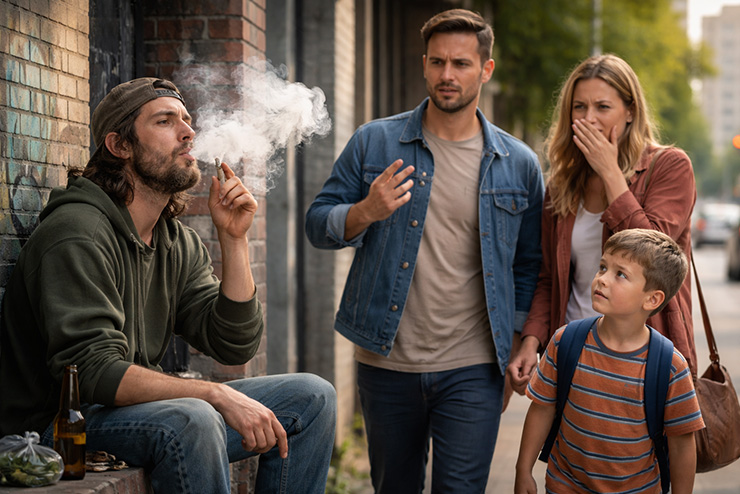
I sometimes miss living in Ocean Beach, but there’s one thing about the place I don’t miss: that pungent, sickly sweet, and ever-present odor of marijuana that hangs in the air like a hot quilt. It is difficult to avoid that standard fixture of coastal communities. It fits in Ocean Beach, though, a community on the edge of the sand and on the margins. I would rather live in a world where weed is relegated to those fringes than in one where it is wafting into your face every time you go to the market. But that latter world, unfortunately, seems to be where we are headed, as the push for decriminalization finds allies on both sides of the aisle.
The thing about marijuana is that it only “fits” when it is associated with the counterculture. The archetypal stoner of American cinema is likable because he is aware of his status as an outsider. Moreover, he offers a contrast both to the norms of sober society and to the edgier types who dabble in more dangerous narcotics. In the words of Jeff Spicoli, the perpetually stoned teenager played by Sean Penn in Fast Times at Ridgemont High, “People on ludes [Quaaludes] should not drive.” The joke works because we think of weed as the stuff of harmless beach bums and surfers—people cognizant of their vice, and its distance from harder wares and “glamour drugs” like Quaaludes. We can forgive and laugh along with red-eyed Spicoli for warning us about the dangers of driving under the influence.
Ironically, the mainstreaming of marijuana has been the worst thing ever to happen to its reputation. I can’t recall a time in my life when the drug was so openly despised, and that’s because it’s increasingly difficult to avoid it. The drug’s ubiquitousness has forced people to think about it—and the more they do, the less they find to like.
Indeed, last August, Gallup found that Americans increasingly take a dim view of the effects of marijuana, reporting that “slim majorities now say it negatively impacts both society as a whole (54%) and most people who use it (51%).”
The same survey found that most Americans still think marijuana is less harmful than other substances. That’s something I suspect will change, as people continue to reevaluate their views on a topic to which they probably didn’t give much thought until recently. In fact, it’s doubtful most people realize just how harmful the drug is, and how little evidence there is to support the claims of its supposed benefits.
Take, for example, “medical cannabis.” The popular consensus goes something like this: It does everything prescription drugs do, but with none of the side effects, and it’s not addictive.
Dr. Michael Hsu, an addiction psychiatrist at the University of California, Los Angeles, strongly disagrees with that assessment. Hsu is the lead author of a new meta-analysis of the last 15 years of cannabis research, “Therapeutic Use of Cannabis and Cannabinoids: A Review,” published in the medical journal JAMA in November. He and his colleagues analyzed more than 2,500 scientific papers published between January 2010 and September 2025. Their conclusion? “Evidence is insufficient for the use of cannabis [the entire plant] or cannabinoids [the plant’s compounds] for most medical indications.”
Researchers only noted “small” to “moderate” benefits in two applications: reducing nausea and vomiting—such as occur during chemotherapy—and increasing body weight among HIV/AIDS patients. Beyond that, they could find little to no strong evidence supporting its use.
Most people, aided by pop culture perceptions, think of the drug as, at the very least, having reliably soporific effects, envisioning the sleepy stoner. However, sleep trials have yielded weak or inconclusive results, which is why organizations such as the American Academy of Sleep Medicine have not endorsed its use. In fact, daily users of the drug have reported difficulty sleeping without it, indicating that what they are actually experiencing are withdrawals—not that they are missing any real sleep benefits.
Another common belief is that marijuana can help treat anxiety, namely, post-traumatic stress disorder. Yet even in that case, researchers have not found any significant evidence pointing to that conclusion. Hsu and his team cited a trial of 80 veterans suffering from PTSD that found no difference in the outcomes of those who received cannabis versus those who received a placebo.
“Patients deserve honest conversations about what the science does and doesn’t tell us about medical cannabis,” Hsu told The New York Post in a statement. “While many people turn to cannabis seeking relief, our review highlights significant gaps between public perception and scientific evidence regarding its effectiveness for most medical conditions.”
However, the evidence about the dangers associated with cannabis is much stronger. Contrary to the belief that it is not habit-forming, about a third of people who use the drug for “medical purposes” met the criteria for addiction, one meta-analysis of observational studies reported. Hsu’s team highlighted that “high-potency cannabis” use is associated with increased risk of psychotic symptoms and generalized anxiety disorder. Earlier this year, another study published in JAMA Psychiatry found that the brain activity patterns in individuals who heavily use cannabis resemble those observed in patients with psychosis.
The paper, “Convergence of Cannabis and Psychosis on the Dopamine System,” asked the question, “Is cannabis associated with the same midbrain dopamine pathway involved in psychosis?” and focused on people aged 18 to 35. Researchers used a neuromelanin-sensitive MRI technique to measure dopamine activity in brain regions associated with motivation, reward, and emotion. Strong neuromelanin signals here indicate that a person is producing more dopamine, and increased production of that happy hormone in this part of the brain has been observed in patients with disorders like schizophrenia. The results were unsettling.
“We found that individuals with cannabis use disorder exhibited increased neuromelanin-MRI signal in a brain region previously associated with psychosis symptoms,” study author Jessica Ahrens told PsyPost. She continued:
Since neuromelanin-MRI signal is considered a potential marker of dopamine function, our findings suggest that people with cannabis use disorder may have elevated dopamine activity in a brain area linked to psychosis risk.
Perhaps that shouldn’t be too surprising, considering that the active component in marijuana, Tetrahydrocannabinol (THC), binds to receptors in the brain and triggers a series of reactions very similar to those experienced by schizophrenics, such as paranoia and hallucinations. In an article published by the Yale School of Medicine, Dr. Deepa Purushothaman, a postdoctoral associate in the school’s psychiatry department, explained that while these effects typically fade after the high wears off, they may last longer, “leading to what’s known as cannabis-induced psychosis.”
“A Finnish study of 18,000 individuals with cannabis-induced psychosis found that nearly 50% were later diagnosed with schizophrenia,” Purushothaman wrote. “Other studies confirm that regular use, especially of high-potency products, increases the risk of developing schizophrenia by four times.” According to Purushothaman, the risk is comparable to the relationship between high cholesterol and heart disease. She also noted that the Specialized Treatment Early in Psychosis program at Yale, where she works, found that over 75 percent of patients with early schizophrenia had a history of cannabis use.
The brains of bona fide stoners have a lot in common with those of certified schizophrenics, something they would vehemently deny, just as they would refuse to admit that cannabis can be addictive. Researchers like Ahrens have commented on that peculiar quality of denialism when it comes to cannabis. “Something that surprised me is that when asked about their cannabis use patterns, we did not find a significant difference in self-endorsed problems (when asked the question: ‘Have you ever had problems because of your use of cannabis?’); those with a cannabis-use disorder reported less frequent personal harm due to cannabis,” she said. “This indicates that individuals with a cannabis-use disorder had lower perception of harm despite the higher measured severity.”
Nevertheless, President Trump in December signed an executive order reclassifying marijuana to a Schedule III from a Schedule I drug, formally acknowledging that it has an accepted medical use and less potential for abuse than other illegal drugs—a move the president said is aimed at increasing cannabis research. The most honest supporters of the drug’s rescheduling or outright decriminalization will skip attempting to defend their position with medical or scientific claims and go straight to talking dollars and cents. Good business is good business, they’ll say, and taxes from cannabis products offer potential windfalls. But even that argument has huge holes. In Nevada, which voted in favor of legalization in 2016, marijuana was supposed to provide a major cash injection to the state’s K-12 schools. Instead, cannabis tax revenue now accounts for about two percent of the budget for K-12 education.
But these debates over tax revenue miss something more important: the invisible cost of becoming a society that openly embraces just about every vice it encounters. Putting it that way might be confusing, because it seems like many of us today are unable to recognize vice as such—which is to say, we don’t acknowledge the concept of immoral behavior. Trying to completely eradicate vice would be a fool’s errand. It’s impossible. But the key difference in our time is that the scope of what we consider immoral behavior is constantly shrinking, and the margins, where vice had once been relegated, are increasingly indistinguishable from the mainstream. There is a price to pay for that. ◆
Leave a Reply