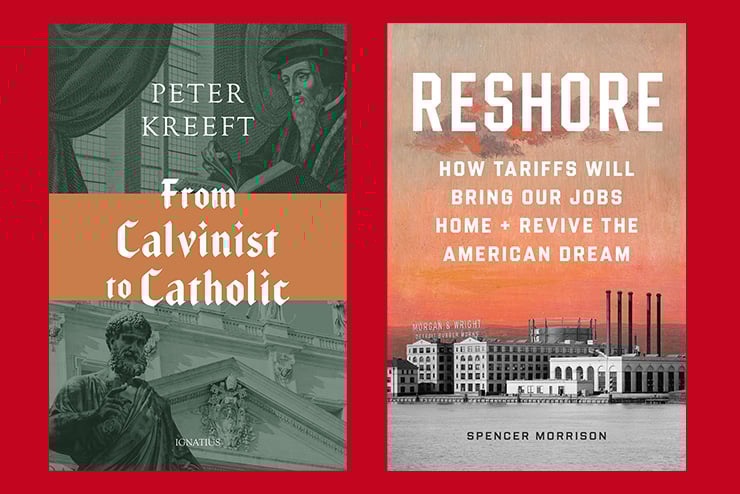
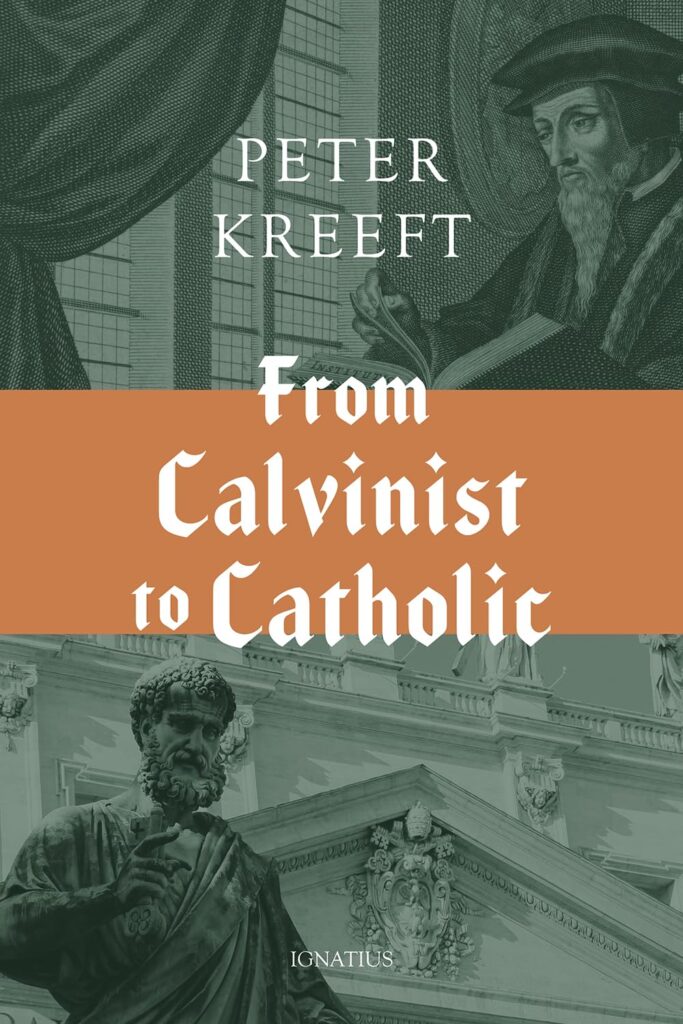
From Calvinist to Catholic, by Peter Kreeft (Ignatius Press; 192 pp., $21.95). Peter Kreeft’s tripartite memoir-cum-apology-cum-last-lecture comprises what, his introduction warns, “is really three books.” Each section merits attention, but for different reasons. English teachers can use his first 10 chapters, his “pre-conversion autobiography,” to show how cliches and excessive parenthetical asides undermine good writing. Kreeft tells us he “loved astronomy (other worlds)” before he jokingly defines “potent propaganda (A propa ganda is the propa mate for a propa goose)”. Anyone with “the IQ of a goldfish” should skip this section. Likewise, for his “post-conversion autobiography,” the book’s last nine chapters. Here, among other irrelevant asides, he ranks his graduate school professors; none of this helps us understand his fascinating journey from Calvinism to Catholicism.
Fortunately, the book’s heart, “the theological issues and reasons that led [him] to Rome,” provides redemption. Catholics and Protestants alike will find their faith and dogma both challenged and affirmed. Atheists, non-Christians, and secular philosophers who ignore his readings of Augustine and Aquinas will persist in their mistaken ways. And social liberals should consider his harsh, and justified, condemnations of the sexual revolution, feminism, and divorce, but they won’t.
Needless to say, they won’t read Aquinas either, even though Kreeft praises him as “the most intelligent, clear, correct, complete, and comprehensive thinker who ever lived.” Protestants need not fear his indisputable assessment. Kreeft considers Aquinas “deeply Protestant in every positive way,” not just because “he spent most of his life preaching Scripture.” Aquinas’ “Bibliocentric and Christocentric” theology will resonate with those on both banks of the Tiber. Add in Kreeft’s other favorites, “Socrates and Augustine … for philosophizing” and “Pascal, Chesterton, and C. S. Lewis … for popularizing that philosophy” and Christians of every stripe will find something here to affirm their beliefs.
As a non-practicing, half-breed cradle (Latin Mass) Catholic, I found Kreeft’s work a necessary challenge to my lapsed state. I wish I could share this book with my long-deceased Protestant mother. Kreeft’s own Protestant mother kept their household peaceful when she assured him, “I believe God is using you in ways I can’t see.”
(Mark G. Brennan)
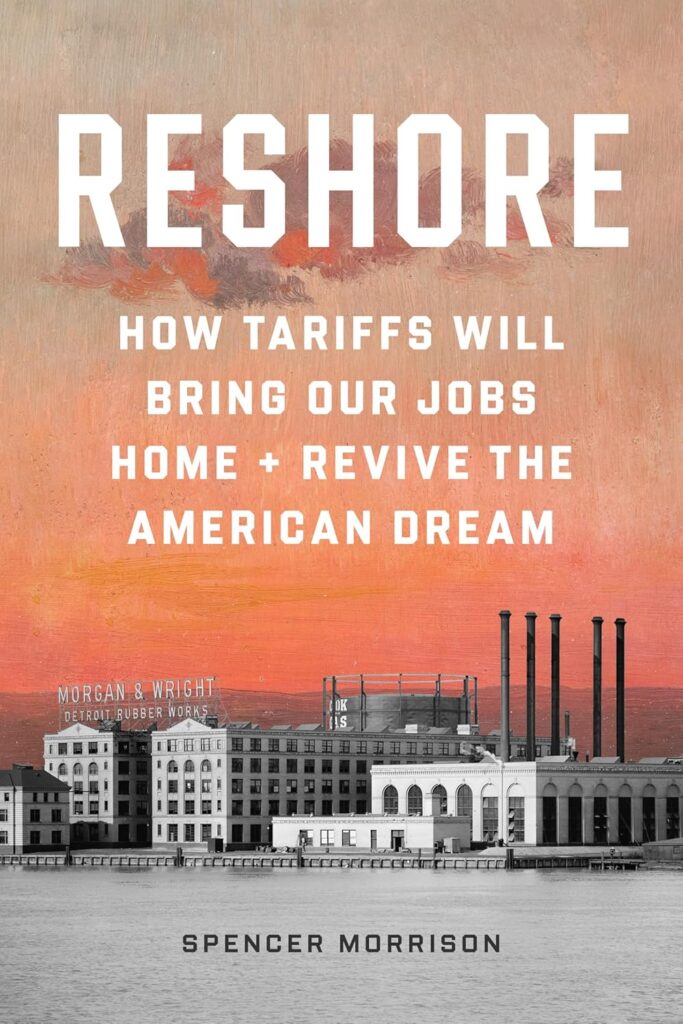
Reshore: How Tariffs Will Bring Our Jobs Home and Revive the American Dream, by Spencer Morrison (Calamo Press; 254 pp., $32.00). Half a century of free trade has thrown millions of Americans out of work, depressed wages, stoked inflation, and pushed the young toward socialism, drug abuse, and suicide. It hollowed out America’s industries and enriched foreign adversaries, making us dependent on them for the manufacture of everything from forks to syringes and semiconductors. It has made America poorer, dumber, and weaker.
This is the compelling argument made by Spencer Morrison in Reshore. How could Morrison, a divorce lawyer with no formal economics training, be right, and a free-trade grandee like Milton Friedman be wrong? First, it’s not 1980 anymore, and the bad fruit of Friedman’s dogma is evident. Second, as a layman, Morrison has the advantage of indoctrination into the Chicago School or one of the other brainwashing protocols. He synthesizes disparate ideas and takes a broad view, where a specialist may miss the forest for the trees.
The wealth of nations is built on technology, and Morrison argues that technology is path-dependent. Advanced technologies follow from basic ones, and it is the nations that control industries that tend to make the advancements. By offshoring industries like machine tooling and semiconductor manufacturing to China, America not only becomes dependent on its rival but also loses the initiative in advancement. “If industrial development is path dependent, then offshoring is akin to stepping off the path entirely,” Morrison writes.
Morrison also argues that free trade bloats the bureaucracy—more than 22 million Americans now work in government, more than twice the number in manufacturing. “The growth of America’s managerial class is largely a response to offshoring and to the burden of increasing complexity,” he writes. “Are Chinese goods cheap, or do they appear cheap because we ignore the opportunity costs associated with employing millions of Americans in non-productive jobs? How many millions of man-hours do we waste coordinating the labor of Chinese peasants?”
Morrison lays out the facts supporting his diagnosis and his proposed cure—the restoration of tariff barriers—at a relentless pace. Readers will have to forgive an abundance of typographical errors. They should probably ignore his foray into health advice (Would Americans really be healthier if they could afford to eat more red meat and animal fat? I’ll stick with the American Heart Association on that one.) But Reshore serves as a quick and compelling re-education on one of the most consequential political issues of our time.
(Edward Welsch)
Leave a Reply