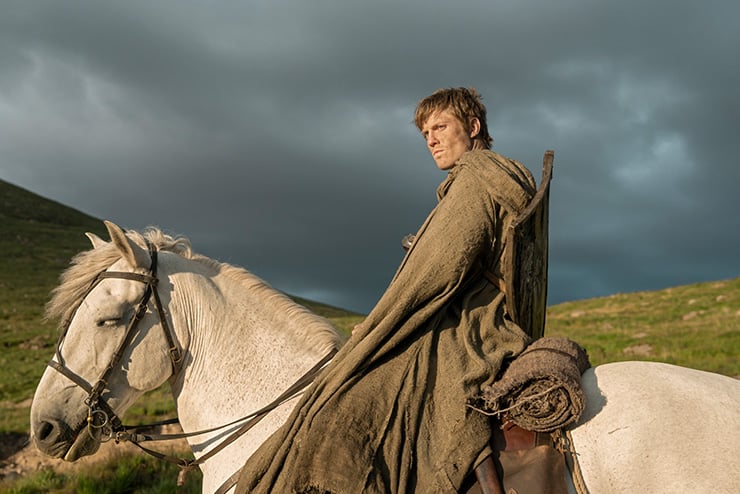
A Knight of the Seven Kingdoms
Television drama series created by Ira Parker and George R. R. Martin ◆ Produced by Friendly Wolf Pictures and GRRM ◆ Distributed by HBO Entertainment
For the last decade or so, fantasy storytelling has found itself in a rather grim place.
If authors like C. S. Lewis, Susan Cooper, and J. K. Rowling once represented one pole of the genre, leavening their tales with British whimsy, creators like J.R.R. Tolkien, Robert Jordan, and Terry Brooks once stood for the other, filling out their doorstopper epics with detailed descriptions, songs and poetry, and dense historical lore. Across the board, moral lines were relatively clear. Romance was courtly, restrained, and chivalric. Violence was stylized, or at the very least disciplined by a moral code.
A lot has changed since then. For female readers, there’s now the enormously popular “romantasy” genre, spanning books like Rebecca Yarros’s Fourth Wing and Sarah J. Maas’s A Court of Thorns and Roses, which pairs fantasy trappings with love triangles and explicit sex scenes. For men, there are the blood-soaked, profane epics of Joe Abercrombie and John Gwynne. Brandon Sanderson, author of Mistborn and The Stormlight Archive, is certainly in the mix too, but his novels—while relatively chaste and willing to hold back on the gore—pair a deeply materialist metaphysics with therapeutic moral categories. These are not the sorts of fantasy stories I remember from my childhood. They stand for something else.
No storyteller was more influential in driving this shift to “grimdark” fantasy than George R. R. Martin, whose bestselling series A Song of Ice and Fire—later adapted as the HBO mega-hit series Game of Thrones—shook up genre conventions from the start. Set in the England-inspired lands of Westeros and loosely inspired by the historical Wars of the Roses, Martin’s tales traded mythopoetic speculation for cynical realism. Here, virtue was no longer rewarded. Indeed, sometimes it was a liability. Heroic or honorable characters—like Eddard Stark, memorably portrayed on-screen by Sean Bean—wound up beheaded or betrayed for making the wrong political judgments. Religion and spirituality were, just as Karl Marx famously quipped, the opiate of the masses. Brutal violence, graphic sex, and moral compromise were the coin of the realm, sometimes quite literally. This was, supposedly, what it meant to tell serious fantasy stories. No elves, gods, or graces—just cold steel and hot flesh.
In the wake of Game of Thrones’ poorly regarded final season, HBO has sought to keep Martin’s lucrative brand alive. First, there was the spin-off prequel series House of the Dragon, which—while certainly better than later Thrones installments—mostly traffics in the same old scheming, seducing, and slaying. This year, the network tried for a third bite at the apple with another spin-off, A Knight of the Seven Kingdoms—loosely based on novellas penned by Martin, set in the same world as the main Thrones series.
Given Martin’s—and HBO’s—track record, one might be forgiven for expecting more of the same. But A Knight of the Seven Kingdoms is a very different, and far more interesting, foray through Westeros than anything previously on offer.

From the outset, A Knight of the Seven Kingdoms distinguishes itself from Thrones and House by its scale. Knight’s two predecessors were sprawling epics that played out across an entire continent, cutting back and forth between small cadres of protagonists working in separate locations towards separate ends. Compared to those, Knight is surprisingly—even radically—restrained.
Season one tells the story of Ser Duncan “Dunk” the Tall (Peter Claffey), a young “hedge knight” working to find his way after the death of his mentor. By the laws and customs of Westeros, any knight can make another knight, and Dunk was allegedly knighted prior to his master’s passing. But without witnesses or any formal lands to back up his title, Dunk doesn’t enjoy the same prerogatives as those associated with more established families. And so, like the ronin of ancient Japan, Dunk finds himself a wandering swordsman looking for work—and food—where he can find it.
On his way to a tournament in the town of Ashford, Dunk stops for a repast at a roadside inn, where he meets a curious yet stubborn boy nicknamed “Egg” (Dexter Sol Ansell). Egg insists on accompanying him to the tournament and serving as his squire. Dunk, whose own shaky road to knighthood ran through a similar path, tentatively agrees.
In keeping with Knight’s smaller scope, the remainder of the season focuses on Dunk and Egg’s sojourn at the tournament—and the adventure in which they soon find themselves caught. When a member of the ruling Targaryen family brutally attacks a performing puppeteer, offended by the puppeteer’s depiction of a dragon (the Targaryen symbol) being slain, Dunk intervenes to protect her. Dunk’s actions, though well-intentioned, transgress the Westeros rules of honor, which forbid anyone from attacking the royal house. The Targaryens have a right to demand satisfaction—and demand it they do, in the form of a bloody seven-on-seven trial by combat. Whoever wins enjoys the gods’ favor.
A seven-on-seven fight, of course, requires that the offending party have six allies to back him up. Dunk, mostly penniless, has none—at least until a handful of near-strangers, some motivated by honor and others by a chance to take a crack at the disliked Targaryens, rally to his side. The result, as any Thrones-watcher might expect, is a visceral, high-octane, and compulsively watchable showdown.
From the outset, an entirely unexpected moral sensibility runs through Knight. Dunk is not a saint or Sir Galahad type. He is crude, rather awkward, and unrefined. His actual claim to knighthood—though seemingly sincere—is undoubtedly murky. And yet this very humble station is, in a sense, his saving grace. Dunk is no Eddard Stark, a statesmanlike figure taking it upon himself to direct the course of the realm. Nor is he like a member of the conniving Lannister clan, aiming to amass vast private wealth and fund endless legions, or like a scion of the House Targaryen obsessed with their own claim to rule. He is an ordinary man of decent moral fiber, facing long odds and bearing up under real disappointments. And yet he remains unafraid to work hard or endure pain, and ambitious enough to work and hope for the best.
In any given episode of Thrones, Dunk would come across as the sort of character destined to die tragically, and probably violently—yet another victim of Martin’s cruel narrative logic. But Knight resists the urge: Dunk is not, in fact, mauled and left to die in the mud. Faced with a crisis, he finds others willing to stand with him, who are motivated—at some level—by their own understandings of honor and knightly character.
And Dunk emerges from his ordeal as, essentially, the same person. Nor is it the first time. Flashback sequences make clear that the Dunk we see onscreen for most of Knight—battered, flawed, but fundamentally upright—has witnessed extreme hardship and pain in his short life, and yet his moral fiber endures. Grim experiences have not forged him into an iron-hearted killer who—like Thrones’ Sansa Stark—only wins out in the end through the brutal exercise of power. Through it all, Dunk remains a knight. And, more importantly, he remains a man.
However intended by the show’s writers, it is hard not to read Knight as, at some level, a meditation on the place of masculinity in society. Just as in Thrones, there are plenty of men behaving badly here, ranging from Targaryen arrogance and backroom conniving to the brutish mistreatment of women. But unexpectedly, there is also an affirmative vision of manhood onscreen, one that might be surprisingly accessible to viewers around the age of Dunk’s own character.
Dunk is an ordinary man who lacks recognized credentials. He has skills and talents, but they are not the sort of qualities that are easily monetized. He disdains abuses of authority by those supposedly in charge. There is something distinctively gendered about his place in Westeros: his physical size, strength, and temper are the instruments by which he acts in the world, and also those factors that place him at risk.
But it is also that very manhood that makes Dunk strong. It leads him to stand up for the weak who cannot defend themselves. It leads him to agree to mentor a young boy who falls in with him. It leads him to do his duty in the face of long battlefield odds. And it leads him to bear up under the crushing weight of hostile circumstances, even when there is no clear path forward.
In a fantasy genre landscape that’s darkened considerably in recent years, Knight is the most unexpected of things: a tale that has passed through the critical fire of cynicism, brutality, and contempt, and emerged with its moral center largely intact. To be sure, Knight largely lacks the overtly mythic sensibility—or alternatively, historical naivete—of older epics. This is still a medievalized world where vice and suffering abound, and where not all who claim to be a “knight” do credit to that title. But in the face of all this, Knight dares to insist that character still matters, even under the worst of circumstances. It doesn’t matter that Dunk isn’t proclaimed king at the end of the story, or found to be the lost son of some noble and whisked off to the halls of power. Moral virtue is its own reward, and the fiber of a life worth living.
Of course, that’s not to suggest that Knight is suitable for all-ages viewing. The violence is graphic, and the tone is grim. But compared with the notorious excesses of Thrones’ early seasons, Knight offers its viewers a far more stirring ideal. At its best, it stands for a fantasy genre that has, perhaps, finally grown up.
Leave a Reply