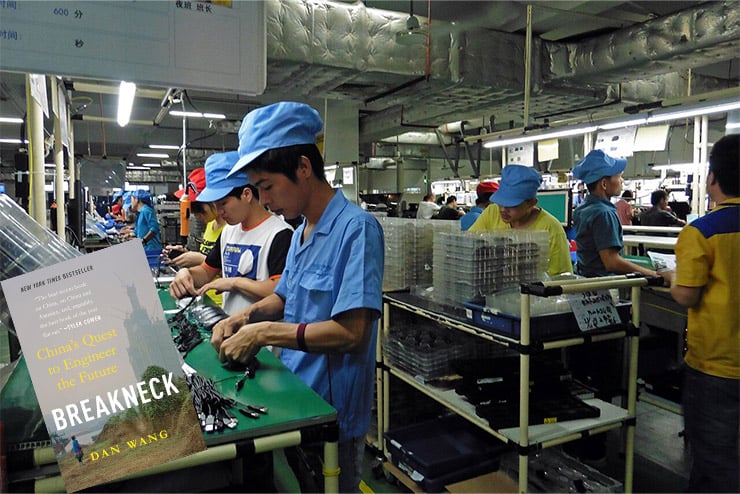

Breakneck: China’s Quest to Engineer the Future
by Dan Wang
W. W. Norton & Co.
288 pp., $31.99
Lawyer societies contrast dramatically with engineer societies.
The former concentrate around regimes of law and rights. They obsess over legal procedure to ensure that every action can withstand the inevitable assault by attorneys in court. This means everything is done at a snail’s pace because every legal loophole must be closed and every legal nicety must be addressed before any practical action.
The latter build and restructure quickly, brimming as they are with technocratic experts, practical agendas, and comparatively little concern for individual rights or legal principles.
This distinction is the central analytical observation of Dan Wang’s Breakneck. It is a compelling rubric that is quite helpful in understanding the competition for global dominance between the U.S. and China. Wang believes fewer lawyers among the U.S. ruling elite would be a good thing for America. Plugging more individuals with engineering prowess into those elite slots would be beneficial, he argues, because that engineering spirit in governance will help persuade the public that government can improve their lives.
Wang provides a crisp example in Shenzhen, which transformed from a rural backwater into China’s Silicon Valley. After the government designated it a Special Economic Zone, the engineer mind took over. Now with a population of nearly 20 million, Shenzhen is a major manufacturing site in the high-tech sphere. The city’s infrastructure building proceeds at an astonishingly rapid rate.
The U.S. does not have Shenzhens because, unlike China, we pay little attention to what Wang calls “process knowledge.” This “institutional memory or task knowledge … exists mostly in people’s heads in the pattern of their relationships to other technical workers.” Whereas the U.S. considers it sufficient to master the invention and planning of new technologies, China emphasizes the infrastructure and organizational work required to build those technologies in mass quantities. Technology, in this view, is not just tools and plans but also the social and physical networks that produce it. China’s engineering spirit has enabled mastery of this sphere, and that alone has been enough to draw the country into competitive parity with the U.S.
A critical accounting of the lawyer mind is emphatically needed because it has profoundly insinuated itself into every American avenue of power and must be challenged. The lawyer mind makes it next to impossible to create anything in America because the works have been so effectively mucked up with legal bureaucracies, and the understanding that whenever anybody does anything, attorneys will sue over it. Wang is without doubt correct on this point.
But Wang says little about the limitations of China’s engineer mind. He does admit that the engineering state is built for “a bird’s-eye view.” The tremendous amount of infrastructure China’s Communist leadership has constructed looks impressive from a distance, where it is impossible to discern the humans living amidst those engineering marvels. In truth, a termite-world mindset drives the Chinese state. Large numbers of people live in massive steel-and-concrete structures, crushed into towering housing units in tiny, utterly unvarying living spaces. From an airplane, these human termite mounds can appear visually impressive. Nonetheless, living in the midst of such gigantic, alienating boxes, with so many others who follow uniform daily routines, is not far from how one might envision Hell.
There is minimal forecasting in the book, though Wang does assert that China’s manufacturing power is so formidable that even if the U.S. outpaces them in diplomacy, finance, and innovation, China can remain competitive because it is so much better at actually “build[ing] … in the physical world.” He admits that an engineering society can accomplish the goals it sets for itself, notwithstanding the political authoritarianism such societies often produce. Free speech, he blithely notes, might not be a necessary condition for such societies. It is true that lawyer societies like ours can distort free speech into tolerance for abject moral evil, but free expression remains a core value in this culture. Wang does not venture into the complex political theoretical debates on this point.
The dark side of the Chinese engineering spirit is closely documented in two chapters on the now-overturned one-child policy and on the Chinese state’s response to COVID.
In 2023, the Communist Party leadership switched from a policy emphasis on gender equality to a more traditional view of marriage and childbirth, encouraging women to stay home and have children. This was a response to the unmitigated disaster of the 35 years of the one-child policy, which was driven by predictions in the 1970s of a disastrous Malthusian population overgrowth outrunning production. The predictions turned out to be bunk. China now suffers from chronic low fertility and a shrinking population. Wang correctly analyzes the one-child policy as an example of overreach into population engineering by the dominant ideology of the Chinese state.
From 1979 until 2015, the one-child policy was fanatically enforced, with huge humanitarian costs to the Chinese people. State bullying was vicious, and many millions of Chinese men and women underwent forced tubal ligations and vasectomies. Female infanticide was widespread during the policy’s first decade. Sterilizations were performed on women during other surgeries without informing them. State-mandated abortions were another arm of the policy, and the human costs are astonishing to behold in their quantitative enormity. Nearly 325 million abortions were carried out in China in those years, approximately the equivalent of the present-day population of the U.S. The state family planning system treated human beings like livestock.
China’s zero-COVID policy, aimed at complete suppression of the disease, was another nightmarish example of the country’s human engineering impulse at work. Wang gives a distressing account of the eight-week lockdown in Shanghai during the COVID-19 omicron outbreak. A city of 25 million people was subjected to a massive governmental effort to terrify the population about the virus. Officials forcibly isolated those determined by cell phone monitoring to have been in the proximity of infected individuals. From loudspeakers on flying drones, they berated citizens about masking. They constantly surveilled for infection status and restricted travel. Severe food insecurity resulted from the draconian lockdowns.
“Only a country ruled by engineers,” Wang writes, “could be so single-minded about pursuing a number,” meaning the rate of new infections. For a while, the zero-COVID policy was successful at curtailing transmission. But, in short order, infection rates spiked as citizens were required to stand in line for mandatory daily testing—a perfect recipe for spreading the virus.
Not all Chinese citizens are convinced of the superiority of the engineer mind. The Chinese have adopted the English word “run” to express the desire to flee China, or at least its largest, most inhuman cities. Wang reports a friend telling him:
China feels like a space in which the ceiling keeps getting lower…To stay means that we have to walk around with our heads lowered and our backs hunched.
In the end, Wang’s own view skews more Chinese than many of his American readers will prefer. His final chapter contains a long meditation on his parents, Chinese immigrants to Canada who now live in the U.S., and whether their lives would have been better or worse if they had stayed in China. The narrative here is distant from anything one might see as consistent with American patriotism or Western culture. His summary:
My parents made a wrenching personal decision based on … a guess about the future… Where did they and their child have the best chance of living a good life?… All these years later, it’s not an open-and-shut case that they made the right call.
Throughout Wang’s account of his parents’ lives, it becomes apparent that they have done next to nothing to assimilate into the cultures of the Western countries to which they immigrated. He describes them constantly searching for Chinese enclaves within the U.S. He describes their life in a well-off Philadelphia suburb as too “dreary.” He does not consider whether the United States would have been better off if his parents and similar unassimilating Chinese immigrants had stayed put.
Wang’s view on the American future is engineering-focused, yet with full acceptance of the multiculturalist base of nearly all contemporary leftist thought. The U.S. can win the contest with China by “hold[ing] onto pluralism while building.” Not a word about refusing termite world or making any effort to hang on to traditional American cultural values.
There is no doubt that the U.S. is losing ground in the competition with China. Wang suggests America return to a greater emphasis on manufacturing, which will require at least limited gains of the engineer world against the lawyer world. Agreed. But it is a foregone conclusion that we will not be able to fully match Chinese abilities here, as American workers will not submit themselves to the authoritarian regimes that Chinese companies impose on their workers. And it is not at all clear that Americans desire to get fully on board with the termite world ideology of the Chinese Communist Party.
Leave a Reply