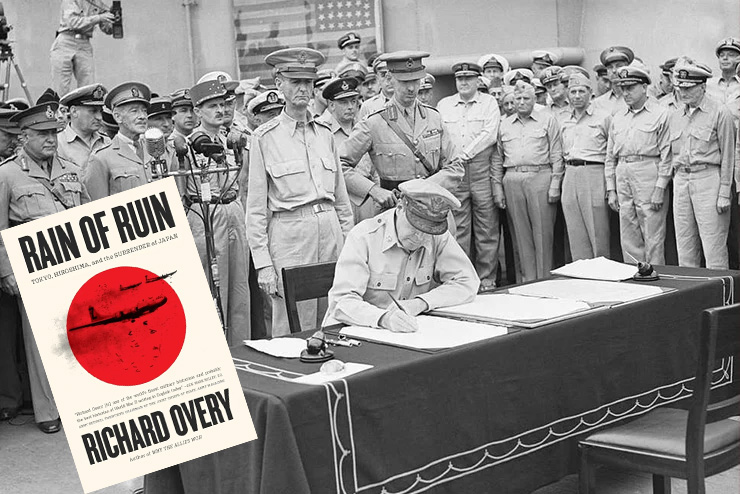
Rain of Ruin : Tokyo, Hiroshima, and the Surrender of Japan, by Richard Overy (W. W. Norton & Company; 224 pp., $29.99). Richard Overy’s new book treats a controversial issue—the fire attacks on Japanese cities in 1945 and the atomic bombings—with his usual excellence. His interest is not in judging these things, but examining why they were done.
In Europe, the U.S. Army Air Force (AAF) had generally avoided, and even disapproved of, British-style area attacks on German cities. Moreover, its basic theory of strategic bombing still hung on daylight “precision attacks” on industrial plants and other facilities. So why did it turn to the fire attacks that destroyed 40 percent of 66 Japanese cities, and then drop the atomic bombs? Although it had moved somewhat in that direction in sanctioning the extremely inaccurate “radar bombing” of German targets when weather prevented visual sighting, as was often the case, that was a decidedly undesired second choice.
As Overy shows, the decision to change in Japan was the result of a confluence of events. There were pressing problems that rendered months of attempted precision bombing ineffective. Clouds that obscured the ground in the fall and winter of 1944-45, and the jet stream that shot the bombers over the targets too fast for the existing bombsights, foiled high altitude bombing. (Flying lower would have rendered the unescorted B-29s vulnerable to Japanese fighters, which were not too dangerous when they flew at 30,000 feet.)
But there was also a long-standing interest (preceding even Pearl Harbor) in exploiting the vulnerability of Japanese cities to fire, which had been pushed by scientists and others in the National Defense Research Committee and the AAF’s Committee of Operations Analysts. At that point in the war, hatred of the Japanese and feelings of revenge were also factors.
General LeMay’s solution was to send the B-29s in low, when they could carry far heavier bombloads with less strain on their unreliable engines, and at night, when Japan’s weak defenses would be least effective. The attack on Tokyo on March 9, 1945, the most destructive air attack in history—even more so than the attack on Hiroshima—showed the effectiveness of these new tactics. Destructive as these tactics were, American military leaders were reluctant to accept the fact that they were bound to kill massive numbers of civilians, and this state of denial, Overy points out, carried over into the planning of the atomic attacks.
Overy notes that it was by no means certain atomic bombs would be available as early as they were, and he explains the decision to use them quite well. He affirms the general assumption that they were used when the Joint Chiefs of Staff, especially General George C. Marshall, and President Truman, thought that Japan would have to be invaded to win the war. He does not try to disentangle whether the first, or both, atomic bombs, or the Soviet attack, or all three on top of earlier disasters, triggered the Japanese decision to surrender.
Overy also makes no attempt to discuss the interesting problem of whether there were less bloody alternatives. He does make passing reference to an argument made in the postwar Strategic Bombing Survey. Instead of the fire attacks, the AAF could have concentrated on attacking Japanese transportation. First, with earlier and more intensive mine-laying by B-29s, an enormously effective effort when belatedly initiated in late March. Then, when fighter escort was available from Iwo Jima, with precision day attacks on the Japanese rail system, supplemented by carrier air strikes. That quickly would have wrecked what was left of Japan’s economy. The job could have been done even faster by using Azon guided bombs.
As for the atomic bomb, the Americans had good reasons to rule out the suggestions made for a demonstration that would harm nothing and no one, for example, Edward Teller’s idea of setting off the bomb 40,000 feet above Tokyo. A possibility that might have been more workable was a combat demonstration using the bomb not on a city but on a major military base, such as the Kure or Yokosuke naval bases. That option does not seem to have been entertained by anyone at the time.
On other historical matters, Overy’s analysis is less well-focused than the rest of Rain of Ruin. While he describes most of the Japanese leaders’ clutching at straws—notably the crazy idea that they might get a better deal via Soviet mediation—he is less clear about certain other illusions. One example is his discussion of the basic strategy dictated by Japan’s military leaders, that if they inflicted heavy losses on the Allies in the next “decisive battle” the Allies would give them a better peace deal.
What is less noted, though Foreign Minister Togo was frank enough to admit it, is that even Japan’s “moderates” imagined that they could retain at least some of Japan’s older colonies after the war. On that one point, Overy makes a rare mistake, suggesting that the Allies in the Cairo Declaration of 1943 were ambiguous about whether Japan could keep Taiwan and Korea. That is wrong; the declaration flatly said that it could not.
These, however, are minor quibbles compared with Overy’s overall achievement. As usual, he writes more skillfully about World War II, and makes more sense, than practically anyone else.
(Alan J. Levine)
Leave a Reply