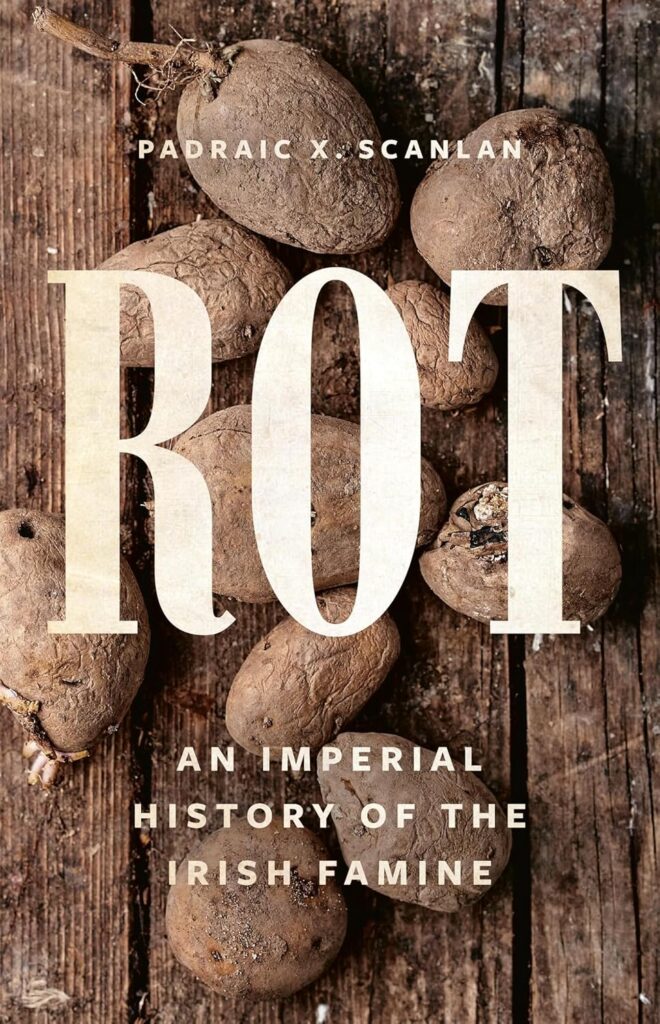
Rot: An Imperial History of the
Irish Famine
by Padraic X. Scanlan
Basic Books
352 pp., $32.00
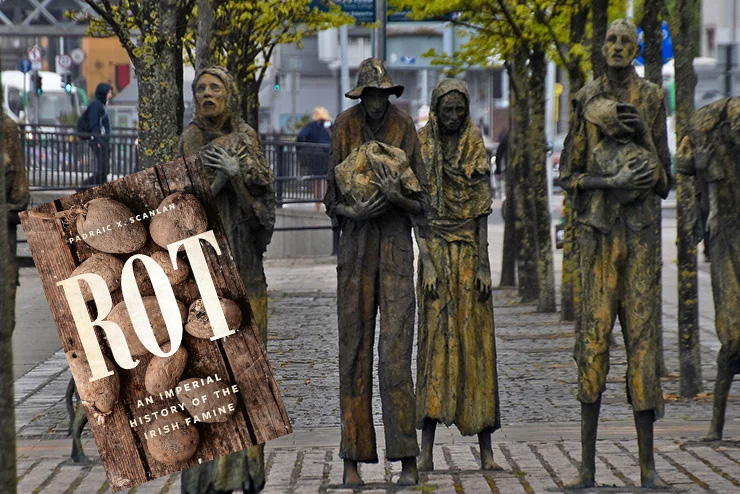
Sometimes great matters depend upon… vegetables. Ancient civilization was founded on the simple discovery that grasses could become grains, reliable and storable, allowing the emergence of fixed Fertile Crescent cities with rulers and philosophers. But vegetables can also yield disaster. The failure of the Irish potato crop in the mid-1840s not only brought terrible suffering to that island but has blighted Anglo-Irish relations ever since. Few other episodes have left such a toxic aftertaste, with over 100 memorials around the world and countless cultural references.
Canadian historian Padraic X. Scanlan has Irish antecedents, and generally left-of-center views. Still, he writes a careful analysis of an episode that is far from England’s finest hour. He has steeped himself not only in the cultivation, mythology, and natural history of the potato, but also in the cultural, economic, industrial, mercantile, and political currents which together heaped horrors on the Irish. He shows that what is often portrayed as a medieval-style catastrophe was in fact a modern one, a predictable product of the dynamic 19th century—and, furthermore, offers insights for our world regarding economic insecurities, environmental destruction, and ever-evolving pathogens.
Sometime in 1844 or 1845, a cargo of seed potatoes from America was offloaded somewhere in Europe. Unfortunately, that cargo contained an unobtrusive mold called Phytophthora infestans, which launched itself onto the Old World with alacrity. Potato crops from Spain to Sweden were affected, causing dearth and deaths, but the direst effects were felt in Ireland, where the population was uniquely dependent on the potato. In 1841, there were some 8.2 million people in Ireland; by 1851, that number decreased to 6.5 million, through death by starvation or disease, or forced emigration. Such was the culture shock that for almost a century afterwards the population of Ireland would continue to decline. The Irish government still issues annual warnings to farmers about the likelihood of blight.
Although Ireland had much fertile land and was famous for dairy and meat products, millions had been perilously reliant on the potato as early as the 1730s. There had been crop failures before; in 1740–41, the harvest was ruined by weather, and 300,000 died, a proportionally higher number than would die during the famine. Since its arrival in Tudor times, the potato had proved its worth as a cheap, easily cultivated, and highly nutritious staple. Grown and eaten close to home, the potato was largely insulated from market vagaries that were just becoming important with the rise of industry and commodity capitalism. Landlords encouraged it because it could feed more workers on less land, leaving acreages open to more lucrative grain or livestock.
This was the unsettling era of Thomas Carlyle and Charles Darwin, and the “Revolutions of 1848,” which toppled thrones across Europe. Radical economic theories and long-distance communication and trade were beginning to boom, thanks to steam power and the electric telegraph. Laissez-faire was becoming the default economic theory, espoused especially by Whigs—and 1845’s potato failure (followed by failures in 1846 and 1847) coincided with the repeal of the protectionist Corn Laws at the hands of Conservative Prime Minister Robert Peel, which split his party but ensconced free-market ideology.
Westminster’s newfound faith in free trade and a perceived imperative to “modernize” made London dreadfully slow to react when the disease struck in Ireland—a tragic failure of imagination. Irish crops that could have helped allay some of the worst effects of the blight were suddenly able to be sold more profitably to England—beef, cheese, grain, and pork went out from Irish ports even as Irish children starved and spoke of an emaciated ghost named Fear Gorta (“Hunger Man”) stalking the land.
In 1801, Ireland had become part of the United Kingdom, theoretically a partner with England rather than a colony. But Ireland was always different—historically dangerous, still partially militarized, and subject to strict Coercion Acts. “The Irish Question” was a perennial interrogative in Westminster politics, consuming vast amounts of political and administrative energy. Ireland was also mostly Catholic, much poorer, often Gaelic-speaking, overwhelmingly rural, and thickly populated. In 1845, almost one-third of the UK’s population lived in Ireland.
English administrators, politicians, and thinkers often fundamentally misunderstood Irish realities and projected modern mercantilism onto a population still wedded to older ideas. Whiggish writers deplored the customs of funeral wakes, holy days, and Lenten fasting, which they felt encouraged idleness and irresponsibility. Foreign modernizers took notice, too. The German geographer Johann Georg Kohl sneered in 1844 at the ragged, third-hand fancy coats worn by potato-diggers, and sad women laborers who “mounted their dunghills in a coarse and tattered ball-dress.” The Times likened government support for Catholics to “pearls before swine.” Even William Cobbett, doughty champion of the English agricultural laborer, saw the Irish poor essentially as competitors for scarce resources—almost a race apart, whose food “is but one remove from that of the pig.”
The expression “Protestant work ethic” had not yet been coined, but there had always been a prejudice that Reformed faith correlated with economic efficiency, hard work, and prudence. There were vaguely formed but powerfully held notions that certain habits and modes of subsistence were markers of “backwardness” or perversity; Scottish and Welsh fondness for oats was a long-standing English joke. Irish dependence upon potatoes was easy for more insulated English Protestants to see as something like swinishness, caricatured as the poor diet of a spiritually impoverished and indolent people.
English critics often dismissed Irish pleas of poverty as impudent exaggeration—a “poor mouth” always open in blarneying cajolery. Even when they conceded some truth in Irish claims, it was very easy to shrug problems away as unavoidable, or a regrettable necessity, a teething pain on the road to inevitable modernity—even a necessary corrective.
Charles Trevelyan, the assistant secretary to the Treasury who administered the Irish relief works of 1845–47, was a well-meaning Liberal, but saw the blight as “some great intervention of Providence to bring the potato back to its original use and intention as an adjunct, and not as a principal article of national food.” The economist Thomas Malthus thought poverty relief would lead to more overpopulation and delay needed reform of the Irish character. Famine, he wrote, was “the most dreadful resource of nature.” The “invisible hand” of the market was supposed to tip the balance, with imports replacing the potato. But even when American maize began to arrive, it was insufficient, and many districts missed out due to poor distribution.
Sometimes caricatures tipped over into venom, exemplified by cartoons in the bestselling magazine Punch, in which Irish people were portrayed as semi-simian shillelagh carriers, living in “Ballymuckandfilth,” addicted to obscurantist religion, potatoes, and poteen. When some starving Irish (understandably enough) took to violence, it was even easier to demonize them. Most violence was apolitical in nature, but the famine did lead directly to the Young Ireland armed uprising of 1847, and fueled Irish-American resentments for generations to come. Stories of desperate parents selling their children, and cannibalism, did little to elevate the Irish in appalled or averted English eyes.
The government attempted to alleviate suffering through a public works program and soup kitchens, but these were sluggish and half-hearted, subject to fiscal and political pressures. Bankers like the Barings gave generously as individuals to famine relief programs, even as their institutions pressured the government to cut spending. Skeletal men and women were expected to work in return for rations, as unconditional charitable assistance was replaced by a merciless wage-ethic.
The most efficacious attempts at relief were made by private individuals and charities, including Queen Victoria, who gave £2,000 (about £300,000, adjusted for inflation)—and there were also touching donations from London police constables, Welsh ironworkers, the Choctaw Nation, and even slaves in Alabama. Protestant charities were frequently suspected of making aid conditional on conversion from Catholicism. There is little evidence of this, but defiant legend-making persisted; Scanlan was told as a boy that the “Scanlon” spelling of their surname signified those who had swapped their principles for Protestant pabulum. What was true is that those who applied to soup kitchens were means-tested before qualifying.
There were good landlords, gallant clergy, and gentlefolk who lost their lives by going into typhus- and cholera-filled hospitals to help. But there were other landlords—usually absentees who rarely visited their estates—who continued to pursue debt recovery, evictions, and “improvements,” even in the depths of the disaster. By the summer of 1847, Trevelyan declared that the famine was no longer a national crisis, even as thousands continued to die or flee abroad. In 1848, he was made a Knight Commander of the Order of the Bath in recognition of his labors. He has ever since been cast as a villain.
Yet none of what happened during the famine was really anyone’s fault, at least according to contemporaneous opinion, as encapsulated by the author: “When the system functioned, it was civilization. When it broke down, it was Providence.” Personal responsibility, we can see, was also farmed out during those years in favor of “historical forces”—yet another way in which the famine can be seen as resolutely “modern.” This well-written account reminds us how the most awful events can occur through simple indifference.
Leave a Reply