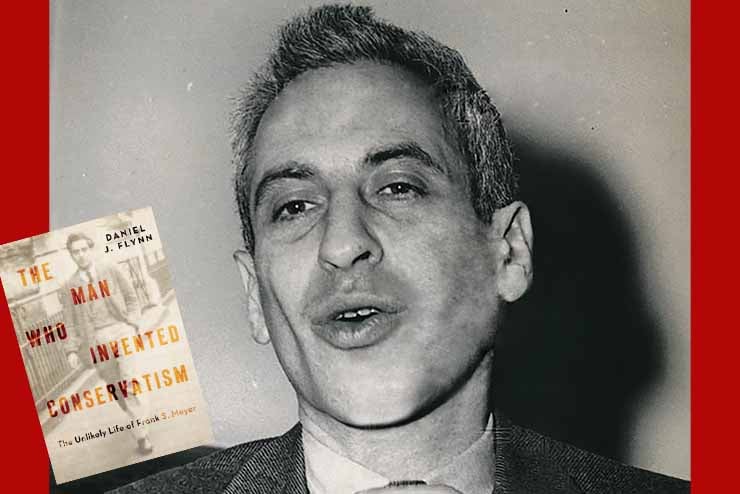
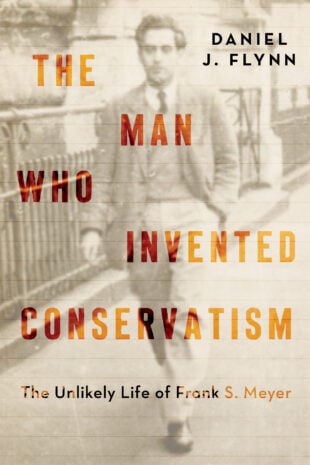
The Man Who Invented Conservatism: The Unlikely Life of Frank S. Meyer
by Daniel J. Flynn
Encounter Books
562 pp., $41.99
If Frank Meyer did not invent conservatism, he certainly built the infrastructure for the movement that came to bear that name. With newly unearthed research, Daniel J. Flynn convincingly argues that Meyer was even more central to building American conservatism than previously understood.
For decades after his death, it appeared Meyer had preserved few personal records for posterity. Undeterred, Flynn contacted those who had long ago purchased and then resold Meyer’s house. He discovered they had moved Meyer’s belongings into a warehouse. Searching more than 600 storage boxes, Flynn discovered 15 that contained Meyer’s private papers, including “tens of thousands of letters.” Stretching across seven decades, this correspondence included many missives from key figures in the American conservative movement. It provided a treasure trove for Flynn, as it will for future scholars.
Born in 1909, Meyer grew up in a prosperous Jewish family in Newark. His grandparents were merchants, and his father owned a factory. Never wanting for money, the Meyers were pillars of the local Reform Jewish community. An energetic and intelligent boy, Meyer attended private school, then set his heart on attending Princeton. He obtained admission only after overcoming the resistance of officials who disliked Jewish students. But Meyer never fit in, and poor grades forced him to withdraw after two years. Subsidized by family funds, he then traveled to England, hired a personal tutor, gained admission to Balliol College in Oxford, and graduated in 1932.
While working as a Communist Party organizer, Meyer entered graduate studies at the London School of Economics. Focused on building communism, he neglected his studies and flunked out. Meyer was an energetic and skilled organizer. He served, Flynn asserts, as the real founder of the Communist student movement in Britain. He established radical student groups, fomented protests, and piloted radical periodicals. Among the many wannabe radicals he mentored was the poet John Cornford. He also dated the daughter of Prime Minister Ramsay MacDonald, a romance that included at least one dalliance at 10 Downing Street.
Meyers’ communist activism caught up with him, however, and British security officials revoked his visa and deported him in 1934. Back in the United States, Meyer continued to apply himself as a Communist organizer. He enrolled in the University of Chicago but seldom attended class because of his organizing activities. In 1940, he married Radcliffe graduate and fellow Communist Elsie Bown one week after she divorced her previous husband. From 1938 to 1941, Meyer led the Chicago Workers School, imparting Marxist theory and Marxist history to a wide variety of students. He continued to build up the Communist Party of the United States, faithfully promoting the ever-changing Soviet line. Meyer was so important to the Party that, once war broke out, it refused to let him join the American military. Eager to fight fascism, Meyer continued to push until 1942, when Party leaders finally gave him permission to enlist.
Meyer’s Army life was brief—his physical shortcomings washed him out by 1943. But the experience changed Meyer. He came to know working-class Americans as flesh-and-blood people rather than as abstract targets of benevolence. Meyer’s newfound patriotism at first appeared consistent with Communist Party Leader Earl Browder’s wartime tactic of embracing American ideals—democracy and freedom—while downplaying class conflict. Meyer even praised Friedrich Hayek’s free market panegyric, The Road to Serfdom, in a book review for a communist journal in 1945.
Later that year, however, Moscow ordered that American communists return to promoting class struggle and denouncing capitalism. Browder silently accepted his own ouster and humiliation, but Meyer broke with the Party. Leadership commanded Elsie to divorce Frank, but she refused.
From 1947 well into the 1950s, Meyer repeatedly testified in numerous federal venues about his years as a Communist. He helped disrupt Communist subversion in America by naming those who had conspired with him. Meanwhile, he found work as a public speaker, book reviewer, and journalist. His conservatism tilted toward libertarianism, influenced by his close friendship with Rose Wilder Lane. Now convinced of the virtues of free market economics and individual liberty, he became an in-demand conservative pundit. After his political about-face, Meyer lived rather reclusively in Woodstock, New York, partly in fear of Communist reprisals. Among his interesting neighbors were his good friend, the classicist Eugene O’Neill, Jr., and the singer Bob Dylan.
On the original staff of National Review at its 1955 founding, Meyer edited the book review section and continued working at the magazine until shortly before his death in 1972. Conducting most business over the phone, he seldom went to the office, racking up huge long-distance bills. Elsie helped with his editing. The Meyers homeschooled their two sons, both of whom became chess champions and went on to successful careers. In April 1972, literally on his deathbed, Frank Meyer converted to Catholicism.
As appropriate for a biography, Flynn tells this tale chronologically. Weaving Meyer’s personal experiences in and out with his professional and intellectual activities, Flynn skillfully portrays the whole fabric of his subject’s life. For students of history, however, details of Meyer’s political writing and organizing will provide the chief interest in Flynn’s book. Meyer’s regular National Review column on political philosophy, “Principles and Heresies,” and his stewardship of the magazine’s books section gave him a solid public platform to expound his views.
Meyer’s libertarianism irked Russell Kirk and other conservative traditionalists. But he also “valued talent over purity.” Hoping to make National Review a must-read for the politically engaged, Meyer opened up the book review section to many shades of thought. His own eccentricities did him little harm at a magazine full of eccentrics.
Meyer failed to halt the increasing dominance at National Review of another former Communist, James Burnham. Burnham favored a more popular, less philosophical approach, and had the full confidence of Editor-in-Chief William F. Buckley. Over time, Burnham pushed out contrary voices. Frank Meyer remained, but when he died, so did the magazine’s regular column on political philosophy.
The title Flynn gives his subject, The Man Who Invented Conservatism, itself makes a major point. If Meyer earned it, he did so as more than a columnist. His chief claim to fame has long been as the father of “fusionism.” At National Review and in his best book, In Defense of Freedom, Meyer promoted a conservatism based on a “three-legged stool”: small-government libertarianism, social conservatism, and anti-communism. Together, these forces would comprise a movement stable and large enough to defeat the regnant forces of liberalism. In March 1981, Ronald Reagan himself, two months into his presidency, publicly credited the long-dead Meyer for creating “the synthesis” which comprised “modern conservatism.”
Going beyond the standard understanding of Meyer, Flynn provides an astute new analysis of fusionism. He demonstrates that its roots lie in “Browderism,” the communist tactic of marrying Marxist principles to American ideals. In a similar way, Meyer would later seek to merge conservative principles with lived American experience. His fusionism, that is, did not simply mix a bit of libertarianism here with a dash of traditionalism there. Rather, Meyer argued that (at least before the New Deal), the triad of traditional morality, love of freedom, and opposition to overweening government comprised the modus operandi of American politics. Fusionism was no mere strategic makeshift. It was really conservative in the sense of conserving a long-standing tradition.
Flynn also shows that Meyer brought more to the conservative table than ideas about fusionism. He knew how to build political organizations. Once erected, these organizations would facilitate the triumph of conservative ideas in the real world. Meyer was not really a party man. He went all in for Barry Goldwater in 1964 but otherwise stayed aloof from politicians. Instead, he built up conservative infrastructure, serving as a founder and key leader of the Young Americans for Freedom, the American Conservative Union, and the Philadelphia Society. Such organizations blazed a trail for Reagan.
One wishes Flynn had spent more time on Meyer’s earliest years. Readers are left wondering why Meyer so eagerly embraced communism. Did a spiritual void exist in his family? Did such a void, as with Whittaker Chambers, make Meyer a restless seeker? Flynn doesn’t say.
Specialists will disagree here and there with Flynn’s judgments, as when he links Willmoore Kendall to Francoist conservatism. And, like many biographers, Flynn is not immune from a tendency to inflate the importance of his subject. Ultimately, one must doubt that Frank Meyer literally invented American conservatism. However, Flynn makes thoroughly documented, cogent arguments to demonstrate Meyer’s importance to fusionism. The focus on his organizing activities and the nod to Reagan at the end might lead one to think Meyer invented “Conservatism Inc.” rather than real conservatism. But, knowing Meyer better after reading this excellent biography, one suspects he would have maintained a critical posture toward any government, whatever its purported principles.
Leave a Reply