Allies at War: How the Struggles Between the Allied Powers Shaped the War and the World
by Tim Bouverie
Penguin Random House
672 pp., $38.00
This huge account of relations between the Allies from 1939 to 1945 is an extremely well-written, well-researched work, from which even World War II historians can learn a good deal. It is rare to encounter someone as skilled as Bouverie in explaining complex developments in such a brief, comprehensible manner, with convincing judgments of men and situations, from the tangled story of Anglo-French relations to the Greek Civil War, the struggle for Yugoslavia, and the British relationship with India.
This is not an exercise of uncritical nostalgia for a clean-cut struggle between good and evil; nor is it one long bleat about the moral faults of the Allied countries, to name two of the ways in which it has been popular in recent decades to mangle the story of World War II. It is a coldly realistic picture of an alliance formed, not out of foresight, as a grand crusade, or anti-Fascist zeal, but by the actions of Adolf Hitler. The Allied leaders were not godlike figures. While rightly treated as heroes, neither Churchill nor Roosevelt was flawless—Bouverie may even be slightly unfair to Roosevelt—while Stalin was a tyrannical murderer on a gigantic scale.
It is often forgotten that the original Allied front was composed not of the three powers that won the war, but of Britain and France. Allies at War recounts how the British and French stumbled from estrangement in the 1920s to appeasement, feeble alliance, and defeat in 1940, then to actually fighting each other during the collaborationist Vichy regime from 1940 to 1942, before finally returning to alliance. There are some surprises here. It is fascinating to learn that the idea of Anglo-French political union was not a last-minute British improvisation to prevent the French from making an armistice with Germany, but a project formulated in early 1940.
Bouverie makes a good case for the policy followed by the British toward the Vichy regime, and, particularly, the attack on the French fleet at Oran in July 1940, an action widely applauded at the time but later bitterly criticized. His account is critical—rightly—of the very different policy toward Vichy followed by the Americans. The British were generally hostile toward the Vichy government, backing the Free French leader de Gaulle; the Americans recognized Vichy and tried to encourage its weak efforts to resist German demands, while staying away from de Gaulle.
To be sure, de Gaulle does not come off well. He was appallingly rude, abrasively nasty, and sometimes downright stupid in his relations with the British. The dislike and distrust of de Gaulle that developed among the Anglo-Americans is perhaps a bit more understandable than is usually allowed, though it is hard to defend the crazed hostility toward the French leader into which the American government descended from 1942 to 1944.
Bouverie is less convincing in his account of relations between the British and Americans, at least before Pearl Harbor. He probably exaggerates antagonisms on both sides of the Atlantic, somewhat overestimating the extent of Anglophobia among Americans and dislike of Americans among the British. He seems to waver between portraying the latter as typical of the British elite and suggesting that it was shared by the general population.
The tenor and extent of the mutual hostility between Americans and British were quite different. Public opinion polls from the 1930s indicate that Britain was the most popular European country among Americans, though an Anglophobic minority existed. The rabid hatred of this minority had no counterpart among the British; while at least some of the British elite had little respect for Americans, they did not seem to have hated them or wished them harm. By and large, the frictions that developed during the war, when a large number of Americans arrived in Britain, seem to have subsided later on.
Bouverie, rather hastily but accurately, deals with American relations with Britain from the destroyers-for-bases deal through the fight over Lend-Lease in early 1941. Like many authors, he gets into a silly argument over whether the British or Americans got the better of the destroyers deal, in which the U.S. traded 50 Navy destroyers for rights to build bases on British possessions in the Caribbean and on Newfoundland. Technically, it may be true that the bases were “worth” more than the old destroyers, but the deal benefited both countries.
Bouverie’s estimate of Roosevelt’s long-range intentions, and his actions from the spring of 1941, seems more dubious. Following the line taken by David Reynolds’ well-known book, The Creation of the Anglo-American Alliance, he thinks that Roosevelt, unlike his cabinet, never intended to go beyond “all-out aid short of war,” or at most a limited naval war in the Atlantic. To the contrary, FDR’s writings show that as early as June 1940, he described a probable scenario at the end of that year that assumed the United States would be fully in the war. And his actions from the spring of 1941 on—occupying Iceland and escorting convoys across the Atlantic—were bound to lead to all-out war eventually. In fact, the American military estimated that Hitler would react to the Iceland move by declaring war.
Bouverie even suggests that Roosevelt did not wish to go to war with Germany at all. And the United States might have stayed out of the European war had Hitler not declared war on the U.S. on Dec. 11, 1941. He notes that Roosevelt did not mention Germany in his “Day of Infamy” speech. But FDR’s “omission” was probably his focus on the immediate issue of Japan’s attack on Pearl Harbor. His radio address to the nation the next day was clearly designed to prepare the public for war against the European Axis and Japan.
Less defensibly, perhaps, Bouverie repeats the idea, common in the 1970s and 1980s, that Roosevelt did not intend an all-out embargo on oil shipments to Japan in July 1941, and that went into operation only on the initiative of Dean Acheson. Waldo Heinrichs and others refuted this idea long ago.
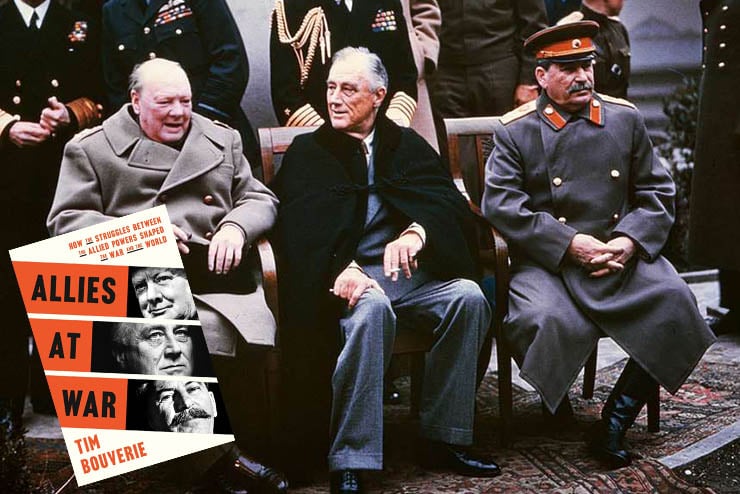
Bouverie is at his best in handling the relations between the Western powers and the Soviets. He does somewhat exaggerate Roosevelt’s delusions about the USSR, but correctly notes that they were sometimes shared by Churchill. Churchill imagined, after his meeting with Stalin in 1944, that he had established a friendship with the Soviet ruler, and he was just as overly optimistic as Roosevelt right after the Yalta conference. In Tehran in 1943, both Western leaders had truckled to Stalin in a rather sickening way, though Roosevelt’s behavior was worse. Bouverie does seem reticent about accepting that Roosevelt’s ideas ever really changed. While neither Western leader behaved as he should have, and Churchill was well ahead of Roosevelt in seeing reality, there is good reason to think that Roosevelt had growing misgivings by the fall of 1944, and his hopes largely collapsed as it became clear that Stalin was violating the Yalta agreements.
There were, to put it mildly, strong indications earlier that there was no hope whatsoever for friendly dealings with the Soviets. As Bouverie makes clear, relations with them were never really good, not even in the darkest days of the war. One might expect that Stalin would have at least pretended to be nice when the defeat of the USSR was a possibility. This was not the case; relations were rocky from the start. After the Moscow conference of October 1943, relations were better—if only superficially—than before or after. But that may be at least partly because Stalin had become better at manipulating his Western partners. Relations soured again after the summer of 1944, when Soviet aims became more obvious, most clearly in Poland.
Earlier, Stalin was often difficult to deal with and downright nasty, even when the USSR’s position was desperate in 1941 and 1942. He could easily have turned Churchill and Roosevelt into outright enemies, had they not avoided taking it personally. Churchill was not alone in being angry with Stalin during that period. Roosevelt once responded to one of Stalin’s insulting messages by remarking that the Soviets did not use language the way we do. That was not a compliment. Later, he spoke to his confidante, Margaret Suckley, of his anger at Stalin.
Bouverie does make one rare error in the Soviets’ favor, suggesting that in 1942, Roosevelt falsely promised Soviet Foreign Minister Vyacheslav Molotov a “second front” (that is, an invasion of Western Europe). However, Roosevelt made it reasonably clear that he alone could not guarantee one. The British correctly estimated that, unless Germany suddenly collapsed—which nobody expected—such an attack was doomed to fail. Moreover, Molotov told the writer Feliks Chuev that he did not take the promise seriously. Perhaps it should be said that Roosevelt and Churchill did mislead Stalin to believe, until the last possible minute in 1943, that an invasion would take place that year. Given Stalin’s veiled threats that he might make a separate peace with Germany, they can hardly be blamed for doing so.
Could the Western Allies have restrained the Soviets? Bouverie is skeptical but thinks the Western powers should have made aid to the Soviets conditional on respecting the rights of Poland and the Baltic states. Nevertheless, he points out that it would have entailed greater costs for the Western allies by reducing the Soviet war effort and increasing the risk of Stalin making a separate peace with the Nazis.
Two other points, not made by Bouverie, rendered such a course not very promising. Most obviously, there is no reason to think that the Soviets would not have violated pledges to the Baltics, just as they violated practically every other pledge until very late in the Cold War. Moreover, any quarrel with the Soviets that became public was bound to encourage people on the Axis side—both leaders and led—to grasp at the hope that the “unnatural” Allied coalition was bound to collapse.
Leave a Reply