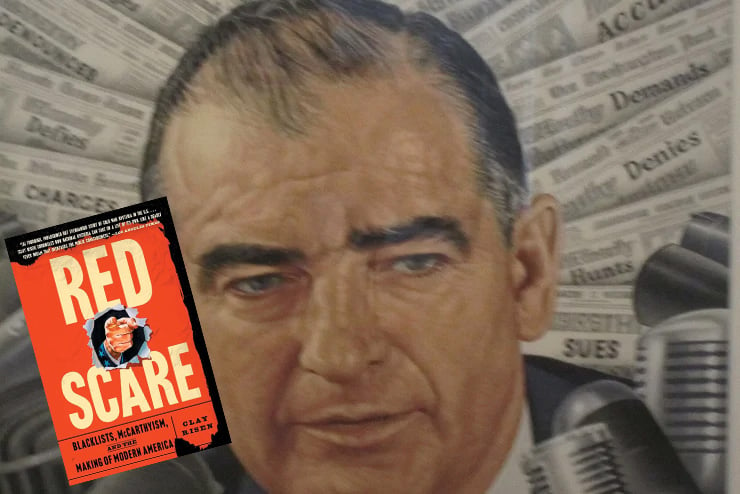

Red Scare: Blacklists, McCarthyism, and the Making of Modern America
by Clay Risen
Scribner
480 pp., $21.00
There are many bad books about the McCarthy Era, now often called the “second Red Scare,” despite the enormous differences between 1919–21 and the period between the late 1940s and early ’50s. Quite a few have been worse than Clay Risen’s new book, Red Scare. But not much worse.
If Risen managed to dig up anything new, it was not noticeable. Mainly, he adds an exaggerated gravitas to the antics of the “Hollywood Ten” producers, directors, and screenwriters who were singled out by the House Un-American Activities Committee. Risen is obsessed with projecting current politics and cultural manias onto the politics of the past. He concedes that “McCarthyism” and the John Birch Society are not exactly the same as “Trumpism,” but they all are linked—at least in his mind.
Red Scare is basically a modernized version of the big legend of McCarthyism, shared by most liberals with the far left, that it was all some giant threat to civil liberties. A more accurate picture is illustrated by the wisecrack that it was intellectuals shouting from the rooftops about the loss of freedom of speech in America. There was, of course, a real downside to the era—though it gets less attention than the sufferings of Hollywood scriptwriters. Quite a few loyal federal government employees were fired between 1952-54 by panicky bureaucrats egged on by stupid politicians. But even that was not quite as serious as were the intrusions on civil liberties by the Wilson administration or the roundup of West Coast Japanese-Americans in 1942.
Along with the giant legend, Risen also peddles some lesser ones, notably that the “purge” of “China experts” from the State Department amounted to a disaster that, perhaps, led to Vietnam. There are, as usual, problems with this. The “experts” reported accurately enough on the fatal weaknesses of China’s Nationalist government but generally failed to provide a realistic picture of its Communist successors and what they were likely to do. None seem to have been Soviet agents, as was once widely claimed, though one or two behaved in such a way that it is not surprising they aroused suspicion.
Risen concedes that Communist infiltration of the U.S. government was once a real problem, and does not generally endorse the “revisionist” position on the Cold War (the idea that the Soviets were not fundamentally aggressive and that the United States was mainly or totally responsible for that conflict). But his occasional references to the larger issues of the struggle are often quite peculiar, for example, his claim that Stalin’s aim in East Central Europe was just to gain “buffer states.” We are told that China intervened in the Korean War because Mao had “good reason” to fear the American forces in North Korea would invade China.
Risen also claims that the Roosevelt administration was always complaisant about internal security matters and even permissive about Soviet espionage. In fact, right up to the Nazi attack on the USSR, the FBI caught Soviet spies in the U.S., including the biggest fish of the time, Gaik Ovakimian. Just before the German-Soviet war, the U.S. government expelled Soviet air attachés for espionage. After the Soviets were forced onto the Allied side, they were allowed to return, and later infiltration into wartime agencies was slightly treated. J. Edgar Hoover showed little interest in the matter, as the FBI spyhunter Robert Lamphere ruefully recounted in his memoir, The FBI-KGB War. Risen omits the fact, wryly noted by George F. Kennan in his memoirs, that Soviet infiltration was most extensive in operations headed by Republicans—the OSS and the occupation headquarters in Japan.
Nor does Risen note the point—often made by indignant liberals in the 1950s—that a substantial number of McCarthy supporters (they sometimes pretended it was mostof them) were not serious enemies of Communism, but rather diehard isolationists opposed to containment, the Marshall Plan, NATO, intervention in the Korean War, and every other serious measure to block the Soviets. Joseph P. Kennedy, the father of JFK, was an unusually nauseating specimen of this type, suggesting in 1950 that the whole Eastern Hemisphere should be abandoned to the tender mercies of the Soviets. Risen also ignores the interesting fact that, strange as it may sound, there were liberal and democratic socialist supporters of Joe McCarthy, primarily among those associated with the New Leader magazine. Although they soon dropped McCarthy due to his reckless rhetoric, they were so distrustful of Secretary of State Dean Acheson and the State Department that they were persuaded, at first, by McCarthy’s earliest charges. Risen also ignores the liberals who had no use for McCarthy but did not rate him as much of a threat, while conservative Southern Democrats were generally tough opponents of McCarthy.
Such things are just too much for Risen. The truth that the Red Scare was just a partly justified, if often exaggerated, reaction to the Cold War does not fit in with his ideological fixation. He is obsessed with hyping up the Red Scare as part of a hideous, culturally conservative, right-wing reaction to the New Deal that threatened to submerge all that was good.
Part of Risen’s skewed viewpoint is a very strange picture of the Depression Era, during which we are told the United States became more egalitarian, diverse, and tolerant. Whatever truth there may be in this, Risen feels compelled to invent evidence—notably discovering that women gained in employment when, in reality, the proportion of women working outside the home stalled during the 1930s. He sees liberals (he usually prefers to use “progressives”)as part of a great coalition, which despite differences agreed on the big things: racial and sexual equality, labor rights, fighting fascism, and defending the New Deal.
As William Leuchtenburg, the ablest liberal historian of the New Deal era observed, one of the distinctive characteristics of the 1930s reformers was their near-total concentration on economic issues, not goading people into a revolution of traditional beliefs or personal conduct. The alleged alliance was loose at best and split by angry feuds, notably between the AFL and CIO unions. Older liberals, like John Dewey and Oswald Garrison Villard were, and usually remained, strongly anti-Communist (it was younger ones who were dupes), while some liberals, notably many associated with liberal magazines like the New Republic, were rather critical of the New Deal, as were Communists up to 1935 and again after Stalin’s 1939 deal with Hitler. Most liberals blathered against fascism in the abstract, but were isolationists, bitterly critical of Roosevelt’s efforts to build up the armed forces.
Some of Risen’s remarks suggest that he thinks the Communists were paladins of integration and the gravitation of some figures, like Paul Robeson, toward them was natural. Communists ranted against racism, but their policy was “autonomy for the Black Belt”—the strip of counties in the Deep South where blacks outnumbered whites. Since most blacks were not thrilled about being fobbed off on that part of the country, few followed Robeson’s example.
Risen paints an even weirder portrait of postwar America, one in which the satanic forces of right-wing reaction used the Cold War, and the Korean War, in particular, to wage a culture war—an effort to recreate a mythic older America characterized by racism, hostility to unions, and objections to the change in the role of women. He sees America’s religious revival, which had begun during World War II, as part of this reaction.
Curiously, Risen contradicts his absurd picture of a terrifying wave of demonic reaction threatening to submerge everything good and decent. He admits that “most of America by 1953,” including Republican president Dwight Eisenhower, had come to accept the tenets of the New Deal—Eisenhower even expanded New Deal programs, such as Social Security. American society had become more tolerant in the 1940s and ’50s than during the Depression. White opinion of blacks sharply improved in the ’50s—much in contrast, by the way, to the late 1960s. At most, American electoral politics briefly swung slightly to the right, with Republicans controlling Congress only in 1947–48, and again in 1953–54. In each case, they promptly lost it. And, it should be noted, not one Republican nominee for the presidency, from 1936 until 1964, represented the right-wing of the GOP.
Except for a short period in 1954, McCarthy and his cause were never truly popular. He was able to profit, for a time, from the general belief of Americans that senators and government officials might know what they were talking about, an illusion no longer too common.
Polls showed consistently that most people rightly regarded Communism a foreign and defense issue, domestic Communism being at most a secondary aspect of the larger problem. McCarthy and his imitators were regularly damned by the prestige press. And the practice of blacklisting was not an answer to popular demand. It was hidden as long as possible, until it was exposed by the journalist John Cogley.
Risen’s presentist obsessions lead him to neglect some of the most sensational episodes of the era—notably the claim, which caused a short-lived furor in 1953, that security precautions in the nuclear energy program were so bad that Soviet agents had stolen enough fissionable material to build up to 20 atomic bombs, which might be hidden in American cities waiting to be detonated!
What’s overlooked in this book and by most people is the similarity of the “Red Scare” to the craze during World War II over the supposed German “fifth column” traitors within Allied countries. This led to great anxiety, wasted energy, and the evasion of responsibility by fools in high places. Almost all of the reports of “fifth column” attacks proved either false, wildly exaggerated, or due not to treason but to German special operations soldiers wearing Allied uniforms.
Leave a Reply