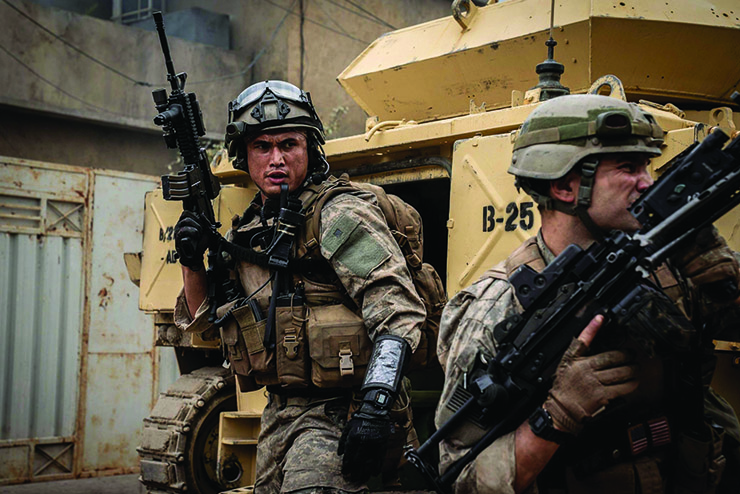
Directed and written by Ray Mendoza and Alex Garland ◆ Produced by DNA Films ◆ Distributed by A24
“This film uses only their memories,” announces a title card preceding Ray Mendoza’s and Alex Garland’s searingly realistic 95-minute depiction of live combat during the Iraq War. Their new film follows Navy SEAL platoon Alpha One, a unit of SEAL Team 5, which deployed on Nov. 19, 2006, to provide cover for U.S. Marines operating in Ramadi, the capital of Iraq’s Anbar province. Their engagement followed an eight-month battle for control of that strategically important city in the fighting that preceded the 2007 “surge,” which temporarily stabilized core areas of the country.
Mendoza, who also co-wrote the film’s script with Garland, was the platoon’s Joint Terminal Attack Controller (JTAC), a communications specialist whose role was to coordinate air support for localized ground operations. In the film, he is played by a rising Canadian actor called D’Pharaoh Woon-A-Tai, who is of Guyanese, German, and Oji-Cree Native American heritage. The remaining actors are mostly British performers in their twenties, who were small children when the events depicted in the film took place. They deliver their lines in expertly crafted American accents, with cadences that account for regional and ethnic inflections and the “bro tones” heard among young military personnel.
Among the handful of American actors in what is essentially an ensemble piece, the most notable include Michael Gandolfini, son of the late James Gandolfini, who played Tony Soprano on HBO’s iconic mafia series The Sopranos (Michael also played a youthful version of his father’s character in the Sopranos 2021 prequel film The Many Saints of Newark).
The arc of the film follows what appears to start off as a fairly standard military operation. Guided by highly sophisticated digital intelligence, the platoon occupies a residential building before dawn to obtain a tactical overview of an important neighborhood and its inhabitants. The building is home to two intergenerational Iraqi families, whom the platoon’s interpreters are tasked with sequestering in a ground-floor bedroom. The other soldiers occupy the upper floor and establish a sniper post, manned by Mendoza’s best friend, Elliott Miller. Miller is played by the English actor Cosmo Jarvis, who has already worked with Garland in science fiction films.
As day breaks, the unit must remain in position unnoticed as the Arab street below awakens. The urgency of the film’s first few minutes contrasts with scenes showing the surprising amount of boredom and inaction that veterans often recount when reflecting on their time in military service. Surveilling the neighborhood takes hours of silent patience and requires breaks to stretch, refocus, attend to nature’s call, and find diversion in banter.
When action finally comes, it is loud and devastating. After the insurgents announce a public call to arms over a loudspeaker, we learn that the SEAL platoon was compromised the whole time. A grenade flies through the window and turns the habitation into a hellhole of smoke and dust.
The grenade wounds Miller, whose sniper duties exposed him most directly to the blast. The platoon calls in Bradley Fighting Vehicles to evacuate him. Exploding claymore mines to create a protective smoke screen outside the house, the unit tries to reach the vehicles, only to walk into a massive blast from an improvised explosive device. The carefully laid trap kills one of the translators and severely wounds Miller and another member of the platoon. The injured men are hastily brought back inside under small arms fire, where their gory wounds must be treated in the confusion of the continuing battle.
The unit calls out for help, but the Bradleys are gone, and further enemy action delays ground relief. All the men can do is call for a fighter jet to sweep close to the street, using the plane’s sonic boom to disrupt enemy action. Eventually, the communications personnel reestablish contact with headquarters, which tells them they are awaiting higher authorization before sending relief. Faced with an impossible situation, they impersonate the headquarters officer in charge to order the evacuation, allowing the beleaguered men to escape their mini-siege in a new fleet of armored vehicles. The bewildered Iraqi civilians emerge to find the insurgents milling about with no American opponents left to target as they take stock of the scene of destruction.
Mendoza is no stranger to either military service or the film industry. After 16 years in active service and a subsequent training role with the SEALs, he became a technical advisor for choreographed combat scenes in film, TV, and video games. Last year, Mendoza worked with Garland on combat scenes in Civil War, Garland’s intriguing feature film about photojournalists traveling from New York to Washington during a hypothetical civil conflict set in a dystopian near future.
As was the case in that film, Warfare gives us rather minimal information about the larger conflict or the reasons behind it. There is no editorializing, no politics, no stilted dialogue about the nature of the Iraq War, no searching inquiry into why the servicemen are really there. Mendoza and Garland even eschewed background music, lest it imbue scenes with sympathies or antipathies that could give a political coloration to what processes across the screen. Plenty of films about the “forever wars” in Iraq and Afghanistan have done precisely that, and it is very hard to find a recent film about World War II or any film about the Vietnam War that avoids the imposition of directorial vision and related ideological tendencies.
As a genre film, Warfare explores a much more visceral dimension. “I want to convey accurately what we all went through,” Mendoza said in a recent interview. “This is just one event of thousands. What I would want civilians to take away from this is to understand when people say, ‘Thank you for your service,’ like, do they really know what they’re thanking us for—the sacrifice and what that means? What are you sacrificing?” “And for me,” he added, “it’s sacrificing your youth. You’re forced to grow up really fast.”
Mendoza and Garland capture this sentiment effectively in Warfare’s first scene, when the platoon gathers to watch a music video featuring pretty girls in skimpy outfits, a communal act of jocular masculinity and a pre-operational ritual. The SEALs’ adolescent reactions rise in pitch, revealing that these young men in their early twenties are still going through pangs of adolescence even as they are dispatched into combat.
Indeed, the film’s realism is so jarring as to seem ruthless in its portrayal. Guts spill out and are placed back in again. A severed leg lies forlornly on the street. Despite being arguably the most arduously trained servicemen in the world, injured SEALs still wail in pain, freeze in psychological fear, lose resolve, suffer mind-numbing effects that appear to slow down time itself, and fight to overcome human foibles that no amount of military training can erase. In this, Warfare may well be the most authentic recreation of combat experience since Steven Spielberg’s Saving Private Ryan (1998). A crucial difference between the two is that Spielberg’s film is heavily fictionalized, while Mendoza and Garland limited their source material to the testimony of the SEALs who were there, and then spliced those accounts together to make an authentic recreation of events, much in the way that a detective might recreate a crime scene to uncover the truth. In addition to their American English phonetics lessons, the actors also underwent simulated military training to approximate the extremely demanding requirements placed on real-life SEALs.
Even at nearly 20 years’ remove, the process of creating the film was difficult. Mendoza has recounted that discussing his combat experiences with Garland in their collaborative process felt more like a therapy session, and sometimes more. That is a clear tribute to Garland’s perceptiveness and high degree of emotional intelligence. Miller, who was on the set during filming but had no conscious memory of his rescue after he was wounded by the grenade, at least once had to withdraw from the process due to the post-traumatic stress of reliving moments of mortal danger.
Although I never served in uniform, I have been under live fire and can attest that merely watching the film in the comfort of a Manhattan cinema revived sensations and reactions I had not experienced since.
Mendoza told an interviewer he made Warfare “for veterans, to show that you’re not forgotten.” In the closing credits, we see warm interactions between the actors and some of the SEALs whom they portray, as well as photographs of the original servicemen alongside the actors’ photos. In some cases, however, the faces of the original SEALs are obscured, suggesting that they withheld permission to be identified. With the exceptions of Mendoza and Miller, in any case, the rest of the platoon are identified pseudonymously. While some of those veterans may prefer to forget and move on, the psychological wounds of Iraq and Afghanistan are still very much
with us.
Leave a Reply