Never before has there been so much talk of internationalism; yet, simultaneously, never before has the provincialism of human culture been so visible, precisely because the obligation to be worldly reigns supreme.
Calls for diversity in American literary programs continue to grow, but rarely are students provided knowledge of diversities outside of the Anglosphere. Consumption of East Asian pop culture grows in the West, from Japanese anime to Korean drama, but rare are the Westerners who endeavor to read classical Chinese poetry and admire Japanese theater. People from all around the world talk to one another, hate one another, and fall in love with one another… but almost always in the watered-down American English that has become the middlebrow medium of serious discussion.
In short, there is only the grand illusion of an authentic globalism, and those who truly express diversity remain few and far between. And when we speak of true diversity of thought and creative expression, we would be remiss to think that an understanding of contemporary trends alone suffices for cultivated worldliness. We must understand the roots of humanity if we are to fully admire its myriad branches. And if an artist is to undertake the task of being worldly, then it stands to reason he must be a synthesizer, one who does not simply paint ephemeral surfaces with a broad brush, but who firstly understands the seeds of culture he takes into his hands and plants within his own garden of expression.
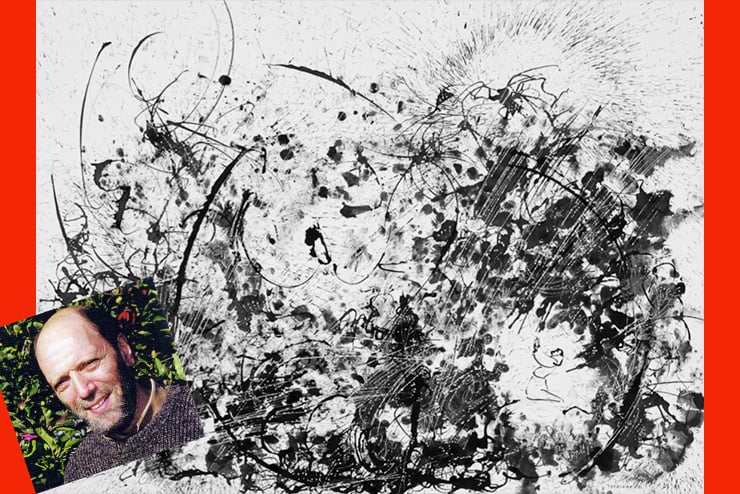
My friend and colleague Leon Steinmetz is one of the few artists today who seems to achieve the almost unthinkable conjunction of the classical and the contemporary. His art is spiritual and full of transcendent feeling. And yet, simultaneously, he paints with an awareness of contemporary sensibilities that is far more subtle and profound than that displayed on gallery walls today.
Steinmetz’s art is truly an art of the world. He was born in Siberia to an Austrian father and Russian mother. He spent his childhood and youth in Moscow, where he was captivated by an array of literary and artistic masters, from Pierre Corneille to El Greco, from Pushkin to Rembrandt, from Thomas Mann to Jean-Antoine Watteau, from Pasternak to Michelangelo.
He received classical instruction in drawing and painting, moved abroad to Italy, England, and America, and began his career as a fine artist, as a writer of essays and stories, and as a professor of European and Russian literature. His art spread from country to country, from the permanent collections of the Metropolitan in New York to the Albertina in Vienna, from the British Museum in London to the Dresden Gallery in Germany, as well as the Pushkin Museum in Moscow, where he had two solo shows. Along the way, the American poets Richard Wilbur and H.A. Crosby Forbes lauded Steinmetz as both an heir to the Old Masters and a visionary of an abstract universe all his own.
And yet, Steinmetz’s name does not carry the same celebrity as some of his peers, particularly among younger generations in the West. One may be quick to cite an indifference to great traditions as the cause, but to contemplate these works as homages to past heroes is to miss what is supremely contemporary in both Steinmetz and his many inspirations.
Never content with a single binding medium or artistic idea, Steinmetz is, above all, a creator of varied visions that he expresses in his diverse series of drawings and paintings, some of abstract images, some of hallucinatory romantic landscapes, still others of expressionistic portraits. As such, there seems to me to be no single Steinmetz masterpiece, nor a single series that best embodies his career. His persona is a puzzle we assemble from the fragmentary musings of his mind. Only through seeing all his series placed beside one another, from the still life of a withering pineapple titled Memento Mori, to his hallucinatory drawings of Gogol’s fiction, do we see the whole man and his unique vision. It’s a vision that is equal parts comic and tragic, classical and modern, traditional and abstract.
In his depiction of Salome frenziedly dancing before Herod’s lustful gaze, which must surely rank among his creative heights, one sees the Spanish grotesque reimagined in abstract spirals and waves, as if bubbles and wild webs of black were rippling across a void of white; the feeling is of the ephemeral musicality so valued by romantics merging seamlessly with the solid storytelling of classicism. One sees the black bloodthirst in Salome’s eyes, the sickly eroticism of her dance, the cacophonous horror so much closer to our times than the pretty sunlit portraits of Renoir or the hotels of Henri Matisse.
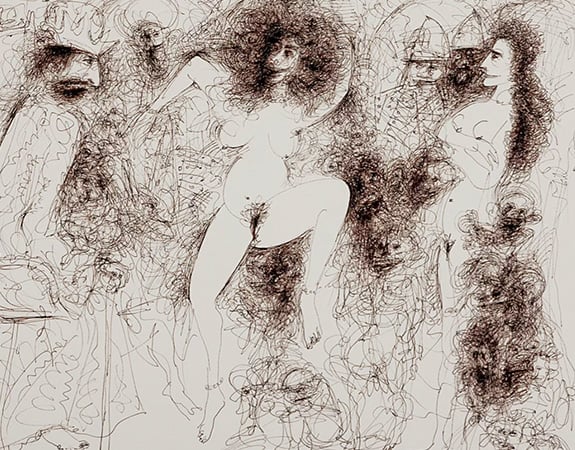
Long have Western romantics shied away from biblical, Greek, and Roman scenes, whether out of fear of invalidating their individuality by a necessary compromise of style or of avoiding the more abstract images of the interior. Yet, Steinmetz shows the interior in the exterior, and the present in the eternal; it is precisely his stylistic modernity that renews the grotesque dance of Salome, bringing this famed story into modernity as both Gustave Moreau and Franz von Stuck failed to do.
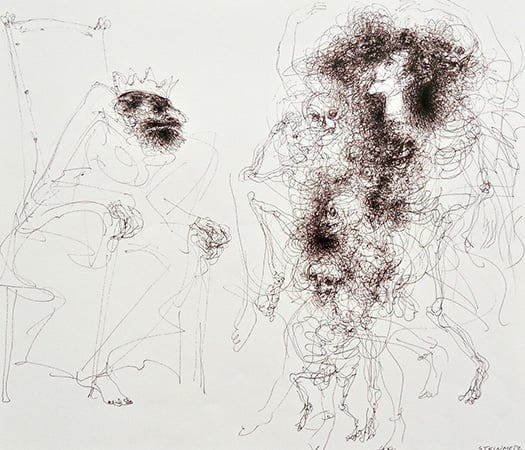
But this ode to Goya’s war prints and black paintings, as well as the mythological engravings of Pablo Picasso’s Vollard Suite, does not reflect the imagery of his entire oeuvre.
Some of his art reaches into the deeply personal, whether in frenzied abstraction or expressionist portraiture. In the case of the latter, several series catch my eye, namely The House of Sorrow, The Haunted, and Their Majesties and Their Dwarves. Notice the old man from the first series, whose deep, wrinkled sockets seem not to contain eyeballs, but two miniscule abysses that stare into the woman before him, compared to the gentle, hallucinatory swirls of colored light in the third drawing, which frame a face as softly drawn and clear as an ukiyo-e print of Utamaro. Such a range of expression seems to me the gauge of a portraitist’s power, and one would have good reason to rank these with the great achievements of small-scale portraiture in the 20th century, namely those of Wyndham Lewis and Giacometti.
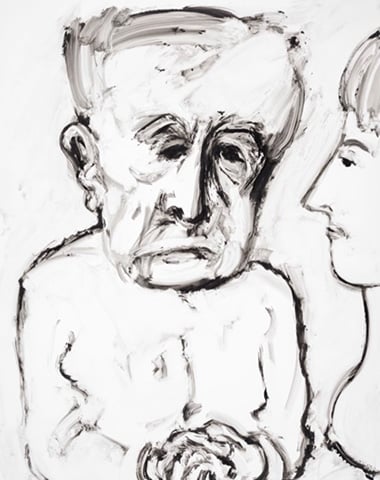
Steinmetz does not limit his subjects, nor his degrees of abstraction. One can say of many artists “they are a master of the portrait,” or “they are an excellent realist in the 19th-century vein,” and easily place them amongst the ranks of other artists who aspired to the same goals, imitated the same masters, and followed the same formulas to arrive at more or less the same conclusion. But Steinmetz has no such formal constants, and lets his art wander as naturally as his mind, recalling that bygone debate of nature and artistry that so gripped 19th-century critics. If so much art today relishes its own structured artifice, then it is he who stands boldly in the realm of nature, making the conjunction of black ink upon the paper as natural as the breeze blowing a lush array of flowers about.
Looking over these four hazy gems of modernism, I see a common stroke, a similar sense of unity to the composition, a touch that is unmistakably Leon Steinmetz’s. From his foggy Hades to the chaotic explosivity of The Temptation of Saint Anthony to the calligraphic anarchy of Gogol’s Diary of a Madman to the romantic blur of nature in his Imaginary Landscapes, I see the seemingly impossible synthesis of Chinese art and Western composition by way of abstract expressionism. It’s a style that has long fascinated him, particularly as practiced by Jackson Pollock.

But perhaps it is Steinmetz, more than the American abstractionists, who truly understands the dreamlike freedom of ink in Chinese art; he understands the Taoist emphasis on the blank void of rice paper, how the mountaintops and black calligraphic strokes and swaying trees must be like the ripples upon the ocean, which unifies all by dissolution rather than stability.
He has long ranked the Song Dynasty masters like Fan Kuan among the greatest of the landscape painters, alongside his beloved Claude Lorrain, Pieter Brueghel, and John Constable. One need only compare his depiction of Hades to the misty hilltops painted by Shi Tao, or his Diary of a Madman to the classics of calligraphy in the running cursive font, to see that abstraction is no modern revolt, but a traditional practice that must be used with as much painterly delicacy as classicism.
Perhaps the success of Steinmetz’s “Asian” technique comes from his lack of either condescension or fixation: he does not see the Chinese masters as distant artists of exotic subject matter, but as the equals of the Western masters. In a time when questions of appropriation are legion, perhaps it will be the works above that shall offer us a healthy understanding of intercultural synthesis.
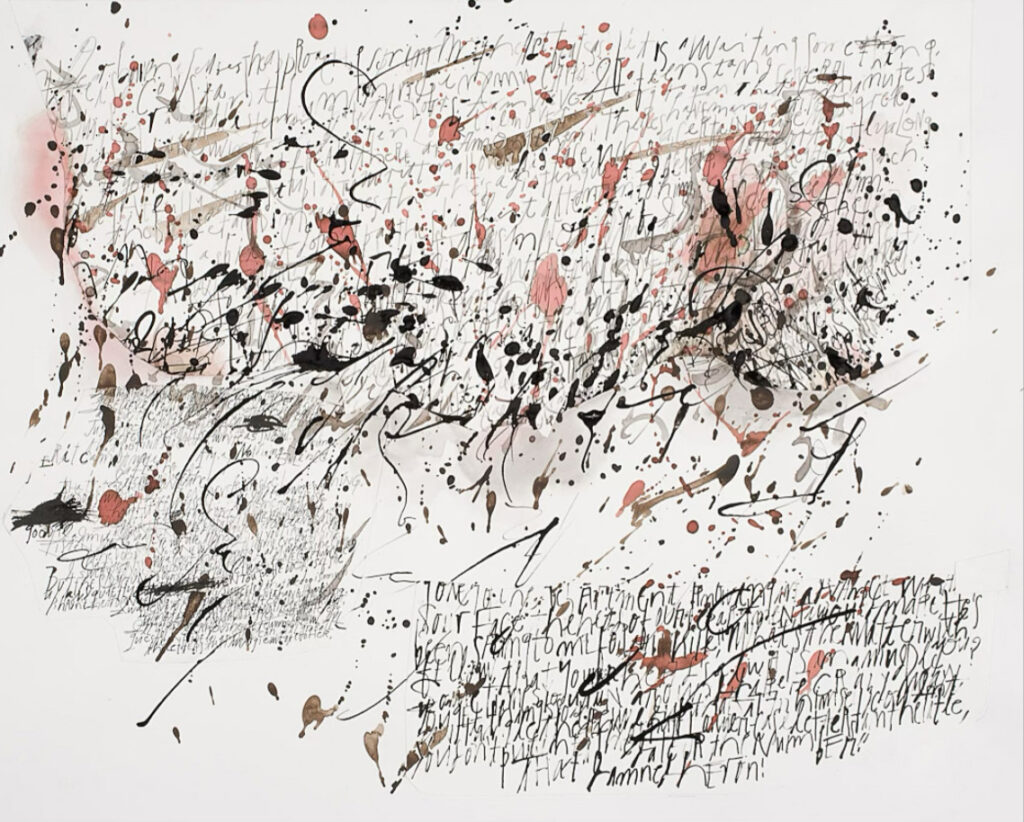
But more than simple aesthetic inspiration, Steinmetz’s art seems to me one of understanding: the desire to portray rather than to profess, to show rather than to lead. His biblical works depict his emotional reaction alone, as do the Taoist mountainscapes. His humanity is to be found in this encouragement to see as he saw, to feel as he felt, to be filled with childlike awe, as he is while swirling the tip of his brush across the page. The same goes for his adaptations of great works, whether Gogol’s Diary, his startlingly expressionistic etchings of Pierre Corneille’s Le Cid, or his sketches from Goethe’s Sorrows of Young Werther. In the latter, Steinmetz
attempts to depict the drawings that Goethe’s titular protagonist could have made; the lush landscapes melting in the light seem to me completely harmonious with the overflowing romanticism of Goethe’s original work.
I recall our last encounter, in the winter, at his house in Cambridge.
“It was built in the time of Pushkin,” he said to me with a soft smile on his lips, leading me inside. An austere photograph of Tolstoy greeted us atop his printer, and we sat down over the wide variety of sketches that he wanted to show me. Their ink rippled across the page like spume upon the shore, branching out into the white like black veins or bare branches against the empty sky.
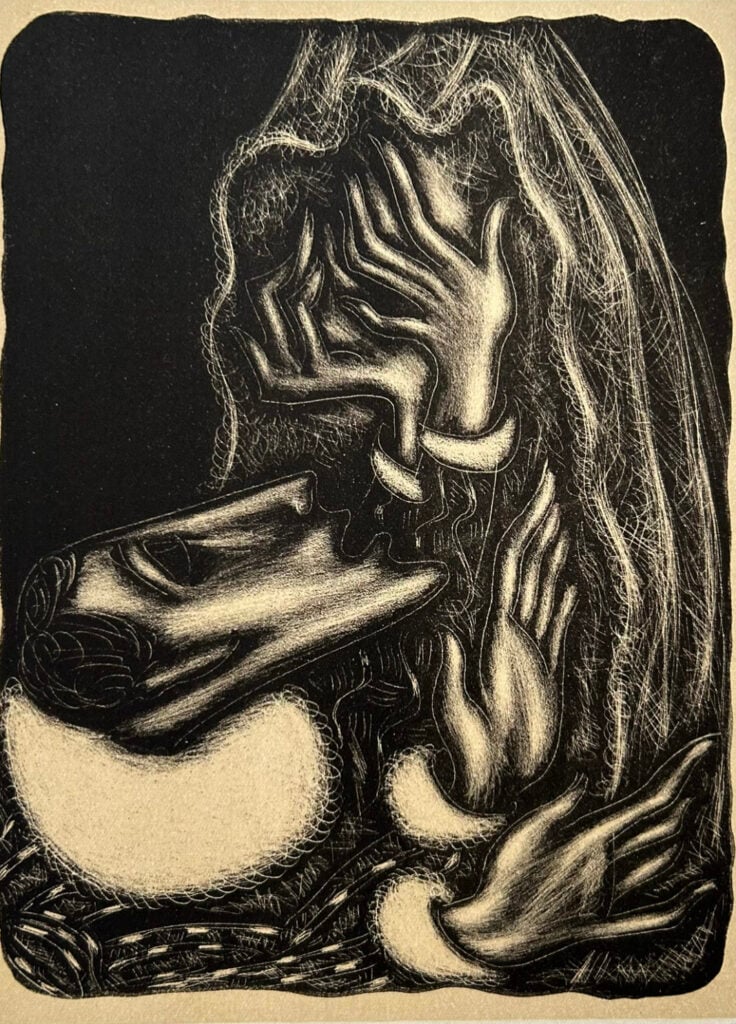
His beard is full of experience, and his heavy voice always sounds with authority on the arts. But in his eyes, I see the childlike wonderment embodied in his art—a kind of innocent tenderness flashes as they look upon the world with weariness and hope. One sees what he himself praises in Mozart, and scorns in Wagner: the former’s innocence, and the latter’s recalcitrant seriousness.
We are surrounded by Mughal miniatures and rice paper lamps, Rembrandt prints and Russian novels stacked beside the English classics he cherishes. I flip through them, trying and failing to sound out the Cyrillic letters.
“They are one’s true friends,” he said, and recalled Machiavelli’s remark, in a letter to Francesco Vettori, that after a day of dealing with the affairs of the world, one can retreat into one’s study and, through books,
enter the ancient courts of men of antiquity, where, welcomed lovingly by them, I feed on the food that is mine alone and for which I was born. There, I am not ashamed to speak with them and to ask them the reason for their actions; and they, out of their humanity, answer me.
We discussed Indonesian gamelan and the French Revolution, Chinese calligraphy and the dreamy theatre of the Spanish Golden Age… the entire universe, in short, sitting in our Windsor chairs and looking through his freeform drawings of Mephistopheles and Faust, his Basquiat-inspired depictions of Robespierre and Marie Antoinette, and his neoclassical drawings of Manon Lescaut, done with the same gentleness of a Modigliani, one of our youthful favorites.
“Most of what I do, I destroy,” he said, with equal parts severity and warmth in his voice.
I asked if what he is after is perfection, but perfection is not the ideal word for Steinmetz’s work: he is a spiritual seeker of the deeper, ethereal beauty in the world. It is the work that fails to graze this life-affirming sublimity that he always discards. He reaches into history, and across worlds, and salvages the vision that lets him see, and the technical mastery that lets him speak.
With the hour striking late, and pleased with the discussion, I departed down the stairwell, bade him goodbye, and set off homeward.
I sat at the back of the bus, smudging the befogged glass until I could make out the strip mall lights of suburban Massachusetts, all like little stars upon the black landscape of the earth, indistinguishable in its darkness from outer space. I felt myself floating, drifting along through the Hericlitean haze of life, this existence we are flung into, as Martin Heidegger says; this whole existence where the one goal seems always to be bound to something grander than what we presently have.
And I thought of Leon, how the two of us both exemplify the eternal wanderer, trekking from nation to nation, from culture to culture, from language to language… always full of childlike enthusiasm and austere wisdom, always ready to filter the good and block the bad, always adrift, and delighting not simply in the feeling of freedom, but the pleasure of the memories and ideas we are bound to by life experience.
Then, suddenly, the highway was empty of light, save the red and gold tail lights that flashed and faded ahead. The snow was falling faintly, and the clouds had cleared to showcase the perfect black of the sky, like obsidian or pearly India ink. How many similar lonely winter roads are there in Russia, how many friendships, how many discussions about the arts! But how rare are those who make something beautiful of themselves to leave behind. And I thought of his works, how the greatest are those that contains some aspect of the artist. How the artist feeds on the beauty of another mind, and then casts the seeds of his personal experience to the soil, almost blindly, in the hope they’ll sprout into a maze in which other minds can stroll, and become pleasurably lost.
Later, I scrolled through his online work. I thought of what it said, collectively, about Leon Steinmetz and his art, which stands in such contrast to works in which celebrity trumps individual achievement, where art is merely a platform for social climbing rather than unique expression with lasting value.
And then I saw: the common thread of this work is Steinmetz himself; Steinmetz the classicist who admires the austere, broken visages of Athenian marble. Steinmetz the European romantic, whose ethereal landscapes fade into the blank white sky like a fond daydream that vanishes to the approaching sound of a human voice. Steinmetz the American, who breaks the bounds of tradition so as to enliven it anew. Steinmetz the Russian, indebted to the spiritual depth of his native literature. Steinmetz the rationalist, who defies category and contemporary trend in pursuit of the transcendent truth.
The reader, the aesthete, the dreamer… the artist, in short, who by his art encapsulates every aspect of himself with creative resolve, turning all this into one abstract threading, into spirals and scratchings, in paint and graphite, in jet black ink and delirious letters toppling over one another in storms of Latin and Cyrilic, in soft hazes of colored chalk upon paper and in delicate delineations of an engraving needle, all made by the same hand across centuries and continents, languages and cultures. The result is not any nation or language in particular, but that of the lone individual who draws and dreams, the artist alone against all and yet accompanied by all those who came before and shall come after us in eras we shall not live. The face of solitary human resistance in the inhumanity of his times.
And so, perhaps, it is in Steinmetz’s myriad drawings that one sees a contemporary picture of what Yeats said of Shakespeare and Sophocles: that to create as they did, one must believe with every bit of one’s blood and nerve that man’s soul is immortal.
Leave a Reply