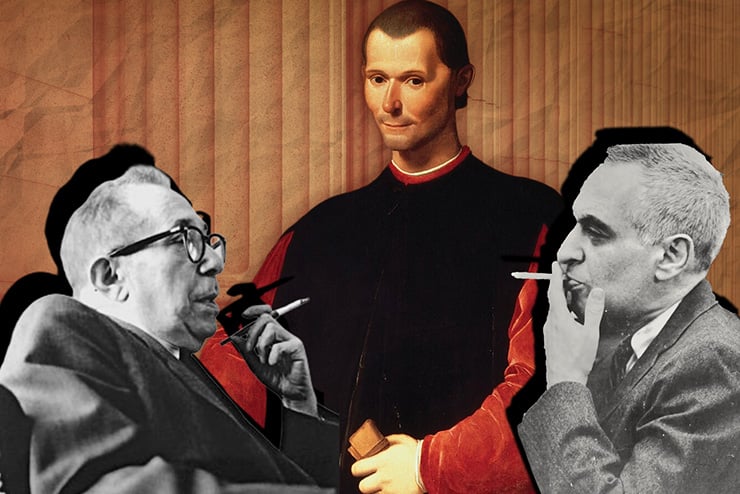
Newly discovered letters between Leo Strauss and the editors of National Review show the magazine’s staff divided over whether Machiavelli was essential to the study of politics or a source of moral corruption.
Leo Strauss received a letter in the fall of 1957 from Frank Meyer petitioning him to occasionally review books for him and, specifically, to review the new Yale University Press translation of Friedrich Meinecke’s Machiavellism: The Doctrine of Raison d’Etat and Its Place in Modern History.
Weeks earlier, National Review founding editor William F. Buckley Jr., following troubles with his co-founder, Willi Schlamm, had appointed Meyer as the magazine’s new literary editor. In an effort to elevate his section, Meyer reached out to a variety of talents. While Evelyn Waugh, W. H. Auden, Ezra Pound, and other established figures ultimately penned reviews for the magazine, Strauss declined the entreaty.
“I would love to do this but I am a very slow writer and I feel there would be a shocking disproportion between the effort I would invest in writing a review and the usefulness of the review for your readers,” the University of Chicago professor, in a letter revealed here for the first time, responded. “So, do not count on me but if I should come across a book which would interest me sufficiently, I shall venture to ask you if you would be interested in having it reviewed by me.”
Strauss never did come across that book. Meyer oversaw book criticism within National Review until his death in 1972. Strauss died the following year. Curiously, at no point did Strauss, considered one of the most important intellectuals of postwar American conservatism, write for the magazine most closely associated with postwar American conservatism.
This absence (save for a private missive refashioned as a letter to the editor) owed not to a lack of effort from Strauss’s fan club within National Review, comprised mainly of Willmoore Kendall and Frank Meyer. That fan club’s effort ended when the first charter member wore out his welcome within the magazine, and when the second’s intellectual infatuation with Strauss faded.
Before that happened, Strauss became, as letters found in an Altoona, Pennsylvania warehouse as part of research for my book The Man Who Invented Conservatism: The Unlikely Life of Frank S. Meyer demonstrate, the subject of a strange proxy battle within a larger war within National Review. And Niccolo Machiavelli became the even stranger tripwire.
As National Review’s “Books, Arts, & Manners” editor, moonlighting in his capacity as a reviewer of books and academic journals for the Volker Fund, Meyer flagged Strauss’s 1958 book Thoughts on Machiavelli as a study of great significance.
Meyer lamented in a report to the Volker Fund that learned men had begun to embrace Machiavelli, even as history rightly regarded him as “a symbol of political devilry.” Machiavelli’s nefarious influence went beyond ends-justify-the-means ethics. In his book, Strauss identified Machiavelli as the “fountainhead” of politics studied as a science rather than “as an aspect of moral philosophy,” Meyer wrote in his report.
Machiavelli was, in other words, a progenitor of relativism, and Strauss stood athwart that mindset. Meyer advised that Strauss’s “book should be distributed and read as widely as possible in academic circles” because of its rare ability to “clarify the confusion and confute the political error that permeates the study of the history of political theory and the study of political theory itself.”
Meyer did not praise the books he reviewed for the libertarian-oriented foundation in a perfunctory manner. That the Volker reviews played to an in-house audience ensured no-consequences honesty. Emphasis on value to scholars meant a favoritism for more serious releases. His report to the philanthropy described Thoughts on Machiavelli as possibly Strauss’s most important work.
In terms of National Review senior editors serving as boosters for Strauss, Meyer acted as the junior partner.
“I am reviewing Strauss on Machiavelli for the Philosophical Review,” Willmoore Kendall wrote his friend in Woodstock, New York, in 1958. “Do hope you are not going to pass it up in NR. It is an extremely important book.”
That letter arrived in late 1958, and in another, sent in 1960, Kendall attempted to recruit Meyer to work in what he hoped to become “one of the commanding departments in the country” at a school—the University of Dallas—whose existence he had only recently realized. “You and one good Strauss product would be a splendid nucleus about which to build such a department,” he wrote.
That same year, Kendall told Meyer of his hopes to finish “an article on Strauss’s Machiavelli, over which I have done a simply frightful lot of work (it is an extremely difficult book).” While the Catholic convert, who lived mostly in Madrid since 1959, complained the following year of 10 full days exerted on a review of Arthur Whitaker’s Spain and Defense of the West, Kendall spent exponentially more time dickering with editors and ruminating over his review of Strauss’s book.
In 1961, the year Strauss and Meyer finally met, National Review published an article, “The Kernel of Machiavelli,” that clashed with the University of Chicago professor’s view, so highly praised by his cheerleaders within the magazine.
In that article, Giuseppe Prezzolini argued not only that those operating in politics would be wise to heed Machiavelli’s counsel, but that Winston Churchill, Abraham Lincoln, and so many other revered leaders had already done so, even if their admirers refuse to admit it. He described “evil” as “a necessary and inescapable factor in political life” that often produces good. Meyer seized on an editorial comment that approvingly noted Prezzolini’s “exasperation” with “ignorant references to Machiavelli” within the political climate.
Four days prior to the date on the cover, the article left the normally positive pen pal Rose Wilder Lane wondering how Meyer could stand to work for the magazine. “I cannot bear this,” she wrote of the embrace of Machiavelli. “I cannot.”
Meyer sounded an alarm heard all the way in Spain. From El Escorial, L. Brent Bozell acknowledged “the Machiavelli abomination” in a letter to Meyer, but regarded the magazine as otherwise “saying pretty much what you and I want.” In other words, his advice was to not obsess over one errant article when scores pass muster.
Frank Meyer and Willmoore Kendall did, however, fixate on that one errant article.
“Are you pissed off as I am about the Prezzolini article on Machiavelli in the issue of April 8?” Meyer wrote Kendall. “Apart from its content, which I think is the worst thing ideologically NR has ever run, the editor’s note was a direct slap in the face to any of us—Leo Strauss in particular—who, to paraphrase Strauss, accept the old-fashioned belief that ‘Machiavelli was a teacher of evil.’”
In essentially rewriting the Bozell letter to Kendall, Meyer received a very different response.
“Yup, I am too pissed off about the Prezzolini article to let myself talk about it,” Kendall responded from Madrid in trademark green ink. “You do not have to educate Strauss of the fact that NR is not exactly run by his admirers there. Things have come up repeatedly in my correspondence with him.”
Kendall generally did not copy originals of his letters, and Strauss did not meticulously retain his correspondence. So, what came up repeatedly, beyond the letters published in Willmoore Kendall: Maverick of American Conservatives, remains lost to history. The Prezzolini piece does not arise in the Kendall-Strauss correspondence published in that book’s addendum.
The article nevertheless acted as one of many battles in the protracted war between the Meyerite faction of the magazine and the devotees of Senior Editor James Burnham (whose conservatism, his in-house critics lamented, started at the water’s edge). These preexisting dynamics help explain the unusually heated response to this one article.
While Meyer controlled his back-of-the-magazine “Books, Arts & Manners” fiefdom, he exerted little say, beyond his presence on the editorial board, on what articles ran in the rest of the magazine. And Kendall, particularly after his move to Spain in 1959, had decreased as a figure of importance within National Review despite retaining his “senior
editor” title.
The title of Meyer’s NR column, “Principles & Heresies,” distilled his preoccupations to its base elements. Burnham appeared, particularly to his adversaries, concerned with not principles but power. This, at least according to Meyer, made him a Machiavellian. So did, according to Meyer, Burnham’s cold and even condescending behavior toward his colleagues, which engendered resentment from fellow senior editors Suzanne La Follette, Willi Schlamm, William Rickenbacker, and, at times, L. Brent Bozell (the first two, with Burnham’s nudging, had left the magazine). Burnham’s 1943 book, The Machiavellians: Defenders of Freedom, advertised his view in its very title. With much circumstantial evidence, Meyer wrote Kendall: “I am sure Jim sold Bill [Buckley] on the article.”
He informed Strauss that he intended to take the unusual step, though not unprecedented for Meyer, of writing a letter to the editor of the very magazine for which he served as an editor. This, he told Kendall, “should keep [Strauss] from taking too great offense.”
Correspondence shows Meyer and Kendall, not Strauss, taking great offense. In the same note that Strauss described himself as “very anxious” to read Meyer’s letter to the editor, he petitions him to send back issues and a form to renew his subscription. Meyer and Kendall took offense on Strauss’s behalf to an article that Strauss had not read until after Meyer called it to his attention. Strauss’s stated desire to renew his subscription to a magazine in which the reverse became such a running joke that its editor later titled a book Cancel Your Own Goddamn Subscription indicates he did not share their outrage.
In his unconventional letter to the editor, Meyer took “sharpest exception” to the Prezzolini article. He advised that “we should, with Professor Leo Strauss in his masterly Thoughts on Machiavelli, profess ourselves inclined to the old-fashioned and simple opinion that Machiavelli was a ‘teacher of evil.’” The article and Meyer’s note catalyzed an inordinate number of letters from well-known readers of the magazine and friends of Meyer, to include two noteworthy figures in the publishing industry, Henry Regnery (pro-Prezzolini) and Neil McCaffrey (anti-Prezzolini), and Ideas Have Consequences author Richard Weaver (who offered measured criticism of Prezzolini). It caused a fuss.
When Kendall began reviewing Thoughts on Machiavelli, he was teaching political science at Yale. By the time the review appeared in print, his career journey had already taken him to Los Angeles State, Georgetown, and the University of Dallas. He had won annulments of his first two marriages, prepared for a third marriage, returned to America, resigned from National Review in Kendallian fashion, and alienated nearly all of his friends and several members of his immediate family.
By late 1965, Kendall and Meyer barely communicated. The previous 10 years witnessed occasional shared holidays and roughly a thousand extant letters passed between the pair. But by the mid-1960s, Kendall, in passive-aggressive fashion, communicated to yet another estranged friend through that man’s wife. “My present picture of him,” he wrote to Elsie Meyer of her husband, “is that of an unjust man who does not even pay me the courtesy of wishing to appear just in my eyes.”
The deterioration of Kendall’s relationship with Meyer coincided with the cooling of Meyer’s Straussian captivation. In 1961, Meyer told Strauss that he valued his judgment above that of all other living philosophers. A year later, he confessed to finding Strauss’s Natural Right and History both “useful and irritating.” A decade after that, when an acolyte of Eric Voegelin described two hectoring “ideological Straussians” driving him from the University of Dallas, an unsurprised Meyer responded to the academic, “Incidentally, I am on your side of the theoretical differences.”
A rare example of direct correspondence between Kendall and Meyer in the former’s last years indicated not merely the personal gap between the men but also hinted that Meyer’s intellectual infatuation with Strauss had ended.
“You cannot Strauss me,” Meyer wrote Kendall regarding their myriad disputes. “Everything I say is written in the clear light of day.”
Whereas Meyer gently ridiculed the notion of obscured messages central to Strauss’s Persecution and the Art of Writing, Kendall incorporated such an approach in textual analysis. In 1966, about eight years after he had started reviewing Thoughts on Machiavelli, the finished product in The Philosophical Review confirmed this late-in-life metamorphosis.
Therein, Kendall presented Machiavelli as a “puzzle” that awaits “deciphering.” He insisted that the Italian, “imitating a well-known device of classical writers, situates the important in the center.” Calling Strauss a “decipherer of cyphers,” he depicted him as uniquely qualified to ferret out his subject’s “secret writing.”
This aspect of Strauss that turned Meyer off turned Kendall on. The tone of the review, like Kendall’s extant letters to Strauss, went beyond reverential to sycophantic, an unusual stance for one so cartoonishly argumentative. Strauss, otherwise generally pleased, confessed to Kendall that a portion of his article made him blush. Kendall, by this final stage of his life, became so all-in on between-the-lines readings of texts that he opined in the review, “The Strauss revolution in the interpretation of modern political philosophy is the [most] decisive development in modern political philosophy since Machiavelli himself.”
Kendall’s Straussian reorientation over his last decade alienated longtime admirers without winning many new friends. Indiana University political scientist Byrum Carter, in an oral history transcript found in Kendall’s papers at the Hoover Institution, judged that Kendall had “let Leo Strauss influence him too much,” in that Strauss had upended Kendall’s initially correct view of John Locke. Strauss disciple Harry Jaffa affixed a neo-Confederate label on Kendall, who rejected Jaffa’s projection of modern equality fixations onto the American Founding.
Because he saw the virtues of Strauss’s interpretations, Kendall had placed himself further outside of the political science mainstream. Yet he also found himself outside of the Strauss clique because he did not study under him. In the end, Kendall characteristically stood contra mundum.
Leave a Reply