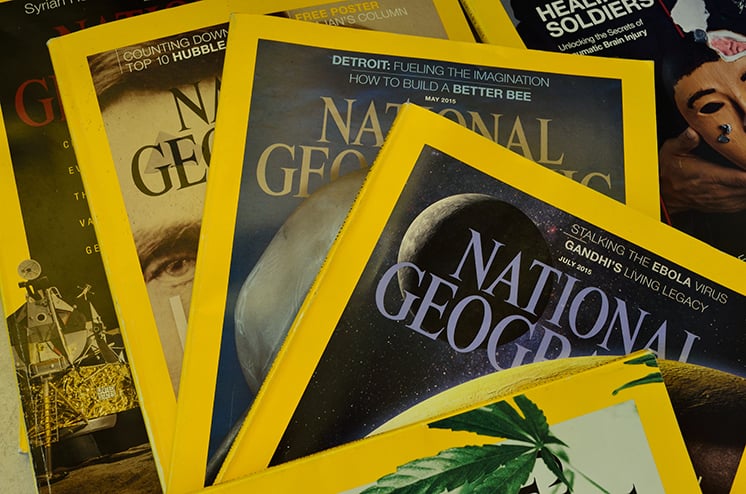
On June 1, the National Geographic Society is opening a new, stunning, multimillion dollar museum. According to its promotional material, the 2026 debut of NatGeo’s “Museum of Exploration,” will feature
a state-of-the-art pavilion entrance, auditorium, iconic photo gallery, exhibition space, immersive walk-through attraction, retail, food and beverage, education center, archives, tours, and exciting new event space. The capstone of the renovation is a one-of-a-kind nighttime experience in the courtyard.
The new museum opens just as the National Geographic Society appears to be reclaiming the grand legacy it lost over several decades in the jungle of wokeness. The spiral has been particularly difficult for me to watch because my father was a writer and editor at National Geographic for the better part of 30 years, from the early 1960s to 1990. This storied organization that was so much a part of my early life and education devolved into a habit of promoting pseudoscience, anti-white racism, and transgenderism. If the new museum, and some recent issues of the magazine, are any indication, National Geographic may be on the path to getting its mojo back.
First, however, a quick journey through NatGeo’s descent into liberal madness. In 2017, the magazine ran a special issue on “The Gender Revolution,” which became the basis for a documentary hosted by left-wing dingbat and TV personality Katie Couric. The magazine issue itself featured a “girl” on the cover—that is to say, a confused and exploited boy—and the section titled “Helping Families Talk about Gender” offered this: “Understand that gender identity and sexual orientation cannot be changed, but the way people identify their gender identity and sexual orientation may change over time as they discover more about themselves.”
As Andrew T. Walker and Denny Burke wrote of it in Public Discourse,
the first half of this sentence asserts the immutability of gender identity, but the second half of the sentence claims that people’s self-awareness of such things can change over time. But is there not a contradiction here once we define our terms? Gender identity is not an objective category but a subjective one. It is how one perceives his or her own sense of maleness or femaleness….If that perception is fixed and immutable (as the first half of the sentence asserts), then it is incoherent to say that one’s self-perception can change over time (as the second half of the sentence asserts).
Another article offers a full-page picture of a shirtless 17-year-old girl who recently underwent a double mastectomy in order to “transition” to being a boy. Walker and Burke ask this probing question that gets to the heart of the matter: “Why do transgender ideologues consider it harmful to attempt to change such a child’s mind but consider it progress to display her bare, mutilated chest for a cover story?”
National Geographic received significant blowback for the issue, prompting a defense from Editor Susan Goldberg. A key paragraph:
We realized several years ago that beliefs about gender were shifting rapidly and radically. For almost 130 years, National Geographic has explored the world through science, exploration, and storytelling. Gender permeates every part of what it means to be human, and reporting on the changing understandings of a biological and social concept is, put simply, what we do. Our coverage doesn’t come with a political or partisan agenda. We created the gender issue—as we do every issue—with the intent to research, understand, and explain.
So gender is not a reality but “a biological and social concept.” Goldberg also equivocated about hormone blockers, which have since been proven to be dangerous.
As part of the magazine’s April 2018 edition, “The Race Issue,” Goldberg offered this headline: “For Decades, Our Coverage Was Racist. To Rise Above Our Past, We Must Acknowledge It.”
Goldberg hired John Edwin Mason, a scholar at the University of Virginia, to dig through the archives to find evidence of white supremacy. Interviewed by Vox, Mason announced that National Geographic “was born at the height of so-called ‘scientific’ racism and imperialism—including American imperialism. This culture of white supremacy shaped the outlook of the magazine’s editors, writers, and photographers, who were always white and almost always men.” Responding to a 2018 cover featuring a cowboy on horseback, Mason argued that “the image of the white cowboy reproduces and romanticizes the mythic iconography of settler colonialism and white supremacy.”
Finally, there was the NatGeo cable channel’s hagiographic documentary Fauci, which was designed to give the impression that the proper response to the disgraced COVID monster Anthony Fauci is unfiltered praise, devoid of any research.
A lot of the problems with NatGeo during this time most likely stemmed from its editor-in-chief, Susan Goldberg. Goldberg left a job at Bloomberg News for National Geographic in 2014, where she stayed until she was replaced in 2022 by current editor Nathan Lump.
In preparation for the reopening of the new museum, I purchased three recent issues of National Geographic. I was pleasantly surprised. The March 2026 issue features stories about the resurrection of the traditional Scottish language; an archaeological dig to find the remains of ancient Vikings; jazz cafes in Japan where vinyl listening is popular; and a photo essay on “the kaleidoscopic beauty of swamps.” The April issue features a cover story on a newly discovered shipwreck from the Byzantine Empire; a story on the introduction of modernist architecture into national parks; and a story on a stunning new dinosaur museum in Abu Dhabi. February’s National Geographic featured a cover story on non-alcoholic beer (I’m a fan); a wonderful piece on the popularity of country music in Brazil; and an exploration with wolf hunters in Kazakhstan.
These are the kinds of interesting stories my father used to write. Joe Judge wrote articles on Ireland, Williamsburg, Alaska, Disney World, Boston, New Orleans, Florence, Ireland, South Africa, Australia, and many other places. He also pushed for contemporary stories that were relevant and interesting. Wikipedia is right in noting that “during his tenure as Senior Associate Editor (1980–1990), Judge was noted for taking on controversial topics, including disputes about the discovery of America and the discovery of the North Pole. Under his leadership, the magazine also made efforts to attract a younger and more urbanized audience.”
My father and his colleague, Editor Wilbur E. Garrett, had become the two top dogs at the magazine in 1980. According to the book Explorer’s House: National Geographic and the World It Made, the editors “prodded the magazine to new levels of achievement. Garrett’s magazine shone with clear design, thoughtful charts and artwork, detailed articles and timely maps, and documentary photography of surpassing quality.”
Circulation increased to over 12 million. My father had been pushing for years to do more relevant stories—not advocacy journalism, just articles that engaged with grittier subjects like women in Saudi Arabia, the rise of democracy in Guatemala, life in Harlem, life in the Vatican, and elephant poaching. These stories didn’t replace more traditional stories about animals, nature, science, and the human body, but added to them. I still remember the afternoon in 1985 when I walked into my father’s office and saw the cover shot for a future issue thumbtacked to a board—the “Afghan Girl” photo, which would become one of the most famous photographs in publishing history.
Still, opposed to Garrett and Judge was Gil Grosvenor, who had been editor of National Geographic from 1970 to 1980 before becoming president of the organization. Tensions between Grosvenor, Garrett, and my father came to a head in 1990, when Grosvenor fired Garrett and my dad. The press depicted Grosvenor as the villain (accurately, in my view), a man who refused to acknowledge that the world had changed and that NatGeo could cover the new without losing the old. Circulation dropped. In 2026, it sits at roughly 1.4 million. Of course, much of the drop was due to the digital revolution and the new ubiquity of phones and photography. But clearly, first the resistance to change and then the desperate clinging to wokeness didn’t help.
Had he lived to see it, my father would have been embarrassed by NatGeo’s descent into madness over the last decade. At long last, however, the magazine may be returning to what he did best—and what readers want. If the recent issues of the magazine and the inspiring new museum are any indication, classic National Geographic may be making a comeback.
Leave a Reply