A contradiction at the heart of modern Western politics reveals the intellectual bankruptcy of the woke intersectional left. This contradiction is not subtle, far from deniable, and by no means harmless. It exposes a growing threat to the very idea of a truly Western civilization.
The same voices that erupt in outrage at the mere hint of Christian influence in public life now show remarkable comfort with the growing and public integration of Islamic identity, rhetoric, and even policy into governance.
This is not tolerance. It is selective enforcement for political gain, dressed up as virtue.
Consider the public branding of cities like New York and London as models of diversity and inclusion. These cities are praised for being wide open and resiliently tolerant toward LGBTQ+ people. Meanwhile, these same places have political leaders who openly center their Muslim identity in governance.
That contradiction is not accidental. It is the product of a worldview that seeks to change Western societies by hook or by crook.
In London, Mayor Sadiq Khan has explicitly framed housing policy to highlight the needs of Muslims, emphasizing proximity to mosques, access to halal food, and religious community life. On its face, that may sound like responsiveness to constituents. In practice, it signals something else: the enshrinement of Islamic identity politics in a government that claims to be secular.
That normalization does not occur when Christianity is involved. When Christian communities advocate for faith-based considerations, they are accused of imposing theocracy.
Khan’s administration has also supported expanded security funding and training specifically for mosques, aligning with a national scheme worth up to £29.4 million (roughly $40 million). Protecting citizens from violence is a legitimate function of government. But security is not the issue. The issue is the precedent.
When faith-specific prioritization becomes embedded in governance for one religion while others are pushed out of public life entirely, the principle of neutrality collapses.
The pattern continues in the handling of sensitive criminal issues.
Critics, including members of Parliament and investigative reporters, have accused Khan of downplaying stories of rape gangs to avoid offending Muslim communities. Woke leadership, in other words, is willing to temper law enforcement in light of Islamic sensitivities. That is not public safety. That is leading lambs to their slaughter.
Symbolism matters as well.
Large-scale Islamic prayers in iconic public spaces, such as Trafalgar Square, have been embraced by London politicians as signs of inclusion. Supporters celebrate diversity, equity, and inclusion. Critics rightly see something else: the redefinition of civic spaces as explicitly Islamic. When similar displays would provoke outrage if they were Christian, the double standard becomes impossible to ignore.
Across the Atlantic, the same dynamic is unfolding.
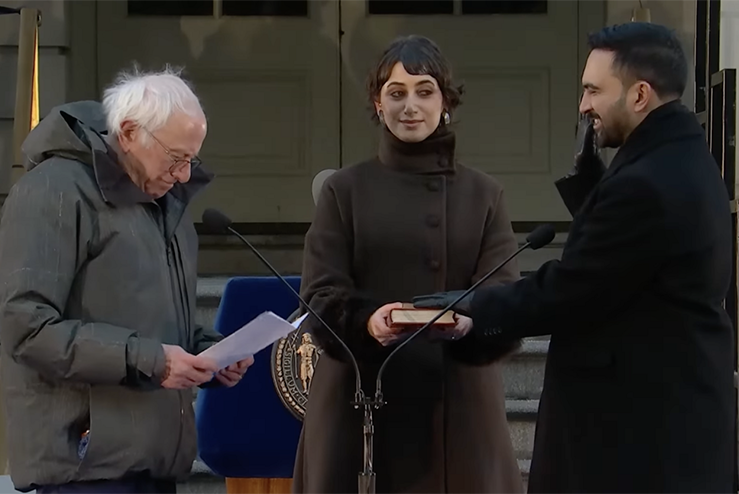
In New York City, Mayor Zohran Mamdani has leaned openly into his Muslim identity as a defining feature of his political persona, framing his leadership through a religious lens. His campaign saw a reported 60 percent surge in Muslim and South Asian voter turnout, driven in part by messaging that connected public policy to Islamic values. Housing, transit, and childcare were not just civic issues. They were presented as “Muslim issues.”
This is a profound shift. It moves religion from the private sphere into the organizing framework of public policy.
Mamdani has even invoked the Islamic concept of Hijrah (“migration”) when discussing his support for mass immigration and sanctuary city policies, drawing direct parallels to the life of the Prophet Muhammad. That is not mere cultural expression. It is theology embedded in public policy.
The alliances surrounding this movement are equally telling.
Mamdani’s associations with figures like Imam Siraj Wahhaj and organizations such as the Muslim Democratic Club position Islamic identity as political capital. His strong alignment with pro-Palestinian activism and the Boycott, Divestment, Sanctions movement reflects a broader “Red-Green” coalition, where leftist ideology merges with Muslim identity politics—or even outright Islamism.
This coalition is not accidental. It is just as intentional as it is ideological.
The term “regressive left,” popularized by the former Islamist Maajid Nawaz, describes a movement that abandons its alleged universal liberal values for identity-based, bloc-power politics. Figures like Bill Maher and Sam Harris have convincingly argued that this mindset defends illiberal practices, yet precious few lefty politicians, public intellectuals, or activists seem to care.
When associated with minority groups, especially Muslims, the purportedly tolerant left embraces behavior that it otherwise deplores. If similar behavior was perpetrated by white Christians, it would be opposed with howls, boycotts, and, in all likelihood, violence.
At the core of woke dogma is intersectionality, a framework that ranks groups by perceived oppression.
Christianity, as the historically dominant Western theology, is cast as a rival source of power, which makes it inherently “oppressive.” Therefore, it is a target for dismantling or subversion. On the other hand, Islam is exalted as an “oppressed” identity and granted deference. Muslims are not simply left alone to engage with their faith but are aggressively used as a bulwark against Western traditionalism.
This is why Christian expressions in public life are labeled as dangerous, while comparable Islamic expressions are celebrated as inclusive.
Mass immigration, academic radicalization, and social media amplification are accelerating this trend. A horrifyingly viable coalition has been formed. It prioritizes raw, destructive, third-world power over time-honored, productive, Western principles. This is a serious problem that is not going away. The West is now facing a test
Leave a Reply