“Until you start holding these judges accountable, they are going to continue to find ways to benefit the criminal element,” Florida Governor Ron DeSantis said last week at a press conference in Tampa, addressing his “friends” in his state’s House of Representatives.
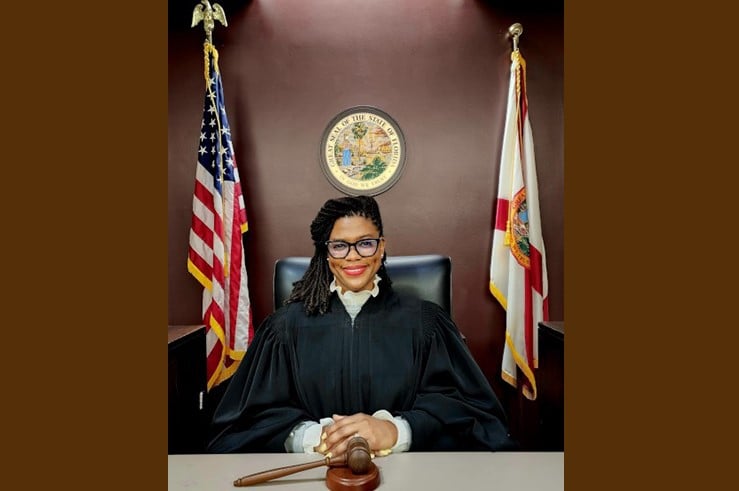
One of the judges in question is the Honorable Tiffany Baker-Carper, who in 2020 was elected to serve in the State of Florida’s Second Judicial Circuit, the youngest woman and African-American ever to be elected to a judgeship there. At issue is the tragic fate of Melissa Mogle, a five-year old girl known as “Missy,” who in May 2025 allegedly was beaten and smothered to death by her stepfather, Daniel Spencer, and mother, Chloe Spencer. Investigators found considerable evidence of long-term child abuse.
Less than five weeks before, Judge Baker-Carper denied a state attorney’s motion to incarcerate Daniel Spencer immediately upon his April 2025 conviction for a separate crime, in which a police sting had apprehended him traveling to meet a minor for sex. Baker-Carper, whose official website says “she strives to change the perspective in the courtroom by treating everyone with dignity and respect,” apparently reasoned that Spencer, who had been free on bond with no violations since his arrest for that sex crime and had no violent criminal history, would not pose a threat if he stayed out of jail pending sentencing.
Wow, was she wrong! The case, which DeSantis called “an outrage” and “such an easy call,” set off a state legislative initiative, known as Missy’s Law, to remove judicial discretion in such cases and require the immediate imprisonment of all criminals convicted of serious crimes pending sentencing. Missy’s Law sailed through both houses of Florida’s state legislature earlier this year. DeSantis signed it into law at last week’s press conference. The Spencers are awaiting trial for first-degree murder, aggravated child abuse, and other charges. The prosecutors in that case are seeking the death penalty for both defendants.
The corrective action taken by Florida’s legislature was not enough for DeSantis, however, who added “I don’t think what you have done is enough.” Building on his laudable eight-year legacy of using state power to enforce law-and-order principles, he reminded the state legislators “you have the power, and you have sufficient numbers in your chamber, to impeach this judge.”
The same day, Florida Attorney General James Uthmeier sent a letter to Florida House Speaker Daniel Perez demanding Baker-Carper’s impeachment for “misdemeanor in office,” which under Florida law “may include any act involving moral turpitude which is contrary to justice, honesty, principles or good morals.” Releasing a convicted sex offender whose home environment included a small child who was then brutally murdered arguably rises to such an offense.
Uthmeier’s previous missives have included warnings to local government officials across the state, including just last month Tampa’s Democrat mayor Jane Castor, informing them that they would face removal from office if they showed dereliction of duty or incompetence by failing to enforce state and federal immigration laws. Here he was equally uncompromising, telling Perez that “Judge Baker-Carper failed in her most fundamental duty and should no longer be a judge in this State.”
Perez has the next move. Under Article III of Florida’s constitution, a judge can be impeached by a two-thirds vote in the state’s house and then removed by a two-thirds vote in the state senate. Both chambers have Republican supermajorities of around 70 percent, which should make that task almost pro forma, though DeSantis speculated that at least some Democrats may cross the aisle to remove Baker-Carper. More power to them! And what a splendid example for the rest of the country as it grapples with an imperial judiciary.
Leave a Reply