Although the Gaza war appears to be winding down, the divisive effect it has had on the American right is anything but resolved. MAGA remains riven, with fervent supporters of Israel regularly exchanging rhetorical fire with its critics. One wonders if the coalition that reelected President Trump is irreparably divided.
This rupture, by all appearances, will play a significant role in the 2028 Republican primary. Vice President Vance, whom many believe is poised to succeed Trump, has recently come under fire for some of his statements on Israel and his close friendship with Tucker Carlson. But he has also been attacked by some on the other side of the divide. Vance thus faces a dilemma. Does he side with Israel’s supporters or its critics?
In recent weeks, numerous influential conservatives have expressed concern that Vance might secretly support Tucker Carlson’s anti-Israel positions. Speaking to “former” leftist Batya Ungar-Sargon last week, Ben Shapiro had the following to say of the vice president’s friendship with Carlson, who has become the right’s most prolific Israel critic:
I’m not going to police friendships between people. I will say, once again, that when people make what are clearly ugly arguments, or when they hide behind guests in order to make ugly arguments without ever asking a single difficult question, when they continue to use their platforms to promote nonsense, then I do think people of good heart should condemn that. But that has nothing to do with friendship. We all have friends with whom we disagree.
In Shapiro’s view, it isn’t enough for Vance not to repeat Tucker’s talking points—he must vocally condemn them.
Rod Dreher recently wrote a lengthy piece on his Substack in which he also urged Vance to condemn the rising tide of antisemitism. “J.D. Vance needs to make a clear, unambiguous, definitive denunciation of these people,” he writes of the Jew-obsessed right. Dreher assures us that he still considers Vance a friend and wants him to be president one day. But, interestingly, he doesn’t rule out the possibility that Vance makes an explicit turn against Israel and the Jewish people.
Other pro-Israel conservatives feel less warmly about Vance. To them, he has already made such a turn. “I feel like JD Vance has some explaining to do,” international security scholar Max Abrahms posted on Twitter on Oct. 28. Two days later, Abrahms wrote, “Vance has gone from front-runner to unelectable in my opinion. Don’t forget no Dem was ever going to vote for him so the last thing he should have done is divide conservatives.”
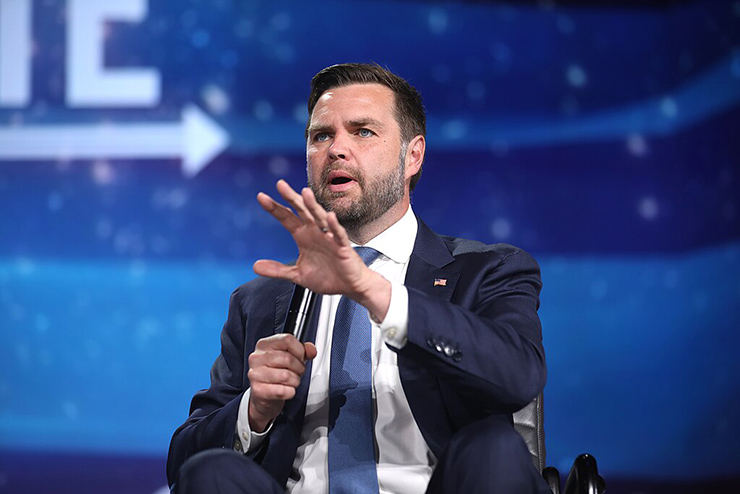
While the vice president has yet to comment on Tucker Carlson, his appearance at a recent Turning Point USA event may reveal how he intends to handle his dilemma. Speaking at the University of Mississippi last week, Vance responded to several questions from the audience—about Israel, of course, which seems to be everyone’s favorite topic these days.
When asked by one young man why America supports Israel, given its alleged ethnic cleansing in Gaza and persecution of Christians, Vance replied that Trump’s foreign policy boils down to putting Americans first, which in some cases entails working with Israel, but not in others. Vance pointed to the Gaza peace deal as evidence of Trump being willing to apply leverage to Israel.
Continuing, Vance said, “So when people say that Israel is somehow manipulating or controlling the president of the United States, they’re not controlling this president, which is one of the reasons why we’ve been able to have some of the success that we’ve had in the Middle East.”
While Vance did argue, toward the end of his response, that Christians and Jews need not agree on theology to get along—a reasonable view I most certainly share—he failed to challenge a premise upon which his interlocutor’s question rested: that Jews in Israel persecute Christians.
Between that and the implication that other presidents, but not Trump, have been controlled by Israel, it should not come as a surprise that some on the pro-Israel right were less than pleased.
David Harsanyi, a senior writer at the Washington Examiner, was incensed. He posted the following on Twitter:
Vance’s answers yesterday were despicable. I’m not sure why Jews are praising him. He let a questioner’s vile smears against American Jews go completely unchallenged, only assuring him that Trump didn’t let Israel pull the US into a World War—as if that’s it wanted.
Imagine some dopey kid going off on how the Pope secretly pays off all US politicians to create open border policy and illegal invasions and then the vice president tells him not to worry, the president has dashed the Pope’s plans.
Vance is Tucker’s boy and everyone understands it. Which is why so many of these people won’t criticize Tucker.
Harsanyi wasn’t the only one upset by Vance’s response. Raylan Givens, a popular pro-Israel pundit on Twitter, was similarly outraged. “VP Vance’s Q&A made me realize the enormous impact the woke right had on the normal right,” Givens wrote. “Soon, you will not be able to differentiate between them and the left; both hate Jews and Israel.”
Vance, however, did have some critical words for the anti-Israel right, which has spent the last year hysterically—and, I would argue, dishonestly—claiming that President Trump is plotting to entrench America in another forever war:
I remember when people said that the President of the United States was gonna get us into a multi-hundred thousand regime change war for Israel. This was four months ago—this was six months ago. Now, the people who accuse the President of the United States of wanting to get us into a regime change war for Israel, I wonder if they step back and say, “You know what, we were wrong about that.”
Judging from these responses and Vance’s previous statements on Israel, he doesn’t appear fully committed to either camp. In his view, Israel is just one ally among many, and it needs to pull its own weight and have something to offer should it want continued American support. Perhaps he views Israel as a uniquely demanding ally, one that managed to boss around previous presidents.
These positions are sure to rankle the pro-Israel right. They are undoubtedly a departure from the Christian Zionist consensus that has dominated the Republican Party for decades. Yet, they are also not the positions of the Jew-obsessed right, which has long departed from sensible noninterventionism and succumbed to deranged and uninformed conspiracism. As I’ve argued elsewhere, there is a world of difference between being critical the state of Israel and believing that every Jewish person is part of a grand, centralized conspiracy against non-Jews.
The vice president may believe that by striking a balance, Zionists (Christian, Jewish, or otherwise) will feel comfortable voting for him and contributing to his campaign, while anti-Zionist podcasters—many of whom boast enormous online followings—will either support him or, at the very least, not rally against him. It should be noted that the pro-Israel faction is far better funded and organized than the anti-Israel faction. Moreover, 75 percent of Republicans are more sympathetic toward Israelis than Palestinians. This suggests that while anti-Israel sentiment is a recipe for success in the podcast world, it is not so in electoral politics.
It will prove a difficult balance to strike if for no other reason than the fact that neither camp wishes for such a balance to be struck. The pro-Israel camp wants Vance to denounce Tucker Carlson’s positions, which he is unlikely to do, whereas the anti-Israel right surely would love nothing more than for him to put Israel criticism at the center of his campaign.
Vance is presented with a unique challenge. To become president, he must unite the now-fractured coalition that elected Trump. Time will tell whether he succeeds. But Vance, by all appearances, is a shrewd operator, and an ambitious one at that. If anyone can pull off such a feat, it is he.
Leave a Reply