Last year, President Trump altered federal nomenclature by renaming the Department of Defense the Department of War. He did not choose a new name but rather reverted to the department’s pre-1949 appellation. The change was part of broader reforms aimed at returning the U.S. military to the culture that once produced an unblemished record of winning wars.
But bloody stalemates and humiliating defeats are not the Department of Defense Era’s sole legacy. Also included is the Persian Gulf War, a war so brief and successful that it has largely become an abstraction in the minds of those who remember it. Luckily, the real Gulf War lives on in the work of its bard, Michael Kelly.
The scion of a journalistic family, Kelly grew up among the Washington press corps. Upon joining the family business, he gained fame for inaugurating the tradition of inviting celebrities to the annual White House Correspondents’ Dinner. After Saddam Hussein invaded Kuwait, Kelly decamped for the Middle East as a freelance writer, hoping his independence might allow him to circumvent the Pentagon’s strict media restrictions.
It was a gamble that paid off. Published in 1993, his book Martyrs’ Day: Chronicle of a Small War is Kelly’s award-winning account of the Gulf War. Combining his Irish gift for storytelling with his ace reporter’s nose for news, Kelly brings the war to the reader from both sides of the military/civilian divide. In Baghdad, on the eve of the month-long Coalition bombing campaign, Kelly begins with reports on the delusional expectations that the Iraqi government cruelly instilled in the minds of its people. From there, he takes the reader through Amman to Tel Aviv, where a London-during-the-Blitz-like resolve awaits the next Scud missile from Iraq.
With the ground offensive to liberate Kuwait imminent, Kelly arrives in Dhahran, Saudi Arabia, and discovers an oil industry company town whose American employees are living a ghettoized, but idyllic, 1950s suburban existence. Renting a Nissan Safari, Kelly enters Kuwait hours after the start of the invasion. By the next day, the Coalition’s advance was slowed more by the hundreds of thousands of Iraqi soldiers attempting to surrender than by any kind of armed resistance. Ten Iraqi soldiers attempt to surrender to Kelly in his Nissan.
Martyrs’ Day then takes a much darker turn. Liberated Kuwait City divulges horror stories of its seven-month Iraqi occupation. Tales of torture, rape, and murder make Kelly’s vivid descriptions difficult to read. But the most memorable portion of the book is Kelly’s tour through human and vehicular carcasses along the Highway of Death.
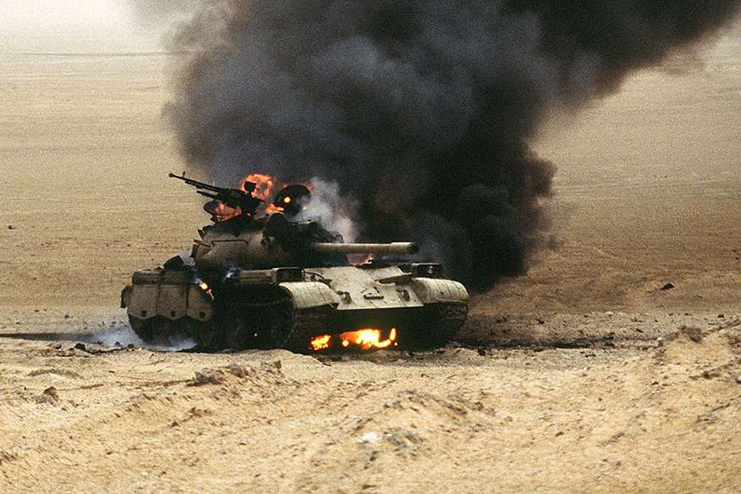
On Feb. 26, 1991, the Iraqi army evacuated Kuwait City, taking with them anything they could. Two roads ran through the desert from Kuwait City to the Iraqi border and beyond to Basra: the six-lane Highway 80 and a two-lane route along the Gulf Coast. The columns of retreating vehicles were easy targets for Coalition aircraft. More than 1,000 vehicles were bombed and strafed. The human casualties were comparatively light (estimated to be in the low hundreds), as most of the Iraqis quickly abandoned their vehicles and fled into the desert. But Kelly’s grisly descriptions of those killed by cluster bombs on the roads to Basra leave an indelible impression on the reader.
The one-sided carnage on the Highway of Death embarrassed the Coalition so much that it entered a ceasefire with Iraq on Feb. 28. Kelly spent the interwar years as an admired syndicated columnist and magazine editor, known for his sharp, humorous contempt for Bill Clinton. Like most of the Fourth Estate, Kelly supported another war with Iraq. When it came, he was on the ground with the Third Infantry Division.
In war and in movies, sequels are rarely superior to the first installment. In Martyrs’ Day, Kelly tells of a photographer who takes pictures of journalists in case photos of those journalists are needed to run alongside their obituaries. That vignette became an unfortunate example of unintentional foreshadowing when Kelly became the first American journalist killed during the 2003 U.S.-led invasion of Iraq. The author of Martyrs’ Day had become a martyr himself.
Coincidentally, the 35th anniversary of the end of the Gulf War came with the start of a new conflict in the Persian Gulf. While further comparisons may be premature, it should be noted that the Gulf War is not the last war that ended in an unambiguous American victory. That later victory would be the eradication of the ISIS caliphate during President Trump’s first term. But the Gulf War is a victory worth remembering if only because such victories have become so uncommon.
Leave a Reply