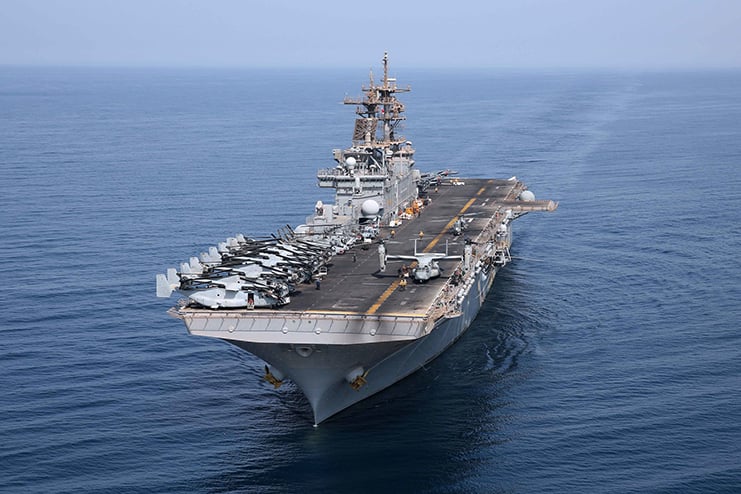
In the last few days, a debate has erupted on X questioning whether I’ve sullied my reputation as a reactionary by failing to oppose President Trump’s use of the military in the latest conflict with Iran.
Supposedly, I should be opposing all military actions taken by the current administration since I was one of the most prominent opponents of neoconservative interventionism. Moreover, as a defender of the traditional right, I should be viewing foreign intervention as a means of increasing the power of a rogue managerial-therapeutic government at home. Finally, as someone who viscerally loathes our present anti-discrimination regime, I should want to focus all our energies on combating this bureaucratic monstrosity while avoiding the distraction of foreign confrontations.
I also have a record of opposing past American use of the military, from the Iraq War to World War I to the blood bath of the Civil War. Shouldn’t we therefore assume that I would oppose all military involvement, no matter what the situation?
Not so fast! Although I deplore the brutal, bloody excesses of World War II and would have favored, if possible, a negotiated removal of the Nazi government, I believe the U.S. was justified in dislodging Hitler from power. Certainly, it would also have been better if, following Sean McMeekin’s back-mirror view in Stalin’s War, we had treated the Soviet tyrant as an aggressive enemy much earlier than we did. In short, I’m not quite the military isolationist I’m supposed to be, even if I have repeatedly warned against allowing the odious neoconservatives anywhere near the State Department.
Neoconservative hostility toward me, furthermore, had more to do with their intolerance of dissent on the right than it did with my supposed isolationism. At the time of the neoconservative-incited war against Iraq after 9/11, all dissenters on the right were slammed in National Review as “unpatriotic conservatives.” But not all opponents of that foolish venture stood in unchanging opposition to all American military intervention. I personally believe that even if we’re burdened with a leftist, woke ruling class, we do have a right to defend ourselves against enemies who finance and abet international terrorism.
In the case of Trump’s use of military force in Iran, the jury is still out on its political outcome. From government reports, it seems that the military operation is expected to last about four weeks, and the Iranian people will then be left to establish a post-Khameini regime. Trump has assured us that he is not preparing for any kind of American ground war; so I’m waiting to see if that’s the case. If I see the president asking the Foundation for the Defense of Democracies or some other neocon front group about how to deal with Iran, I may change my mind. But so far this has not happened. It makes me nauseous to see the frenzied jubilation with which the neoconservative-occupied Murdoch media have greeted this military operation. But I try to avoid taking positions dictated by always being on the opposite side from my adversaries.
In that exchange on X between Brion McClanahan and Patrick Casey regarding my view of this military action, Casey may be closer to my position than McClanahan. Although I value the friendship of both these discussants equally, Brion may be reading too much into my remarks about the interwar right on a panel in which the two of us participated. The observation made by Albert J. Nock and other libertarians of his persuasion, that there is a tension if not outright incompatibility between a constitutionally limited state and a large military, is essentially correct. Unfortunately, that bridge was crossed a long time ago, just like the construction of a large welfare state, which is not likely to be revoked even by a right-wing populist.
We can still benefit, however, from the interwar right’s justified warning against using the military to wage ideological crusades. Those perceptive critics looked at the American political situation after Woodrow Wilson’s ill-conceived crusade to bring democracy to the world. That enterprise, as I’ve argued in articles and reviews, may have prolonged the European bloodbath while permitting the brutal suppression of dissent at home.
I would also distinguish between enthusiastically backing the attack on Iran and giving the Trump administration, provisionally, the benefit of the doubt. I am taking the second course, since the threat represented by the now mostly overthrown Iranian regime may have been great enough to justify the use of force. The Iranian government has sponsored international terrorist activity consistently for the last 47 years. It was also working to build nuclear weapons to use against countries that Iran’s clericalist leadership marked for destruction. This seems to me to be true despite the unfortunate fact that neocon windbags are saying the same things.
I won’t deny others the right to criticize this military involvement; nor do I expect anyone on the traditional right to support Trump’s action simply because he’s “our guy.” We on the real right do not require neocon litmus tests, and others associated with our magazine are free to hold views about this military operation that differ from mine. But please spare me Senator Schumer’s partisan complaint that Trump has not “revealed the scope” of this military engagement. I am struck, instead, by how well coordinated this military action has been and how often cabinet officials have laid out its scope. Moreover, considering the shameful way the last two Democratic administrations bestowed unfrozen Iranian assets on a rogue regime and did everything possible to ignore the progress of its attempt to acquire nuclear weapons, Democratic politicians would do well to shut up.
Leave a Reply