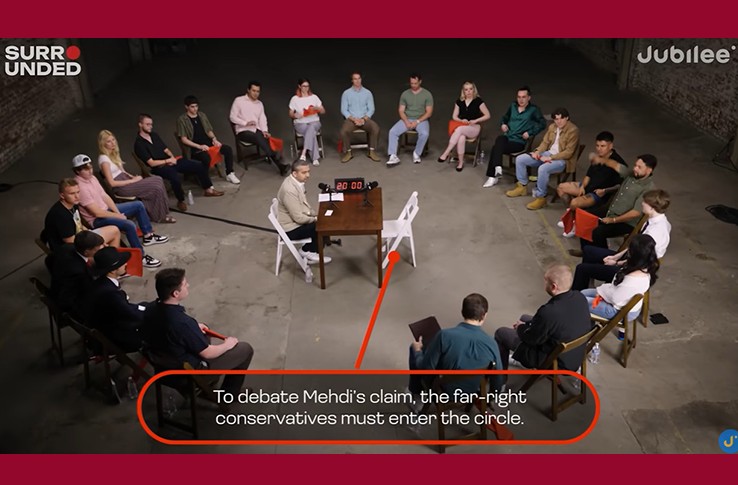
Former MSNBC host Mehdi Hasan recently sat down for a debate with a group of young “far-right conservatives” on a show called Surrounded. It was often more a shouting match than anything else, and it was most productive in showing where one increasingly influential faction in the GOP wants to go.
But first, I should preface this by placing it in the context of broader Gen Z trends.
One of the more interesting aspects of the last presidential election was the fact that Donald Trump shored up a surprising amount of Gen Z support. But after six months of MAGA 2.0, Zoomers have seen enough. Virtually all public polling shows that Gen Z is walking away from Trump.
There are different explanations for that. The best ones are the most obvious: young Americans thought Trump would bring hope and change, and he has, instead, enacted policies that darkened their view of where the country is headed while, for the most part, keeping the “swamp” fat and happy. A lot of people, not just Gen Z, feel the same.
But there is another explanation that some on the right have bought into: Trump’s Gen Z support is collapsing because he is not “far right” enough for their tastes. I’ve written at length elsewhere about why this is fundamentally wrong. It’s less an explanation than a coping mechanism for Millennials and Gen X Republicans who think of their movement as a youthful one and cannot comprehend why the actual youth are less thrilled about it than the old heads.
That being said, there are indeed Republican Zoomers for whom Trump is too soft, and 20 of them were on Surrounded with Hasan. Most were Gen Z, but a few appeared to be Millennials.
Some were staunch Trump supporters, others merely saw him as a means to an end, and at least one person confessed that he did not cast a ballot for Trump last year. For the most part, this group supports what I think one could accurately characterize as an “America First” agenda: severely restricting immigration, implementing socially conservative policies founded on Christian beliefs, and dramatically reducing America’s foreign policy footprint, especially in the Middle East. While not everyone in this faction is white, there is an identitarian streak that runs through it, which the members see as a kind of corrective element.
There was no shortage of attitude in the room, but few handled themselves well against Hasan, who has mastered the art of a certain skill, though I’m not sure I would call it “debating” because that implies persuasion, attempting to change someone’s mind, and reaching real common ground. Hasan never tries to convince anyone. He’s there to bulldoze people for the camera. He sets up traps that even the most fervent Trump supporter would find insurmountable. He bobs and weaves and shoulder rolls when he can’t mount such traps. Hasan is very good at this thing-that-looks-like-debating-but-isn’t, and its efficacy is enhanced by the fact that most of his interlocutors are young and inexperienced, and often ignorant about obvious things.
For example, one of the challengers, a political commentator named Sarah Stock, seemed giddy when Hasan agreed with her that the United States should cut aid to Israel. The look on her face suggested that she considered it a coup. Stock apparently had no idea that Hasan is a critic of Israel who regularly debates its supporters. The claim Hasan asserted to set the stage was: “Donald Trump’s plan for Gaza is ethnic cleansing,” referencing the president’s proposal to place the region under our control and then develop it as if it were just a sweet real estate deal. That didn’t seem to tip off Stock to where he might fall on the issue. Moreover, she resisted from the outset that it was Trump’s plan at all.
“Why do you say this is Donald Trump’s plan?” she asked.
“He says it’s his plan,” Mehdi said.
“When did he say it?” Hasan quickly ticked off all the times Trump had brought it up. Incredibly, Stock was incredulous. She asked Hasan to tell her word-for-word what Trump proposed, which he did, quoting the president directly, in detail. Stock pushed back, suggesting that “there might be some special interest group or perhaps religious or ethnic group that’s, you know, maybe he’s received money from them and that’s the whole reason why he wants to cleanse Gaza?” In other words, the Israelis or the Jews are to blame, not Trump, Stock suggests.
I have no idea how old Stock is, but she must have been in infancy or asleep during the first Trump administration and his second successful presidential campaign. Trump, like every other Republican, is pro-Israel, and always has been. He has said so outright for years and, his occasional beefs with Bibi Netanyahu aside, he has made good on his word. Stock seems completely unaware of any of this and instead—eyes alight and cheekily satisfied with herself, but playing a little dumb to keep things coy—suggests that some deviation has occurred this time, unlike last time, although nothing has actually changed at all and Trump has always just been very pro-Israel.
I’m not sure what to call this phenomenon, but I see it often on the right, and not just among Gen Z pundits who have figured out that saying edgy things on camera is a good way of getting attention. Instead of drawing conclusions based on the readily available record, the answer instead lies in a conspiracy or an inside joke.
“Donald Trump is a white man,” Stock points out astutely. “He identifies as Christian,” she adds, implying that it is out of the ordinary for a white Christian to support Israel, apparently unaware that white evangelical Christians are some of Israel’s staunchest supporters. Hasan, though somewhat confused, picked up on what Stock was getting at. She laughed, as if it were a secret.
This cognitive maneuver and trapeze routine relieves people from the burden of having to think critically and be consistent when it comes to supporting Trump while opposing Israel, or differing with him on any other issue. They imagine they can have their cake and eat it, too.
Others were more coherent than Stock. Maybe too coherent for their own good. One interlocutor named Connor explained, in careful detail, that his ideal form of government would be an autocracy grounded in Catholic values.
The Constitution? He doesn’t really care about it. Trump? Didn’t vote for him. Wrote in “John Pork or someone.” Connor said that he supported democracy only to the extent that it served as a stepping stone toward his “ideal” state, in which free speech would also be curtailed. Free speech, Connor said, was a means to an end, a ladder that the strongman would yank up upon his ascension. Hasan was mostly baffled at how forthcoming Connor was about his motives and preferred strategies.
“We may have to rename this show, because you’re a little bit more than a far-right Republican,” Hasan said.
“What can I say?” Connor replied.
“I think you say, ‘I’m a fascist.’”
“Yes, I am,” he said before letting out a belly laugh to applause around the room.
Hasan didn’t seem to know that there are plenty of examples of democracies voting themselves into undemocratic regimes. Napoleon’s reign was consummated through the plebiscite. But that’s neither here nor there. What stood out to both Hasan and viewers, again, was the fact that Connor was so transparent. Even people who identify with the far right thought he went too far in that respect, as if he was trying to discredit them or validate some caricature.
Shortly after the episode aired, Connor claimed to have been fired for the political views he expressed on the show. A fundraiser was created to support him. But then it came to light that Connor tweeted in January—months before the episode aired—that he had been “laid off.” It’s unclear whether he was let go more than once in the last seven months or if this was just a stunt to capitalize on his appearance going viral. Indeed, a few of the contestants seemed to view the debate as an opportunity to deliver an attention-seeking performance.
One of the older-looking challengers claimed to be a “Native American” because he could trace his ancestry back to the 1500s. Hasan said that made him a “settler,” not a “Native American.”
“I am Native American. Whites are Native Americans!” he replied. Passionate applause and cheers in the background.
The political scientist Samuel P. Huntington once wrote a book about identity, which was meticulously researched, combining sociology, psychology, anthropology, and ancient and modern history. He brought all these things to bear for a very cerebral, thoughtful case that America is a nation of “settlers” who founded a polity, distinct from “immigrants,” who travel from one polity to another. The argument jibed with paleoconservatives. But little did Huntington know that he was all wrong. He should have just beaten his chest and grunted that he was “Native American” instead of going through all the trouble of writing Who Are We?
The most productive discussion came at the very end, when Hasan got to pick an interlocutor named Kai, a self-described “originalist,” to spend the last 10 minutes of the show debating Hasan about whatever topic he chose, which ended up being birthright citizenship. It was surprisingly civil, approaching a discussion between two people who disagreed but could at least talk to each other, maybe even share a drink.
Both agreed on one key point.
“We don’t value citizenship enough,” Hasan said.
His challenger didn’t dispute that.
Overall, the episode was a fascinating glimpse into what is behind the trajectory of the emerging GOP and who might be driving the bus soon. I think there’s a desire among conservatives to “do something” about it, but that seems like stepping in front of a train. You can tell that more mainstream organizations like Turning Point USA are trying, essentially, to create containment zones, drawing ideological lines in the sand over which young people must not step. But these taboos that paralyzed conservatives in the past don’t mean much to the younger generations.
The left is experiencing its own revolt, gravitating toward people like Zohran Mamdani in New York. Someone said that America feels like Spain in 1935, in which the populace was divided between right- and left-wing factions before a brutal civil war. A matchbox waiting to explode. I don’t think things are nearly that serious. But there’s no doubt the coming years will be strange ones.
Leave a Reply