I would like to express how much I enjoy reading Chronicles, and particularly the “Letter From the Heartland” that Jane Greer writes. But “Eastern Montana: a gigantic plate of congealed gravy”? Harsh words from Greer (December 1988), one of the unfortunate residents of North Dakota—the state where the interstate curves so that a driver won’t...
Year: 1989
Post
On ‘Millions of Fathers’
The comments in your December issue about the anomaly of the laws, as now constituted, that affirm both the woman’s sole right to decide on abortion and the father’s duty to financially support the child once born were very well taken. The fact is that abortion is always justified on the basis of the tacit...
Post
On ‘Our Stumbling Giant’
Having served as a pastor and naval chaplain under the authority of the United Methodist Church, I can truly appreciate Robert Nisbet’s comments concerning “Christian millennialism” (December 1988). Methodism and the National Council of Churches have stuffed that concept into the ears of their adherents at every opportunity. I wish Mr. Nisbet had commented on...
Post
Prison Pencil, Supermarket Crayon
“Poets in our civilization,” a famous poet wrote in his most famous essay, “must be difficult.” He went on to explain his thought, and his Englishspeaking audience understood him. When the thought was translated, it went on living in other languages. But would an English-speaking audience understand his famous lines: Please come with me When...
Post
A Prince of Our Disorder
“Very few care for beauty; but anyone can be interested in gossip.” —C.S. Lewis In 1982 The Village Voice published an article accusing the famous Polish emigre writer Jerzy Kosinski of being a fraud. The authors (Geoffrey Stokes and Eliot Fremont-Smith) argued that Kosinski’s novels had all received extensive and unacknowledged “help” from various editorial...
Post
The Southern Myth
Andrew Lytle and Allen Tate, two of the original Vanderbilt Agrarians, maintained a remarkable friendship spanning some half a century, from the early 20’s until Tate’s death in 1979. While both pursued prolific literary careers, their paths crossed less frequently, particularly as Tate became identified with modernist poetry and criticism in the Eliot tradition. Lytle,...
Post
Recreating the Epic
“And the Lord God formed man of the dust of the ground and breathed into his nostrils the breath of life; and man became a living soul.” —Genesis 2.7 The 19th century had an unfortunate passion for novels in verse. I have tried to read some of the more celebrated, notably Elizabeth Barrett Browning’s Aurora...
Post
The City of Man—Texas Style
We all know something of cities that thrived once and then for one reason or another ceased to exist—preclassical cities we read about in myth and epic; Homer’s Troy or St. Paul’s Ephesus. So used are we to thinking of these extinct places as ancient and, therefore, remote, that it is hard to conceive, as...
Post
Violence and the Subversive
Terrorism has been a plague for Western democracies over the past decade, but in France and Britain it has not been a fatal disease. Other countries have not been so lucky. The Tupamaros of Uruguay took a country that, with all its problems of inflation and corruption, enjoyed 90 percent literacy, low infant mortality, and...
Post
Amateurs and the Olympics
In 1889, when the Baron Pierre de Coubertin was in the middle of formulating his plan to revive the Olympic Games of ancient Greece, one of his primary worries was the use of cash as an incentive for performance. He feared that “a mercantile spirit threatened to invade sporting circles,” and that amateur sports had...
Post
Walt Disney Rolls Over in His Grave
Fun for the whole family, the ad for the movie said. (I was relieved to know that it wasn’t zany or lafF-packed, although later I would have settled for that.) Our kids, then eight and 13, deserved a celebration for lasting through the final day of school before Christmas vacation, so, loaded with grotesque candy...
Post
Songs of the South
I like that old-time rock and roll. I’m sure nostalgia has a lot to do with it: the older I get the better the 50’s look. But there’s more to it than that. I like what the music says about America, and especially about the South. Let me explain. Some time ago, a geographer at...
Post
Break a Leg
In 1963, when Tyrone Guthrie produced his first season at the new Guthrie Theater in Minneapolis, the States did not have much in the way of regional theater. In a country whose two most famous actors are, respectively, a President and a presidential assassin, Ronald Reagan and John Wilkes Booth—two actors who, in other words,...
Post
A View From the Top of the Ridge
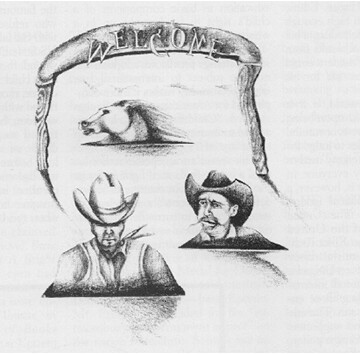
On the Literature of the American West For the last several weeks, working at a leisurely pace, I have been reading through the new and extremely ambitious Columbia Literary History of the United States. This is a huge work, one which has many merits and aspires to be inclusive. Indeed, it is a conscious attempt...
Post
Epitaph for Tombstone
Edward Lawrence Schieffelin’s story seems like something made up by a Hollywood writer long on cliche and short on imagination, for his silver strike epitomized the hopes and dreams of every sourdough prospector who ever wandered the lonely mountains, valleys, and streams of the American West. For years he searched in vain, living on the...

Post
Decline of the West
Imagine yourself going ahead in time—60 years ahead. Imagine yourself in the People’s Republic of North America, in the year 2050. In discussing the rise and fall of the American civilization, it will be necessary to examine the situation at the last time when historians felt this society could have saved itself from disintegration. Consequently,...
Post
On Poetry
People want to save their souls by writing poetry, or so they say. Should we take that seriously? Did Smart save his soul in the madhouse writing all those lucid lines? Perhaps it’s enough to say that from primitive times there has been a need for expression. Poetry is older than prose. Poetry was the...
Post
Piping Hot
Concocted by four editors of something called Equator magazine (I am told it is a large glossy tabloid of odd people doing odd things), Hot Type‘s subtitle is: “Our Most Celebrated Writers Introduce the Next Word in Contemporary American Fiction.” On the basis of the writing selected, I don’t know if I would let some...
Post
Intellectual Operator
It is a distinct possibility that we leave to posterity writers and works from which the future curious will conclude that this century was the stupidest, most verbose and obscene, altogether the worst in the historical record. What else can you say of a century that elected Michel Foucault as one of its mâitres à...
Post
A Literary Proctology
“My goal from the beginning,” states Caldwell, “was to be a writer of fiction that revealed . . . the inner spirit of men and women as they responded to the joys of life and reacted to the sorrows of existence.” The conclusion, however, of what he sought to achieve “with all my might” is...
Post
The Flies of Summer
Last summer I was standing next to a great bull buffalo in western Kansas. He was mad and had a right to be. My buddy Joe Kramer, along with other men from Kansas Fish & Game, had this great American bison in an animal squeeze while they took a blood sample and gave him a...
Post
Lone Star Populism
Out of thin air—or of mythic consciousness—a Texas governor once plucked unhesitatingly the mot juste. The governor, Allan Shivers, who served back in the 1950’s, was indignant over some piece or other of legislative tomfoolery. As he saw it, the whole enterprise was downright “un-Texan.” “Un-Texan.” Right there we had the nub of the matter....
Post
Breaking the Cowboys
I had occasion to visit Pendleton, Oregon recently. It is the “purple mountains’ majesty, above the fruited plain” that we sing about, only the peaks that rim the valley bowl are the Blue Mountains, and the fruit of the land is animal as well as vegetable. Pendleton is famous for its glorious woolens, which you...
Post
The Banality of Fiction
It’s Sunday morning in London. The Sunday Times is here. (Yes, we too have a Sunday Times.) The “Week in Review” section is nice and fat. (Yes, it’s nice and fat here, too.) Headline: “End Game: Why the Soviets are pulling out of Afghanistan.” Photo of Najibullah, photo of Gorbachev, photo of two smiling soldiers....
Post
A Visual Atrocity
It used to be a pleasure to cross the Seine from the Left Bank to the Right, and to pause for a moment by the Louvre to take in that glorious vista, admired by innumerable busloads of tourists and many others besides: the view one gets, framed by the graceful central arch of the diminutive...
Post
Inspiration and Craft
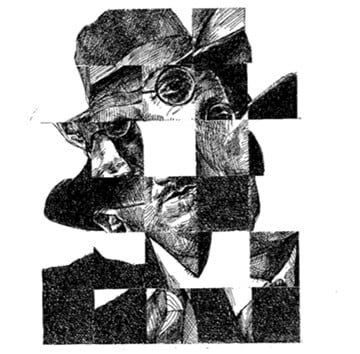
“Take these two books,” is an entirely arbitrary prompting by an editor who happened to have them around on a shelf. Willy-nilly, here they are together, and one looks at them, shuffling through the poems, some familiar and some not. And there is a moment when the rightness of the conjunction seems wonderful! A piece...
Post
Publishers and Sinners
The misadventures of James Joyce’s Ulysses at the hands of publishers and editors has recently been in the news. Many of the commentators seem to believe that what Joyce suffered was unusual, and that most contemporary authors are treated better. Listen to Thomas Marc Parrott (writing in 1934) on George Bernard Shaw: Mr. Shaw, for...
Post
Ahistorical Admonitions
“One age cannot be completely understood if all others are not understood. The song of history can only be sung as a whole.” —Ortega y Gasset In The Politics of Human Nature, Thomas Fleming has boldly undertaken to delineate a system of natural politics. A classicist by training, Fleming believes that “the collapse of Roman...
Post
Publishing Is . . .
“Publishing is something I sort of drifted into.” —Gary Fisketjon In a world, ours, in which large and small atrocities are our daily fare and to which atrocities we often seem to have become so ruthlessly accustomed as to have surrendered our ability to raise our eyebrows or to perform any moral gesture whatsoever above...
Post
The Secular Imagination
Under the tyranny of ideology that is a grim fact of contemporary life in university English departments, it is tempting to reflect on the career of Lionel Trilling (1905-1975) with an uncritical wistfulness. It is to Stephen Tanner’s credit that his astute and balanced introductory study resists such a temptation; for however much Trilling’s criticism...
Post
Our Conception of the World
When we argue about what should be taught in schools and colleges, at stake is our conception of the world. Our theory of the world tells us what we should teach, and whom we may ignore. Debates precipitated by Secretary Bennett’s important criticism of the Stanford curriculum centered upon the inclusion of formerly-ignored groups. But...
Post
Don’t Quit Your Job to Raise a Litmag
“Poetry is the most overproduced commodity on the market, next to zucchini.” —Judson Jerome, Writer’s Digest poetry columnist since 1960 According to a 1985 study cited by Writer’s Digest Books, 23.3 percent of all people who think of themselves as writers—or “more than two million people“—write poetry for publication. It follows that there are then...
Post
The Passion of Patsy
The lights come up on an old woman holding a candle. It is Auntie Rula. RULA Do you hear a child crying in the cellar? Yes, yes, it is you. Patsy! Back again to haunt your old Auntie Rula. But why are you crying, child? Or are you laughing? Crying, laughing—with you, they always sounded...
Post
US Out of Dixie
Browsing at a local newsstand the other day, I spied a startling comic book, issue #11 of Captain Confederacy. Its $1.95 price was even more startling (the last comic book I bought, back about aught-56, cost something like 15 cents), but I had to take this one home, and did. Let me tell you about...
Post
Books and Book Reviewing, or Why All Press Is Good Press
When Bob Woodward published Veil: The Secret Wars of the CIA, in October of 1987, two things made that book news. One was his assertion that William Casey, the late director of the CIA, had admitted to knowing about the transfer of funds in the Iran-contra deal. The other was the skepticism over Woodward’s claim...
Post
No Nongovernmental Publishing Houses
I recently returned from a visit to Moscow, Leningrad, and Kiev, and there is no question about there being more freedom to express ideas. But reports of change are exaggerated. There are still no nongovernmental publishing houses. Two of the more popular journals, Ogonyok and Literaturnaya Gazeta, are sold out quickly and there is a...
Post
Totalitarian Disease
Viktor Trostnikov, a scientist and philosopher from Moscow, recently paid a visit to Washington, DC. A decade ago he was fired from his job as professor of higher mathematics at the Moscow Institute of Railway Engineering, for participation in the almanac Metropol, and he currently earns a living as a mason. He is the author...
Post
Writers’ Unions
“PEN international is working for your release,” my lawyer told me. In the bare, mean interview room of the Belgrade District Prison he smiled at me, and I smiled back, because the mikes could not pick that up. There were no TV cameras there, yet, to monitor our winks and nods—the language of slaves, as...
Post
Who Is Pete Schaub?
When Pete Schaub, a business major in his senior year at the University of Washington at Seattle, couldn’t get into an overenrolled business course for the first quarter of 1988, he signed up for “Women 200: Introduction to Women Studies” instead. He was expecting to learn about “the history of women and the contributions that...
Post
An American Burke
John Randolph (1773-1833) survives in America’s footnotes as a colorful contrarian, and the Gore Vidal school of historiography pants at his duel with Henry Clay and his taste for opium. A master rhetorician, he left a long list of choice barbs, nearly all concocted on the spur of the moment. James Kilpatrick characterized the errant...
Post
Transylvanian Tales
“Tyrants are always assassinated late; that is their great excuse.” —Cioran It is no surprise that there are a number of mysteries about this book. The author was the deputy director of the Romanian Foreign Intelligence Service; for reasons that he does not care to explain, he defected to the USA in July 1978. Was...
Post
Kazin and Caligula?
“Our literature is infested with a swarm of just such little people as this—creatures who succeed in creating for themselves an absolutely positive reputation, by mere dint of the continuity and perpetuality of their appeals to the public.” —E.A. Poe In our age the business of literature has become as stale and well-organized as the...
Post
The World of the Small Press
If your local bookstore does not stock Wittgenstein’s Mistress by David Markson, Guilty by Georges Bataille, Altazor by Vincente Huidobro, Compact by Maurice Roche, Space in Motion by Juan Goytisolo, I-57 by Paul Metcalf, Concierto Barroco by Alejo Carpentier, or Cold Tales by Virgilio Pinera, you’re living in a culturally deprived area. All these books...
Post
Beyond Moral Equivalency
“The triumph of demagogies is short-lived. But the ruins are eternal.” —Charles Peguy Jeane Kirkpatrick has given us two useful ways to think about that segment of the American intelligentsia that continuously finds fault with virtually everything this country does: they are the “blame America first” crowd and the believers in “moral equivalency.” After reading...
Post
Come to a Close
The Bennett interregnum has come to a close at the Department of Education. The former secretary of education had his shortcomings, but the vice with which he was most frequently charged—being “confrontational,” failing to “build coalitions with educators”—was actually his greatest virtue. Bennett knew better than to attempt significant reform by backroom dealings and conciliation...
Post
Ethnic Disturbances
Ethnic disturbances pose “the most immediate threat to Gorbachev, the one thing that could put him out of power,” said the Deputy Director of the CIA, Robert M. Gates. Zbigniew Brzezinski and other US analysts concurred. The recent ethnic strife in Estonia, Latvia, Armenia, Azerbaijan, Romania, Bulgaria, even Yugoslavia is, in the words of The...