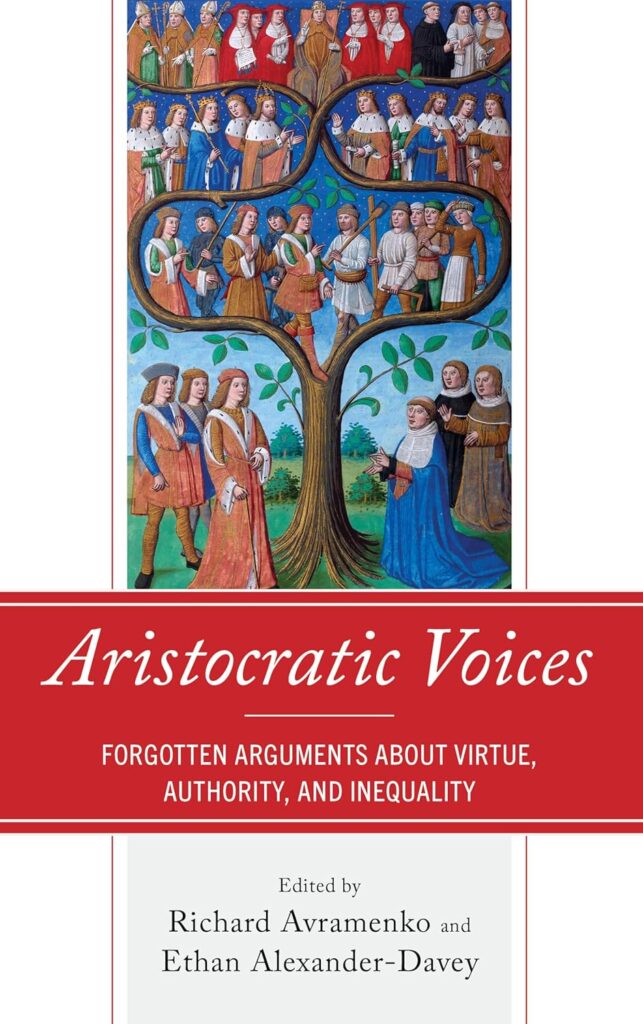
Aristocratic Voices: Forgotten Arguments about Virtue, Authority, and Inequality
Edited by Richard Avramenko and Ethan Alexander-Davey
Lexington Books
420 pp., $135.00
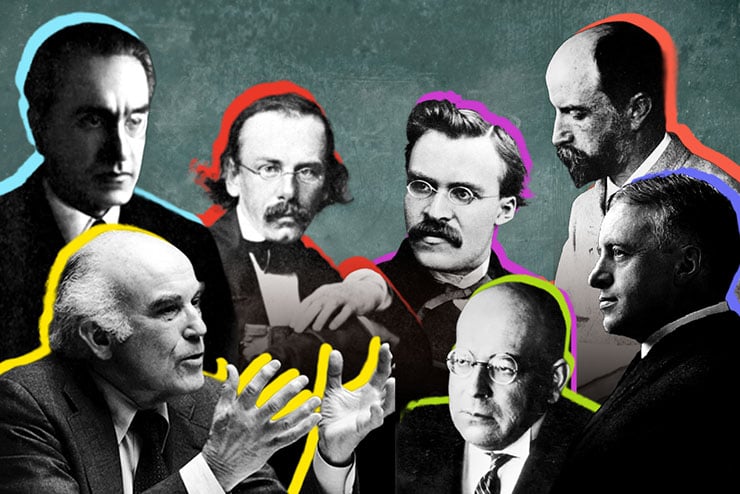
This timely anthology, focused on what could be called the aristocratic wing of the “conservative tradition,” chooses some unconventional thinkers, not all of whom would be recognizable to serious historians as conservatives. One might question whether Friedrich Nietzsche, Oswald Spengler, and Julius Evola should count as traditional conservatives. But the authors of the essays on Nietzsche, Evola, and Spengler (Michael Harding and Grant Havers) argue they are relevant to conservative thought because they were all devastatingly critical of the modern notion of equality and stressed the value of aristocracies.
Although historical conservatism as a body of thought and political practice emerged from the French Revolution, there is also an American tradition of criticizing democratic equality and defending traditional social elites that represents what Russell Kirk called “the conservative mind.” Irving Babbitt, Henry Adams, and Robert Nisbet, who are all deservedly treated in this anthology, stood for this peculiarly American kind of conservatism, one that outside of our surviving conservative traditionalists barely exists anymore.
Alexander-Davey explores “aristocratic liberal” thought in his essay on the 19th-century German novelist and political theorist Wilhelm Heinrich Riehl (1823-1897), who was a moderate European conservative during what might be described as the silver age of European conservatism. (The golden age occurred during the European restoration following the Napoleonic Wars.) Alexander-Davey treats both Riehl and his Russian near-contemporary Konstantin Leontiev as “prophets of anti-modernity.”
Like John Stuart Mill and Alexis de Tocqueville, such thinkers viewed the modern world as producing some positive good, certainly in the material sense, and being, in any case, an irreversible phenomenon. But, unlike their more democratic contemporaries, neither Riehl nor Leontiev sang the praises of political and social modernization or sought to reduce existing communities with their hierarchical structures to “pale remnants of or substitutes for traditional social forms.” Such liberal conservatives wished to revitalize “historic customs and institutions” as a guardrail against “the dangers of individualism, egalitarianism, homogenization, and mediocrity.”
Riehl did not oppose constitutional government or the integration of the bourgeoisie and working class into both the political and cultural nation. But he insisted on the presence of both the peasantry and the nobility as means of perpetuating the customs of a people and of providing constraints on centralized power. Riehl spoke particularly of the nobility as the “estate of social barriers,” a class that placed barriers on the inroads of the modern state while representing “the national historical consciousness.” Not surprisingly, a similar argument appears in Hegel’s Philosophy of Right (1821), which underscores the “mediatory” role of an aristocratic class standing between the monarch and his subjects. Aristocracy, according to Hegel, forms an intermediate institution that tames the power of the head of state while acting as a check on the popular will.
From the introduction, it seems that Alexander-Davey was led to compile this anthology at least partly by Matthew Rose’s A World After Liberalism (2021), a book that explores radical right thinkers whom Rose clearly wishes to warn us against. Two of these thinkers, Spengler and Evola, receive generally sympathetic treatment in Alexander-Davey’s anthology as decidedly “aristocratic thinkers.” Although Rose’s book and this one, as Alexander-Davey assures us, deal with voices on the right that tried to address “needs liberalism cannot provide,” such as community, organic relations, and structured authority, the two books serve opposite purposes. Unlike Rose, Alexander-Davey and his collaborators engage with their subjects instead of treating them as dangerous precursors of right-wing extremism.
For me, a special merit of this anthology is that it presents the thoughts of identifiable conservatives rather than the utterances of those who arbitrarily label themselves as such. Riehl fits the historic definition of a “conservative” much better than Ben Shapiro, Martin Luther King Jr., or even the editorial board of National Review. We should be grateful that every now and then books are published that describe political camps accurately. Although I would treat Evola, Spengler, and Nietzsche as men of the right rather than “conservatives,” there’s much to be said for including these “aristocratic voices” that excoriated egalitarianism and praised aristocratic ideals. For a more complete list, I might have added John C. Calhoun, Edmund Burke, Joseph de Maistre, and a few more Americans, but what Alexander-Davey has put together suggests the richness of the authentic conservative tradition.
The reason, according to Alexander-Davey, that we should be taking his subjects seriously is that lots of people have grown tired of “liberalism” and “may be looking for political alternatives that suit their social and emotional needs better.” I’m not sure this is, in fact, the case. It is hard to imagine that we can recreate a conservative society simply by convincing American readers that “liberalism” is no longer meeting their “emotional needs.”
It’s also hard to show that our present Western societies have much to do with liberalism properly understood. How exactly do the woke managerial states that have established themselves throughout the West fulfill specifically “liberal ideals”? Our self-described democratic governments have engaged in the mission of socializing and controlling their infantilized subjects while redistributing their incomes.
We are living in what can best be described as a postliberal society, but one whose leaders and authorized opinion-givers continue to express themselves in increasingly archaic liberal rhetoric. Wherever this situation leads, it will not likely be toward the world that produced those “aristocratic voices” that this anthology presents.
All the same, there is instructive value in reading about conservative and right-wing thinkers of the past, even if their ideas are no longer dominant and the world in which they lived has disappeared. These thinkers and social critics understood the direction in which revolutionary slogans and agendas lead and never fooled themselves by imagining that “the pendulum swings back.” Revolutionary changes are usually for good, but their severity may be mitigated by subsequent adjustments made by those who replace the more intransigent revolutionaries. Sometimes the moderate counterrevolutionaries, like Wilhelm Heinrich Riehl, can work toward creating a middle ground between the advocates of social change and the conservatives, but usually that results in merely slowing down the dynamics of revolution.
The most interesting approach to taming a continuing revolution from the left came from the interwar revolutionary right, which tried to selectively preserve certain counterrevolutionary themes while calling for a political and social upheaval against “liberalism.” Although representatives of the European right reaped disaster in the end, they did correctly understand that the political pendulum, contrary to a fatuous but widespread notion, never swings back and that “Thermidorean reactions,” like the one that occurred during the French Revolution, merely moderate but do not undo revolutionary change.
As another positive feature of this anthology, we might mention that it offers the true meanings of political terms, before the modern media and PR experts manhandled them. Conservatives are exactly the people described as such in this book. They are not transgender celebrities who announce on Fox News that they intend to vote Republican in the next election. Nor are they black athletes who used to pal around with Donald Trump and who voted for him out of fraternal feelings.
Liberals, this anthology at least sometimes reminds us, were not supporters of unrestricted abortion rights and “gender-affirming” surgery on minors. They were the people who used to advocate for constitutional government and who championed a bourgeois civilization. They also believed in a suffrage limited to men of education and means.
Both the liberals and their counterrevolutionary opponents were defending honorable causes, and one can wish that the political contest was still between these two worthy sides. But (alas!) that’s not the case; nor will it ever likely be again.
Leave a Reply