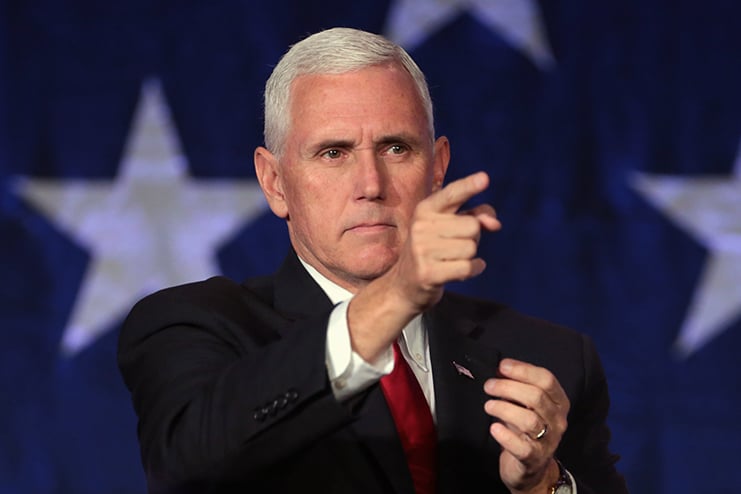
Now that Santa Claus has returned to the North Pole and the Republican Party’s tent police are back on patrol, it is time to speak openly about what many are afraid to say. When Mike Pence and his circle accuse the Heritage Foundation and others on the right of “tolerating” or “enabling” anti-Semitism, they are not making a moral point—they are making a branding move. After years of sitting on the sidelines writing books destined for remainder bins, Pence has now reappeared to scold those people who have been fighting for an actual conservative agenda.
Pence’s scolding reflects the mentality of an entire Washington D.C. political class made up of think-tank lifers who have been unable to stop those things they claim to abhor. When they are not courting donors, they are playing hall monitors within the conservative movement, policing rhetoric while excusing every Republican failure of governance. These people are motivated by the same establishment muscle memory we have watched for decades: Cheer on endless wars, shrug at open borders, then rediscover “order” the moment it polls well at dinner parties and the donor circuit.
The same voices that once mocked the MAGA movement and treated the defense of Western civilization like a dirty phrase now claim the moral high ground on anti-Semitism. At the same time, they sneer at anyone who dares connect the dots between immigration restriction and genuine security or mass immigration and real anti-Semitism.
Stephen Miller put it plainly to Fox News: “When you see the state of Somalia, that is what [the Democrats] want for America.”
It’s easier to rule over an “empire of ashes,” he said, than a functioning high-trust Western society with a strong middle class. Somalia is their model—they want to make the whole country into a version of that kind of tribal society. Everything they do gets down to that.
But our Republican tent police have no time for such concerns. They have no fear of Minneapolis becoming Mogadishu or about those imported masses draining Minnesota’s proud state culture and taxpayer wallets. Likewise, there is no concern for New York City electing Zohran Mamdani as its first Muslim mayor—a man arrested at anti-Israel protests who has shared center stage with Imam Siraj Wahhaj, an unindicted co-conspirator in the 1993 World Trade Center bombing. No. There are bigger anti-Semitic fish to fry, according to them, at the Heritage Foundation headquarters.
Some of us will not accept that.
Anti-Semitism will not be defeated through ritual denunciations or elite scolding sessions. It does not recede because the right people post the right statement at the right time or perform the approved outrage gestures in the proper sequence. Those gestures are easy. They are performative. They offer moral satisfaction to the performer, giving him cover without requiring him to do anything so bothersome as governing.
And spare us the demand for a performative social media “high five.” High fives will be deserved when they stop treating a poem on a statue as a governing philosophy—one vague stanza elevated into a substitute for law, prudence, and national judgment. Somehow, we are told that the Emma Lazarus poem carved onto the Statue of Liberty requires us to absorb masses of migrants from societies where anti-Jewish hatred is entrenched in institutions, culture, and religion.
The irony is too perfect. Back in 2006, then-Representative Mike Pence stood at a Heritage Foundation event and invoked the Lazarus quotation to argue for comprehensive immigration reform—which is to say, amnesty. The same man now positioning himself as the arbiter of conservative principle spent the Bush years championing the very policies responsible for the conditions he now claims to deplore. The same poem. The same platitudes. The same refusal to govern responsibly.
Contrast that with the people willing to state hard truths, like JD Vance, who told CBS News anchor Margaret Brennan, “Just because we were founded by immigrants doesn’t mean that, 240 years later, we have to have the dumbest immigration policy in the world.” That is what governing sounds like. That is what it looks like when you treat restricted entry, immigration enforcement, and assimilation as obligations rather than suggestions.
The work that matters begins with order. As Russell Kirk observed, it is not sentiment or symbolism that a society needs most of all, but order. Order means limits are recognized, and norms are defended. It means equal application of the law with institutions willing to live by that principle. And it begins with the most elementary boundary of all: the national boundary that makes law, equal protection, and public safety possible in the first place.
Which is why our present fixation on supposed anti-Semitism within conservatism is so badly misplaced.
We are suddenly being told that the real danger lies inside our conservative political “tent” and that anti-Semitism is primarily a matter of internal speech policing, tone monitoring, and ritual excommunication. Say the wrong thing, miss the denunciation window, fail to clap loudly enough at the right moment, and the sentence is exile. This is more of the same gatekeeping that the conservative establishment has been forcing on the right for decades. But why does this war against the right stop at our border? The nation is a tent too, and it is the only one that matters.
While elites spend all their time pointing fingers and combing through indelicate rhetoric, consequential choices are made. Chief among them: the choice to permit continued mass migration from regions where anti-Jewish hatred is institutional, cultural, and doctrinal—a reality that Western elites ignore when it comes to immigration.
They acknowledge it only when their war goggles are on, when it’s time to stick a feeding tube down the throat of Mesopotamia and force-feed it a meal of Jeffersonian democracy. That project, incidentally, always ends by importing the very pathologies they claim to want to destroy. See why these people have been sidelined?
Anti-Semitism does not flourish because condemnations of it coming from the right are insufficiently emphatic. It flourishes when entry into our country is treated with a lack of seriousness, enforcement of the law is neglected, and assimilation is treated as optional. This pattern is not theoretical. It has been visible for years across Europe and the broader West. Jewish communities within these nations now require armed security not because leaders failed to strike the correct rhetorical pose, but because these states failed to exercise basic prudence.
Synagogues are guarded. Schools are fortified. Ordinary religious life proceeds under threat. These are not the costs of insufficient moral signaling. They are the costs of civilizational denial and collapse.
During a debate about immigration at the Oxford Union, I remarked that “if no one can be illegal, no one can be safe.” The chamber laughed. But laughter is not a rebuttal—it’s a way of avoiding responsibility. When I later called out the Muslim rape gangs, the response was gasps, anger, and a call to order. It is easier to sneer and shun than to govern, and certainly easier to posture than to defend sovereignty.
Our former vice president Mike Pence offered a master class in that kind of posturing in the same hall months later, saying nothing risky, nothing consequential, and nothing that threatened the reigning orthodoxy. His remarks were proudly posted and highlighted by the left-wing foreign students who now run the place. Six months later, my stolen land debate footage remains under wraps. I wonder, why?
Borders are not abstractions. They are the lines that make law possible and pluralism sustainable. They are how freedom of worship becomes more than a slogan. Anyone serious about Jewish security must be serious about borders—not as an act of hostility, but as an act of stewardship.
Which brings us back to that poem.
The Statue of Liberty inscription was a sentiment, not a mandate. It was never meant to replace judgment with abstraction or turn acts of national self-preservation into moral failings. Yet an entire class of professional conservatives—with shiny new donor-fed institutions popping up—exists to launder elite consensus as “responsible policy,” treating it as holy writ whenever immigration restriction is mentioned, invoking the “huddled masses” as if Emma Lazarus had been a Cabinet secretary and her sentiment is a substitute for law.
A serious nation treats entry as a privilege tied to standards. It enforces its laws. It treats restricted entry, enforcement, and assimilation as obligations rather than suggestions. These are not acts of cruelty. They are the preconditions of social peace.
This is where the Pence archetype fits—not as a singular villain, but as a representative figure. One moment, he is the loyal evangelical vice president defending actions that clash with his own professed moral framework; the next, he certifies an election and decries populism as a “road to ruin.” All the while, he quietly positioned himself as the guardian of classical conservatism, in a post-Trump treatise coauthored with the same institutional stewards who presided over the decay we now face.
That shapeshifting reveals less a man of conviction than one committed to mainstream opinions, someone who prioritizes big business and institutional preservation above borders, cohesion, or consequence. Pence speaks in platitudes about family values and limited government, but when pressed, offers no bold defense of borders and no unflinching stand against the cultural erosion he once decried.
Even the fly that perched undisturbed on his head during the 2020 debate felt symbolic. It recognized the stillness of a man who posed no threat to the status quo. He is the last man on earth who would cause the left discomfort. A relic of an establishment era that survives by saying nothing while crises metastasize.
A nation that cannot say no is not compassionate. It is unserious. And unserious nations do not remain safe, pluralistic, or free.
This is why the recent wave of choreographed resignations, loyalty oaths, and moral pageantry should be read for what it is: neither courage, nor conscience, nor principle, but an expression of disappointing conformity. It is easier to leave a room loudly than to stay and fight for something real. It is easier to issue statements than recognize real problems, like being overrun by unvetted Muslim zealots, who happen to hate both Jews and Christians.
The tent police will continue their patrols. The donor class will continue to fund institutions that mistake consensus for wisdom and sentiment for law. And the same people who failed to defend the most basic obligations of sovereignty will continue to demand applause for their symbolic gestures.
But history is indifferent to applause. It records outcomes.
Nations do not fall because they lack the proper denunciations or fail to quote the right poem at the right moment. They fall because they refused to enforce limits and dedicated themselves to abstract universals. Order is not cruelty. It is the condition that makes pluralism possible. Without it, the slogans and the childish posturing will get us nowhere.
That is the choice before us. And it will be decided the old way: by whether we are willing to govern, or if, instead, we are content to perform while the country pays the price.
Leave a Reply