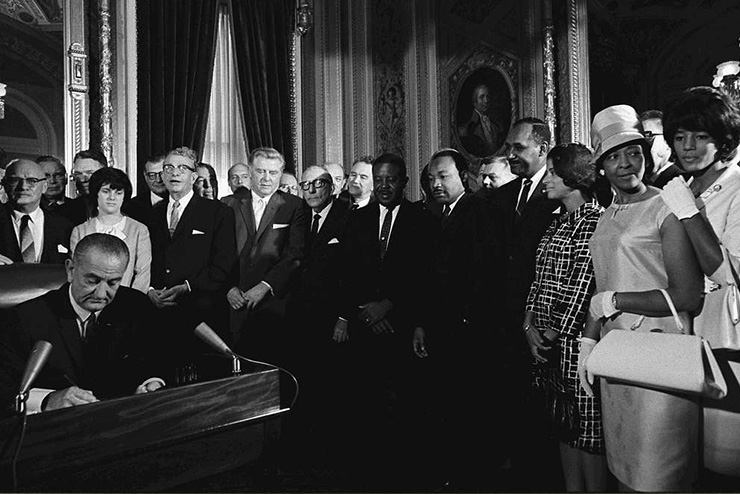
On Sunday, Oct. 19, I was listening to the Fox News Big Weekend Show when the subject of the specially created black electoral districts in Louisiana, now before the Supreme Court, came up. David Webb, the black participant in a racially and sexually balanced panel, let it be known that the best reparation for blacks is learning to succeed in a society that no longer discriminates against them. The two women on the panel then opined that the existence of separate black districts must have been a misinterpretation of the Voting Rights Act of 1965 (VRA). After all, that worthy legislation only aimed at “access.” In any case, so much “evolvement” has occurred since 1965, when that act was passed, that such measures no longer seem necessary.
The impression I got from listening to this talkathon is that none of the participants, least of all Joey Jones, a disabled former Marine from rural Georgia, had the slightest desire to honestly examine the civil rights legislation under discussion or the resulting cultural and social changes. Every time the unsettling subject of race comes up in Conservative Inc. media, the white speakers fall into nervous blather.
The usual narrative to which these talking heads repair is that the U.S. used to be a racist society, but that because of the “evolvement” of civil rights laws and their enforcement by public administrators, we’ve overcome that sad chapter in American history. The conservative establishment, as Carl Horowitz observed in our last month’s issue (“Conservatism Inc.’s Ceaseless Quest for the Great Black Hope”), panders ludicrously to black voters, whom it views counterfactually as a demographic yearning to join the GOP. As part of that pandering, Republican talking heads glorify the civil rights revolution and condemn the Democratic Party, for which blacks just happen to vote overwhelmingly, as the Neo-Confederate Party, or the pro-slavery party of John C. Calhoun.
The same Republican boosters then work to dissociate the civil rights revolution from wokeness, antiwhite racism, or anything else that might be reasonably associated with that transformation. Finally, these GOP partisans indulge in an obvious contradiction—celebrating our racial tolerance and lack of discrimination and complaining about leftist bigotry and its political implications. If white people, Christians, Jews, and males, are being vilified and discriminated against by members of our ruling class, it’s difficult to show that we’re now living in a far more tolerant society than the one that existed circa 1960. As someone who was in college back then, let me assure my readers that this is exactly the opposite of what I remember as a student.
Why can’t we simply say that, while blacks were treated unfairly under Jim Crow laws, the civil rights revolution went overboard? That cataclysm produced an anti-discrimination regime led by public administration, educational institutions, the mass media, and the culture industry. The legislation that punctuated that regime was part of an incremental revolution that has continued to the present. The current reconsideration of the separate black districts by the Supreme Court may be a modest step toward mitigating the effects of an oppressive regime set up to combat, quite broadly understood, “prejudice.” Although there’s no reason to deny that real unfairness initially fueled this reaction, the result has been frightening.
Even in the cases of black success, we find very mixed results. While the scandal of segregation is gone and genuinely talented blacks have been able to move up professionally more easily than before, most of black society is in shambles. And the mobilization of the black vote (which tripled because of the VRA) has resulted in an explicitly antiwhite, racially driven voting bloc that allies with the woke left. The identification of supposed black success with government action has turned blacks into government dependents at every economic level, from anti-discrimination administrators and DEI beneficiaries to welfare recipients. Black economic advancements, as Thomas Sowell demonstrated, were far greater between 1920 and 1950 than during the decades of the civil rights revolution.
Like other civil rights legislation, the VRA was a revolutionary bomb, one that public administrators now wield against their fellow citizens. The left may have a point that the presence of “opportunity districts” for black voters prevents the strength of the black vote from being “diluted,” and thereby in some places rendered inconsequential. One of the explicit purposes of that act was to prevent the suppression of the black vote, and districts throughout the country were closely supervised from above to make sure black voters there were at least proportionately represented.
Having specifically black voting districts was and is a way of ensuring that a once-underrepresented demographic never again suffers that fate. Until 2013, states thought to have suppressed the black vote in the past required “preclearance” before they could redraw voting districts that might affect blacks.
Contrary to what the chirping Con Inc. lady said on Fox News, the VRA was not just about “access.” It was intended to increase the black vote and its influence, and it did so at a time when blacks were moving decidedly toward the antiwhite left. Although blacks became predominantly Democratic during the New Deal for economic reasons, they became radicalized during the civil rights era. The VRA, therefore, has left us with a large, radicalized black voting bloc that naturally refuses to surrender its power. Because it is firmly allied with the left, our leftist ruling class has run to its defense and insists on retaining an advantage that accrued to its side because of the VRA.
Claiming that this was not how things should have turned out is so much wishful thinking. Vast power was surrendered to hardly neutral public administrators to decide whether the much-maligned majority was harboring “prejudiced” thoughts. Were these custodians of virtue supposed to declare their work done in some hypothetical future and then step out of public life? Hardly! They made a lasting business out of combating “discrimination” and got both parties, but especially the Democrats, to pass legislation punishing other perpetrators of discrimination, like sexists, homophobes, and transphobes.
Why would I believe this self-perpetuating crusade would end with the race-based legislation of 1964 and 1965, especially since women were already included as victims of discrimination in the 1964 Civil Rights Act? And why would I think that what the federal government did in that area would not be replicated at the state and municipal levels? Lower levels of government take their lead from the federal government, and the federal anti-discrimination apparatus has reproduced itself, sometimes in a far more oppressive form, in state and local administration.
Even if the federal government stops this oversight, it persists at lower levels of government across almost the entire country. Moreover, attempts to use anti-discrimination laws to protect white males, a proposal Christopher Rufo has presented and defended, might be stymied unless one could replace the leftists who administer the war against prejudice. The anti-discrimination warriors are not going to abandon their conquered turf without a fight.
No, this revolution was never just “about access”! It was about creating an anti-discrimination regime, which, despite President Trump’s war against DEI, will likely be around for a very long time.
Leave a Reply