13 Novels Conservatives Will Love (but Probably Haven’t Read)
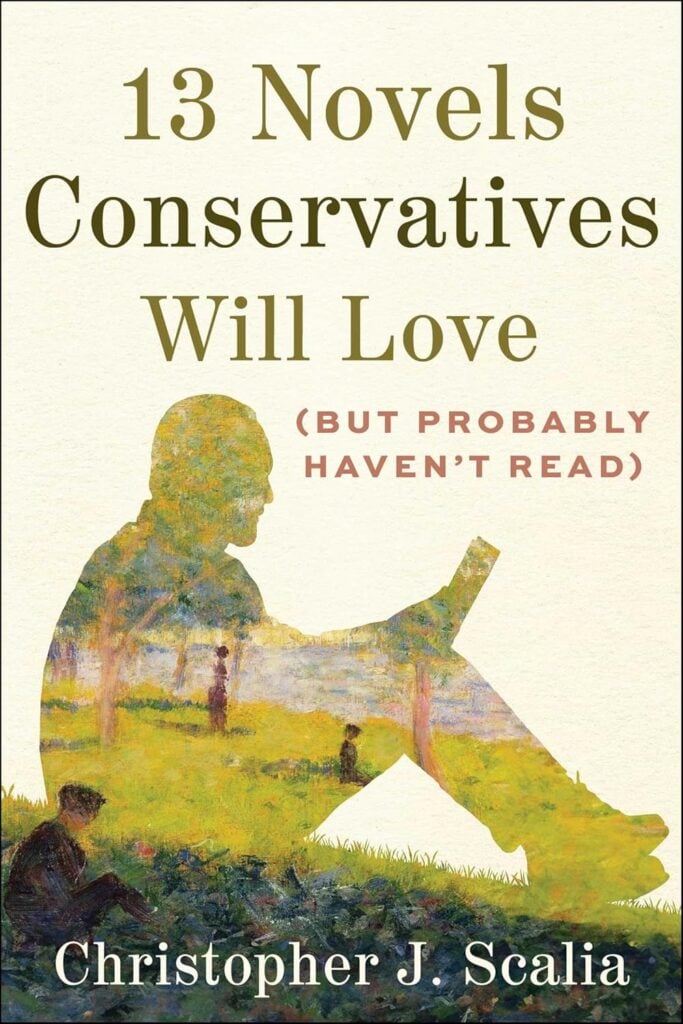
by Christopher J. Scalia
Regnery
352 pp., $32.99
If you want the unvarnished truth about the human heart, your only choice is to read fiction. A great novelist can, with great precision, teach you moral and spiritual lessons unavailable elsewhere, except, perhaps, in Scripture. That, or something like it is the central insight that drives this delightful collection of essays by Christopher Scalia, son of the late, great United States Supreme Court justice, grandson of a distinguished professor of romance languages, and himself a former university teacher of English literature, who is now senior fellow in the Social, Cultural and Constitutional Studies department at the American Enterprise Institute.
Scalia’s project in this book was to bring little-known novels to the attention of conservatives. He has picked 13 spanning three centuries: Samuel Johnson’s Rasselas (1759), Frances Burney’s Evelina (1778), Walter Scott’s Waverley (1814), Nathanial Hawthorne’s The Blithedale Romance (1852), George Eliot’s Daniel Deronda (1876), Willa Cather’s My Ántonia (1918), Zora Neale Hurston’s Their Eyes Were Watching God (1937), Evelyn Waugh’s Scoop (1938), Muriel Spark’s The Girls of Slender Means (1963), V. S. Naipaul’s A Bend in the River (1979), P. D. James’ The Children of Men (1992), Leif Enger’s Peace Like a River (2001), and Christopher Beha’s The Index of Self-Destructive Acts (2020).
It’s a splendid reading list, picked by Scalia both for obscurity and for inspired style. He sought deliberatively to avoid “works that … conservatives already frequently recommend to each other,” and he sought out artists who “demonstrate exceptional technical skill and aesthetic judgment.” His hunch is that “few casual readers have read more than a couple” of these books, and he’s probably correct. I had read five (Scott, Hawthorne, Eliot, Waugh, and James), but then I used to read and write for a living.
Wonderful as all these books are (based on the five I’ve read and an inclination to assimilate several of the ones he recommends that I haven’t), the greatest virtue of Scalia’s tome is the introduction it provides to Christopher Scalia himself. He’s a self-described “cradle conservative” who claims to be “Burke-besotted,” and this introduction to these 13 novels is also a primer on literary criticism, conservative philosophy, Christian theology, and ’80s rock music. Scalia’s dad was widely acknowledged as the greatest contemporary stylist on the Supreme Court, but his son has gone places I don’t think even his father knew, and, as did his dad, Scalia fils drops bon mots and hidden gems with splendid panache.
Christopher Scalia calls himself a “classic rock nerd,” and he reveals, for example, that Willa Cather was born not far from Patsy Cline’s birthplace, and that the theme song Rush Limbaugh chose for his radio show, from Chrissie Hynde of the Pretenders, was a “Burkean lament.” Even more intriguingly, he throws off an obscure reference to the British 1980s new wave one-hit wonder band, Modern English (“I Melt with You”), about making love while an atomic bomb is dropped.
All of this might not be to everyone’s taste, and Scalia himself confesses that his “choices may strike some readers as idiosyncratic or just plain weird.” He explains that he’s “focused on great novels that have not yet been adapted into roughly one thousand movies and mini-series, self-help books, memoirs, travelogues, and fan fiction featuring zombies.” And so he has— yet this quirky little book struck me as exceptionally endearing, and there’s even an appendix with short descriptions of three dozen other books to try.
In describing the themes of his recommended books, Scalia gives us a helpful capsule summary of the essence of conservative desires, channeling most obviously Edmund Burke and Russell Kirk, and setting forth, by implication, a paleoconservative credo that ought to appeal to readers of Chronicles:
They include the preference for gradual social and political change over sudden innovation and revolution; the recognition of the imperfectability of mankind and the consequent dangers—and inevitable doom—of utopian projects; an inclination toward time-tested traditions over abstract theory and untested innovation; a respect for religious belief, particularly in the Judeo-Christian tradition; and an emphasis on the institutions of civil society, especially the family. These works also include plotlines relevant to education, national identity, immigration, the American Dream, postcolonial ideology, demographic decline, the relationship between the sexes, cancel culture, social propriety, racial identity, and competing ways of understanding the world around us.
There are a few fairly recent novels included in the 13, but, as we might expect from someone suffering from what he calls “a severe case of Anglophilia,” who spent a “former life as an English professor” reading and writing about “eighteenth-and nineteenth-century literature,” most of these books recommended reflect the “purifying wisdom of the past,” or what C. S. Lewis called “The clean sea breeze of the centuries.”
Scalia is attempting nothing less than a catalogue of universal timeless truths. Nevertheless, in the course of his exposition, not only does he cite a bewildering variety of literary critics, contemporary and classic authors, pundits, politicians, and professors, but he throws in a myriad of incisive, unexpected observations and asides which demonstrate a literary flair as engaging as those of the authors he illuminates. Here’s a sampling:
When speaking of advanced age, “in preparation for what the great moral philosopher Francis Albert Sinatra called the September of their years…”
“This is no way to treat a lady—even if she is French;”
Hazlett was guilty of “smirking overstatement;”
“If you want utopia, you need to break a few eggs;”
Referring to the use of the third person in Moby Dick, “The novel’s narrator—Let’s call him Ishmael;”
“The Eden of Nebraska has its own serpent;”
Reflecting on, but not quoting, Sartre’s famous comment that “Hell is other people,” Scalia notes, “As Sartre may have observed, Hell is friendly people on mass transit;”
Borrowing from a Talking Heads song, “We may ask ourselves, in our best David Byrne impression, well—how did she get there?”
Possibly alluding to South Park, “Consider Canada. (I know, I don’t like doing that either, but let’s, just this once);”
Or, in an effective summary of Scalia’s effort, in the course of evaluating V. S. Naipul and quoting another critic, “It has been said that the real purpose of conservatism is to keep liberals honest, and the purpose of pessimistic anti-liberal writers is to tell us that life is not so simple and so benign as we would like to assume.”
As he writes about Willa Cather, Scalia clarifies his own aims when he speaks of citing “the old Hebrew prophets, the Greek dramatists, Goethe, Shakespeare, Dante, Tolstoy, Flaubert, and such for the deeper truth of human nature.” This is a guidebook through our current political and military conflicts, and, in particular, our culture wars. It is also an effort, as he attributes to Willa Cather, to achieve “nobility,” and to help attain “the sacrifice of self and the expansion of the self.” His essays on each of his 13 authors are, essentially, and most pointedly in his remarks on Zora Neale Hurston, a recognition and even a celebration of the inevitability of both good and evil in our lives.
Perhaps it does not go too far to say that Scalia even offers a prescription for salvation, as when, in his essay on Muriel Spark, he notes the teaching of the Catholic Catechism that “Grace is favor, the free and undeserved help that God gives us to respond to his call to become children of God, adoptive sons, partakers of the divine nature and of eternal life,” and the observation of Cardinal Newman that God “gives grace by little and little. It is by coming daily into His presence, that by degrees we find ourselves awed by that presence and able to believe and obey Him.”
To put it slightly differently, Scalia is urging us to recognize and accommodate the philosophical and religious timeless truths, the permanent things cherished by Russel Kirk, and he is artfully seeking to forge a means of coping with modernity through both altruism and self-actualization. His theme in his analysis of Waugh’s Scoop is the dismal professional and moral failure of the mainstream media accurately to report on the human condition, and thus our need to resort to great fiction. As in the greatest novels, Scalia’s reach probably exceeds his grasp and ours, but that’s what such works are for.
It is possible that occasionally it’s difficult to tell whether Scalia is being ironic or sincere. He quotes George F. Will’s claim that “the foundational conservative insight can be expressed in two words: nothing lasts.” But these purportedly wise words themselves belie, since Scalia’s book rebuts impermanence through a study of truth, beauty, and God.
Inevitably, when one encounters a maker of lists, the response is to notice what’s left out. Where, for example, are the works of Robertson Davies, A. N. Wilson, or Iris Murdoch? But to raise such quibbles is to fail to recognize that all biography and probably all literary criticism is a sub-genre of autobiography. This is Christopher Scalia’s book and his set of choices, and excellent they both are.
Leave a Reply