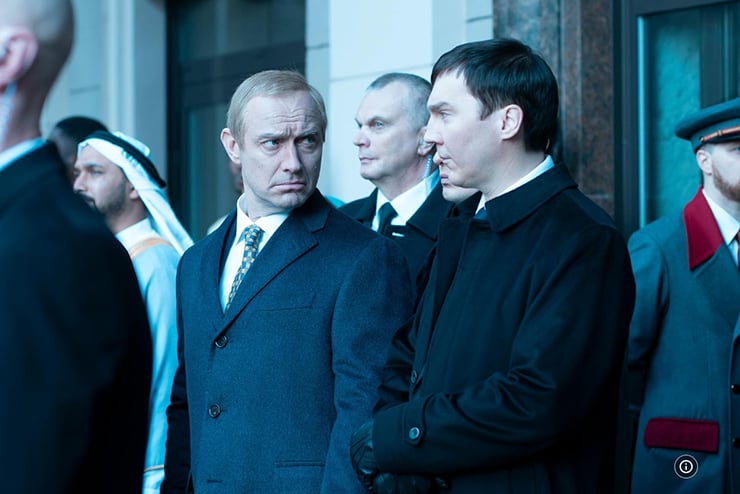
The Wizard of the Kremlin
Directed and written by Olivier Assayas ◆ Based on the novel by Giuliano da Empoli ◆ Produced by Curiosa Films, Gaumont, and France 2 Cinema ◆ Distributed by Gaumont
“In Russia, things generally go pretty well. But when they go bad, they go really bad.” That line could be uttered by just about anyone who has had any amount of success in post-Soviet Russia, where achievement can prove a liability dangerous enough to invite prison, exile, or death.
In The Wizard of the Kremlin, Olivier Assayas’s new film adaptation of Giuliano da Empoli’s 2022 French-language novel of the same title, the line goes to a fictional visiting American academic, Yale University professor Lawrence Rowland, who arrives in Moscow in 2019 to research the life and work of the early Soviet dystopian writer Yevgeny Zamyatin. Zamyatin’s only famous work, the satirical novel simply titled We, bitterly critiqued authoritarianism and its suppression of the individual. Written in the 1920s, it was banned in the Soviet Union until 1989, just as the collapse of communism ushered in the hope and chaos of Russia in the 1990s.
The literary metaphor will probably mean little to most viewers of The Wizard of the Kremlin, which Assayas introduces as “a work of fiction with artistic intent” that recounts the rise and rule of Vladimir Putin through the eyes and actions of a close media adviser. The film never fully explains the literary connection but awkwardly relies on it to launch Rowland’s unlikely encounter with the adviser, a character called “Vadim Baranov,” whose fictional career parallels that of Vladislav Surkov, a real-life media entrepreneur who became Putin’s spin doctor and close adviser.
Surkov worked for Putin from the late 1990s until 2020, when he unwisely began to level public criticism against his increasingly autocratic boss and was dismissed from all posts. Recent reports have suggested Surkov is under house arrest. The narrative frame of the story involves the American academic Rowland, played by Jeffrey Wright, a black actor who can never quite escape his comic role as an elite academic, a role he last played in Cord Jefferson’s 2023 film American Fiction. It’s through Rowland that Baranov, played by the fairly insipid American actor Paul Dano, imparts his tale.
The film’s cursory plot will be familiar to anyone who has followed Russian politics over the past 35 years. The chaotic new Russia of the 1990s offered exultant personal, creative, and intellectual freedom, but also unleashed a rapaciously materialistic society in which money was the primary determinant of value and success. For Baranov, a sensitive soul from a safe but privileged Soviet background, whose family’s former status has become meaningless, his vocation in theatrical arts leads only to disappointment. His formative moment comes early in the film, when he loses his artsy girlfriend Ksenia, played by the pert Swedish actress Alicia Vikander, to his school friend, a flashy capitalist whose life arc parallels that of the real-life Russian oligarch and Putin friend-turned-foe Mikhail Khodorkovsky. (Not coincidentally, Khodorkovsky employed Surkov in his 1990s business enterprises.)
Baranov processes the loss as a lesson and suavely retools his persona and artistic interests to work in the vulgar abyss of reality television production. He is quickly taken up by Boris Berezovsky, the late businessman and fellow Putin friend-turned-foe, who grew a used car business into Russia’s biggest media empire and deployed his wealth to support the country’s ailing first post-Soviet president, Boris Yeltsin. When Yeltsin falters, Berezovsky shifted his attention to Putin, a competent and ostensibly reliable figure, who in 1999 was plucked from his job as head of the KGB’s successor organization to serve as prime minister and then, after Yeltsin’s resignation a few months later, as president.
Following Surkov’s reported real-life role in Putin’s rise, Baranov manages Putin’s media image so effectively that Putin wins his first election and proceeds to create what specialists call “the verticality of power,” essentially a top-down dictatorship in which all political authority originates in the executive. Evil compromises must be made. The initially unknown Putin’s public image is burnished by his forceful and highly visible military responses to the bombings of Moscow apartments. Those bombings were blamed on Chechen terrorists, but many observers believe they were a false-flag operation.
Baranov masterfully manages numerous public relations challenges, portraying Putin positively and coolly through the subsequent war, the Kursk submarine disaster, the Khodorkovsky character’s political opposition and dramatic arrest, and Ukraine’s resistance to Russian hegemony. Ultimately, Baranov’s work leaves him drained and resentful, dismissed from office like Surkov, his real-life double, and left to his own devices until the film’s final scene, in which he tumbles bloodied to the snow-covered ground following an unseen gunshot, possibly an homage to the reported circumstances of the Arctic prison demise in February 2024 of Russian dissident Alexei Navalny.
Da Empoli’s novel was very much of the moment when it appeared in April 2022, just two months after Putin launched his war in Ukraine. A Swiss-Italian politician and academic who leads pro-EU civil society organizations, da Empoli’s anti-Russian animus is obvious, and he clearly did a lot of reading among Western specialists on Russian politics. One wonders, for that very reason, why he, and Assayas in his film adaptation, chose to fictionalize Surkov and Khodorkovsky under pseudonyms while leaving all other historical figures undisguised. It is hard to imagine Surkov, who is internationally sanctioned and possibly under house arrest in his own country, filing a defamation lawsuit, though Khodorkovsky, who survived nearly a decade of imprisonment and now circulates in the West, could argue that he has grounds and standing to do so. Maybe it would have been too much to claim that what da Empoli wrote was history.
In any case, The Wizard of the Kremlin’s story is more than a little simplistic. Putin has far more political acumen than the film suggests, and both rose to and retained power for many other reasons beyond having a “wizard” around him managing media. Throughout his career, and for years before Surkov came along, the Russian president was able to cultivate an image of competence amid chaos. He did this while remaining unexpressive, even insipid, to avoid detection as an ambitious rival or bumptious underling. Baranov/Surkov’s role seems rather exaggerated and unconvincing to anyone who knows the history.
Casting Jude Law as Putin may have been a mistake. While Law has a certain mastery of Putin’s trademark stare and intense eye contact, he is simply too charismatic and has facial features that are too well-defined to pass as a successful imitator. Even if he had mastered the Russian president’s pallid lack of expressiveness, we do not meet his character until about 40 minutes into a film that runs for just over two hours.
The narrative frame also falls flat. By 2019, when Wright’s character Rowland turns up in Russia, visits by Americans had long ceased to be normal or unsupervised. Scholarly programs facilitating in-country literary studies had been indefinitely suspended or relocated to freer neighboring countries. Indeed, Assayas implicitly acknowledges this unpleasant state of affairs by having filmed in Riga, Latvia, which still has enough Soviet-era and Imperial Russian architecture to pass for Moscow, much as Warren Beatty’s 1981 film Reds, made at another difficult time in Russian-American relations, relied on the urban landscape of Helsinki, Finland, for revolutionary Petrograd. Low-quality stock footage of Moscow’s central landmarks and ceremonial sites contributes to the underwhelming cinematography.
Confusingly, Rowland, who is there to study Russian literature, is also the author of a major political analysis of Baranov/Surkov’s work in Foreign Affairs—such a duality could never exist in the hyper-specialized universe of modern American academia. It is the professor’s political analysis that, strangely, prompts Baranov to use an anonymous electronic messaging service to make contact and then to disgorge his life story to a total stranger. The conceit is simply too unbelievable.
If Law’s gravitas and charisma are too overwhelming to produce a credible Putin, Dano’s pallor and expressionless delivery as Baranov leads one to wonder whether he might have been a better choice. Either way, the disparity in acting ability and presence is jarring. Law’s arrival as Putin late into the film easily overshadows Dano’s Baranov, who is with us from the first moment, but whose life, fate, and ideas never produce much sympathy. For raw excitement, the English actor Tom Sturridge’s Khodorkovsky stand-in adds perhaps the only real energy in the film. Even then, the breathy tones endemic to almost all characters become tedious as the film progresses. Their Russian pronunciation recalls the distinctly non-Russian flavor of the mostly British or British-educated cast of David Lean’s 1965 adaptation of Boris Pasternak’s Doctor Zhivago.
Assayas clearly has a story to tell, but as the final credits roll, the lasting impression is that he got lost in the details. Cramming them all into a standard-length feature film made the film rote and ultimately a bore that scarcely merits rewatching. As a drama, the story is better told in Da Empoli’s novel or, if one truly cares about accuracy, in the voluminous political science literature on Putin’s Russia.
Leave a Reply