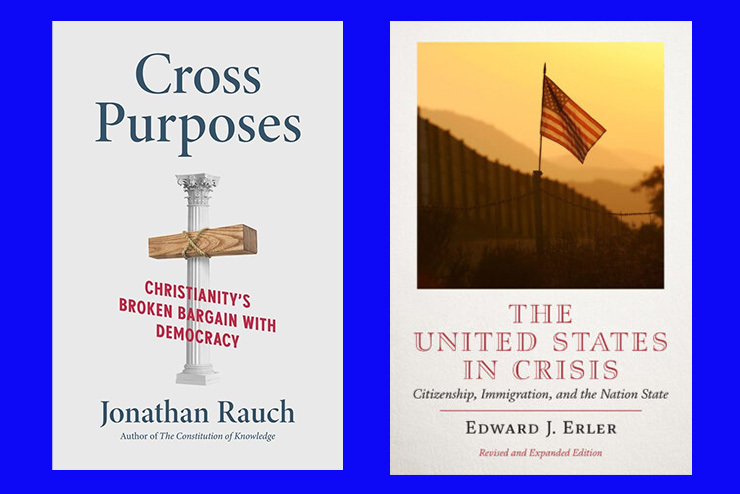
Cross Purposes: Christ-ianity’s Broken Bargain with Democracy, by Jonathan Rauch (Yale University Press; 168 pp., $27.50). This is a curious little book, written by an atheist to Christians to tell them how they should do Christianity in order to bridge its distance with the secular left. The author not only makes no effort to acquaint himself with the history of Christian thought; he completely fails to recognize the extreme moral threat his own secular religion represents.
Rauch denounces “post-liberal” Christians who notice important contradictions between the faith and the liberal political project, but offers no substantive rebuttals to their arguments. The Christianity he appreciates is mainline Protestantism, which is on its deathbed because of its ever-increasing distance from Christian theology and moral tenets.
Rauch wants to remind Christians of their supernatural focus on the world to come, in order to strategically argue that Christians with any interest in cultural struggle in this world “betray” their faith. If Christians would withdraw from politics and leave this sordid world to the secular leftists, we could find compromise! Effectiveness of means cannot be a Christian goal. We Christians are called to be humble as a principle, continuing in our humility to the point of offering no resistance as we are crushed into the dirt by vicious foes. Viktor Orbán and his ilk are anti-Christian because they insist on defending their homelands instead of dropping to their knees to be martyred.
There is no justification for Christians to vote for Trump, Rauch says. After all, he lies, he’s mean, he’s a fascist—you know the drill. If Trump is “not even a little like Jesus,” no Christian should support him. Never mind that the mainstream Democratic Party calls for the destruction of traditional American culture.
It is “the Gospel of Compromise” that Rauch promotes. In practice, this means the victory of the secular left, and especially total acquiescence to the LGBTQ worldview. We should cheer Eve’s decision to eat the fruit of the Tree of Knowledge of Good and Evil because that affirmed human agency. “The Fall was a good thing,” Rauch dares to inform Christians, because before that, humans were mere sheep. Now men are free to marry men, or to become women. How much better than Eden, this liberal paradise in which we find ourselves!
Are there any books by atheists about Christianity that Christians ought to take seriously? Whatever the answer, Cross Purposes is not among them.
(Alexander Riley)
The United States in Crisis: Citizenship, Immigration and the Nation State, by Edward J. Erler (Encounter Books; 168 pp., $27.99). There is so much heat and hyperbole around immigration and citizenship that sorting out the facts is a difficult task. Erler’s aim is to provide a thorough review of the judicial decisions and critical legislation of the field as the basis for reasoned discussion.
He delves into the writings of the Founding Fathers, who believed that the emerging nation-state required firm control of its borders and clear standards for citizenship. But much of their commonsense approach has been undermined by progressives who insist that the principles of sovereignty and citizenship, and even borders themselves, are inherently racist. These partisans often argue using out-of-context phrases from court judgments, laws, and the Constitution; Erler makes a point of revealing the whole context. For example, the meaning of the pivotal case regarding birthright citizenship, United States v. Wong Kim Ark, is different from what the open-borders advocates say it is, which becomes clear when the background and details are set out.
He disdains the bleeding-heart ideologues who supported the flood of illegal immigrants into America during the Biden administration (though its roots go back to the Immigration Act of 1965). “Immigration driven by compassion is misplaced,” he writes. “No-one has a right to emigrate to the United States.”
He also takes a close look at the issue of birthright citizenship. The original intent of the 14th Amendment, passed after the Civil War, was to ensure that the children of former slaves were citizens. But it is now often presented as meaning that any child born on U.S. soil is automatically a citizen, even if the child’s parents are in the country illegally. Not so, says Erler. He sees the often-overlooked phrase of the 14th Amendment, “subject to the jurisdiction thereof,” as forming a strong argument against the idea of automatic citizenship for “anchor babies.”
While Erler prefers that matter be resolved by legislation rather than by executive order, he argues for an order to end dual citizenship. He applauds many of the actions taken by Trump but says there is much more to do.
Erler writes with authority and clarity, and his essential call is for clear thinking. He concludes, “A nation that cannot control its borders and distinguish between citizens and aliens is no longer a sovereign nation. A nation that is no longer sovereign will not be free for long.”
(Derek Parker)
Leave a Reply