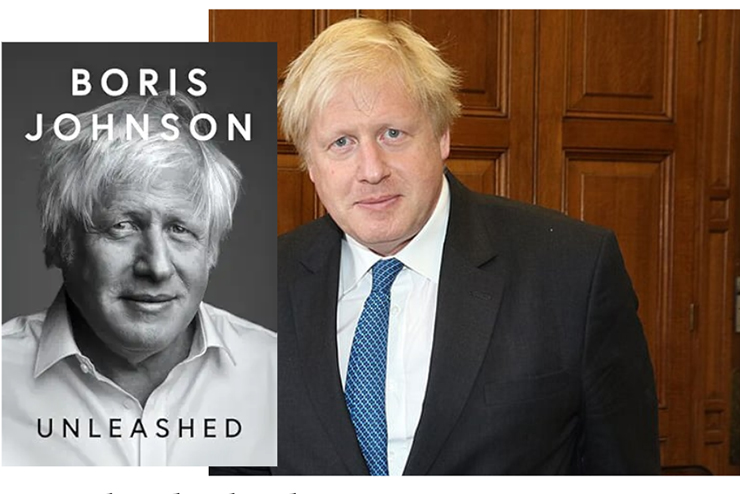
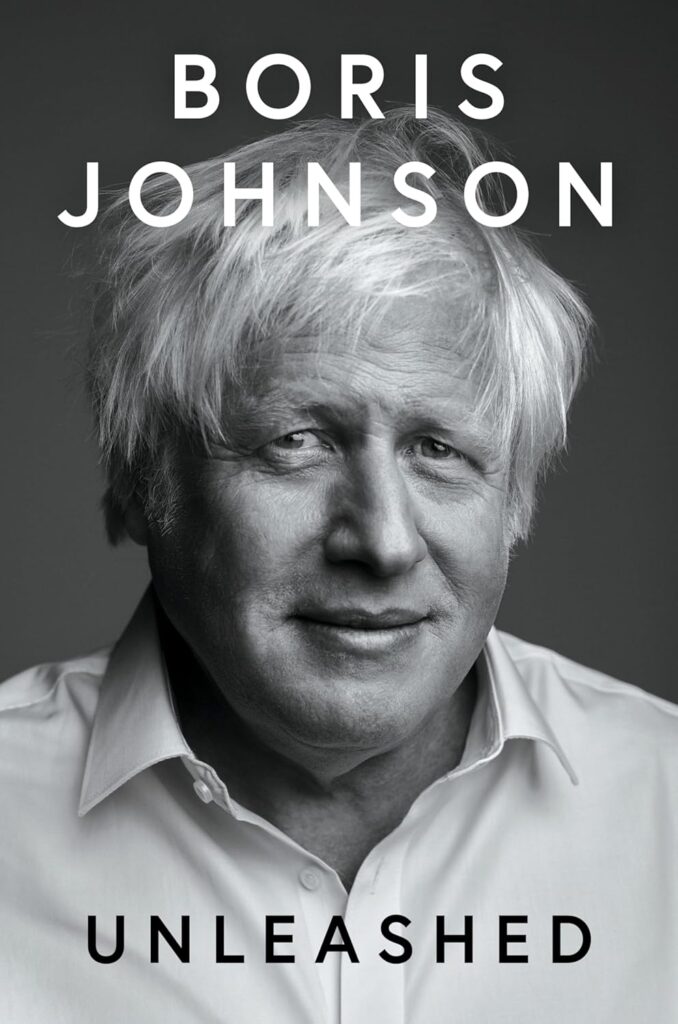
by Boris Johnson
HarperCollins
784 pp., $32
The writing of history is speeding up. Once, politicians waited until they had retired from public life before producing memoirs, which, if inevitably self-justificatory, at least had the merit of perspective.
Now, too many rush into docudramatic print as soon as they leave office (or office has left them) to “set the record straight” (as they see it), but also to capitalize on their fame while they still have some in a world of abridged attention spans. This premature rush into print is encouraged by publishers less interested in the merits of any book than in meretricious brand-name recognition. “Boris” is a globally recognizable brand—and he, unlike many other celebrities, is capable of entertaining writing—so it was inevitable that he would add to this tendentious genre.
Johnson has been extraordinarily lucky in life and both lucky and unlucky in his political career. Few are born into such wealth and privilege, and even fewer possess such charisma—charisma which assured him the editorship of the Spectator, then got him elected as the mayor of generally anti-Conservative London, as a member of Parliament, and lastly as a prime minister with an 80-seat majority, including support from constituencies which had not voted Conservative for a century or more. Boris’s ebullient and facile phraseology made people feel good about voting Conservative; as The New York Times once remarked of Warren G. Harding, “In [his] misty language the great majority see a reflection of their own indeterminate thoughts.”
His advocacy of Brexit in 2016 had been a key factor in pushing the “leave” vote over the line. Millions seem really to have believed his 2019 promises to “get Brexit done,” after three years of prevarication during Theresa May’s tenure. But all these advantages, and any potential for long-term political betterment, were derailed by the pandemic, which briefly threatened Johnson’s own life and then killed his premiership, the missteps of which were magnified by often-hysterical media coverage.
The author famously had a classical education and can emit ancient world allusions or references applicable to almost any situation. This ability to channel talismanic ancient authorities helped to put his less well-educated opponents subtly in their sociopolitical places. Boris effortlessly conveys a Renaissance-1960s world of public schools and easy assumptions, when men could rise almost without a trace thanks to family connections.
That some of these appointees adorned their eventual offices is irrelevant to progressive opinionators, who persist in seeing Britain as a class-bound “male, pale, stale” dystopia. This view was always a caricature and, insofar as it contained much truth, is now roughly a century out of date. Johnson would have been excused for his privileged background had he not also been a Conservative, but as these opinionators “know,” Conservatives are heartless beasts who deserve neither credit nor understanding. (This is another factor impelling Conservative autobiographies: the attempt to absolve themselves of endless imputations of moral turpitude.) Johnson is not heartless, of course. Sometimes he’s not even conservative, which is perhaps more concerning.
Johnson’s classical education means he frequently has Rome on his mind, and he sees Roman history in shinier and more liberal lights than most, as an ideal society characterized by borderless movement and trade over a vast area; one that is multiethnic, multilingual, religiously diverse, and lightly taxed and regulated. Rome, long-lived though it was, would surely suggest to most the ultimate fragility of all civilizations, and the omnipresent risks of overconfidence and overexpansion.
Nevertheless, Johnson’s sunlit Dream of Rome (the title of one of his books) accords with his neoliberal and libertarian outlook. It also explains why he supported a party and then presided over a government which increased the immigration it had been elected to reduce. Before the Brexit referendum, net immigration was around 300,000 a year and mostly from within Europe. In the year ending June 2023, it reached over 900,000—mostly from outside Europe. The Western Roman Empire had become too large and too diverse, and too addicted to ease, but Johnson (unlike the wiser if less winsome Enoch Powell) cannot see any parallel. As for the Eastern Empire, it eventually succumbed to the Islamists of their day, the Ottomans, for whom Johnson has misplaced affection on the sentimental grounds that one of his ancestors once held high office under the Sublime Porte of Constantinople.
Johnson is known for proposing grandiose architectural schemes, such as a “garden bridge” across the Thames, and even one across the English Channel. These were always unrealizable because he is notoriously impatient when it comes to detail. He is boosterish by nature, but often seems to have nothing of substance to boost. His chief architectural legacy dates from his time as London’s mayor, when he presided over a skyscraper-building bonanza that many feel has made London less attractive and less distinctive—a strange legacy for a Tory.
He prefers to focus on what he sees as the apex of his eight years as mayor: the Olympic Games of 2012, “golden weeks of sport … togetherness and rejoicing in our beautiful multicultural identity.” Cynics might say such crowd-and media-pleasing rhetoric is just him evincing the other Olympian quality he lauds, “an utterly ruthless determination to excel, to beat others and to get on that podium.”
Johnson has consistently taken a long view on environmental issues, so differentiating himself from Donald Trump’s crass mantra of “drill, baby, drill.” Like Margaret Thatcher, Johnson can see that although ecologists are sometimes hard to like, they are not necessarily wrong. Here, he makes a defense of global warming theory that is too rare on the right, albeit mixed with shrewd skepticism about the proposed Net Zero “remedies.” He takes a Pascal’s wager on climate change: “If we are wrong, we lose nothing… If we are right, and we take the right measures, then we are also ensuring the salvation of much of the human race and the natural world as we know it.”
In London, he planted huge numbers of trees amongst his vaunted skyscrapers and made great strides in reducing air pollution by encouraging cycling and improving public transport. So noted is his affection for animals that he was accused of prioritizing them over humans during 2021’s chaotic evacuations from Afghanistan.
One allegation often made against Johnson is that he lacks principle; in particular, that he backed Brexit only because he thought it would be politically astute. This theory was made more credible by his changing his mind about Turkey’s entry into the EU in 2016 (something he had previously supported), using that prospect to argue for the UK leaving—and by his manifest unpreparedness for actually winning the Brexit vote. This seems overly complicated and unfair to the author.
Johnson was Euroskeptical since the late 1980s, when he began reporting from Brussels for the Daily Telegraph, and first encountered the EU’s mind-numbing pettifoggery. He also always felt that other member states shared scant recent history and fewer political traditions with the UK, and that Britain should cultivate the rest of the world rather than pursue closer links with an inflexible Europe.
“Surely we [Britons] aspired to be citizens of the world, not just citizens of Europe,” he expostulates. “It felt a bit culturally supremacist, a bit surreptitiously racist.” This accurately reflects his expressed views of the 1990s, and we can see in his whole career a foreshadowing of the post-Brexit immigration free-for-all. What may be most surprising is that many Boris-backers seem really to have expected him to take an interest in controlling migration.
Johnson is generally neoconservative in foreign policy. For example, he denounced China’s crackdown on democracy in Hong Kong, which left Beijing unmoved but did result in his typically reckless 2020 promise to allow up to 3 million Hong Kong residents to settle in the UK and eventually obtain UK citizenship. He was inevitably a strong supporter of Ukraine from the start of the war, visiting frequently and making blustering promises of eternal aid, seemingly without wondering whether they could really be kept. Those visits were possibly partly to distract himself, as much as the media, from gathering clouds at home. These included allegations of hypocrisy, incompetence, and sleaze during COVID from allegedly dubious government deals with Conservative-supporting medical equipment suppliers, and “Partygate”—a scandal in which Downing Street employees and Johnson himself mingled freely while the rest of the country was under lockdown.
He acknowledges errors around the pandemic, but also claims credit for the impressively swift construction of extra hospitals, and being the first country to roll out the vaccine. A typical Boris flourish comes from this section, where he reminisces about a madcap scheme he toyed with in 2021, to send a British military squad to raid a Dutch laboratory to ensure 5 million vaccine doses belonging to Britain were not diverted by EU health authorities. Boris here, as he does so very often, talks a good fight.
Unleashed contains fine lines, but overall fails to live up to its literary promise; the author’s style is better suited to newspaper columns. His generally dispiriting subject matter does not really lend itself to his trademark jocular wordplay. It nevertheless will be widely read, both because it gives his version of still emotive, still unfolding events, and because, although he is presently out of Parliament, he may even now have a political future. As his party battles against extinction, many of its rump supporters are looking back nostalgically on high points with which Johnson is inextricably associated, and making fond excuses for his mistakes—and Johnson has himself hinted of a Cincinnatus-like return. Unleashed is underwhelming, but it will always have an audience so long as Britain remains undelivered.
Leave a Reply