
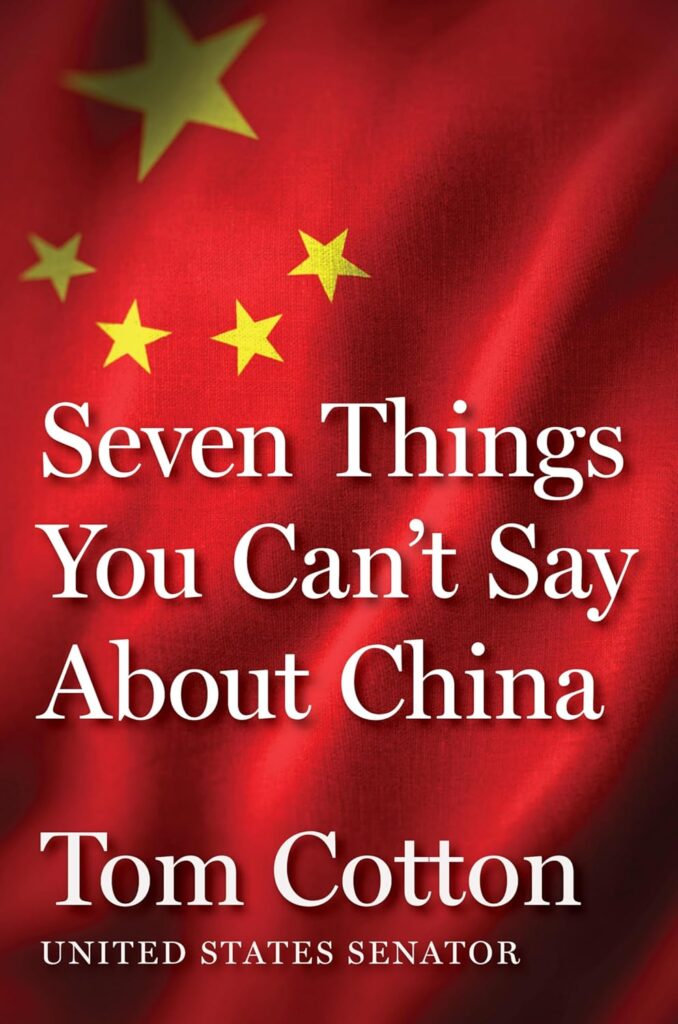
Seven Things You Can’t Say About China, by Tom Cotton (HarperCollins; 208 pp., $27.99). Chinese general Sun Tzu underlined the importance of subterfuge, disruption, and intimidation to defeat a more powerful enemy. Chinese President Xi Jinping and the cabal around him have put these ideas at the heart of their geopolitical strategy, according to a new book by Senator Tom Cotton. In Seven Things You Can’t Say About China, he provides a remarkable analysis of Chinese moves against the U.S. As a member of several crucial Senate committees, he has had a ringside view, and his expertise is clear.
He dates the beginning of the U.S.’s bloodless war with China to 2000, when the U.S. foolishly granted it Most-Favored-Nation trading status, which was followed by China joining the World Trade Organization. The Western hope was that trade would lead to political liberalization. But this, says Cotton, was folly. China instead enacted plans to dominate the Asia-Pacific region and to exert its influence across the globe. It used its new status to infiltrate multinational institutions as well as colleges and corporations. It established a program of stealing intellectual property, often using the pilfered tech to bolster its military expansion.
Cotton notes that even as China exploited the liberal West, it brutally suppressed its minorities and kept its population under comprehensive surveillance.
There was no shortage of evidence demonstrating this, but Cotton emphasizes that anyone pointing it out was pilloried by the mainstream media and roundly attacked by Chinese interest groups. He points out that many journalists are very willing to defend China. This is especially so if it is a way to attack conservatives as racists or hysterics, such as when Cotton suggested that the COVID virus may have come from the Wuhan lab (he and Steve Bannon were among the first to say so).
He delves into China’s attempts to claim new maritime territory and intimidate its neighbors. Taiwan is most obviously on the firing line, and Cotton advocates a greater level of political and military support from America. At least the Trump administration has identified China as its key adversary and is taking action in several of the areas discussed by Cotton. Cotton rings a warning bell; now it is up to others to follow through with policy.
(Derek Parker)

Antisemitism in America: A Warning, by Chuck Schumer (Grand Central Publishing; 256 pp., $20). The leader of the Democratic minority in the Senate has chosen to give us the “real deal” on anti-Semitism in America. He has produced a book that is not all bad, but often so long-winded and exasperating that his occasionally sensible observations will never be read before his readers succumb to fatal boredom. The book also contains some dubious history and occasional disingenuousness as Schumer dodges important issues and engages in emotional button-pushing.
Schumer does, however, give an entirely reasonable exposition of how the rise in anti-Semitism is a general danger to society, not just to Jews. He makes some good points in his examination of how it is connected to the general growth of pessimism, anxiety, and division among Americans, by the fractionating of news media, and the rise of “social (or antisocial) media.” He also provides a sound distinction between reasonable criticism of Israel and anti-Semitism. It is hard not to share his seething anger at the accusation of genocide leveled at the Israelis. These parts of the book show that Schumer can think—at least when he lets himself do so.
Schumer is rather surprisingly critical of how Israel has handled things since the Oct. 7, 2023, Hamas attacks—possibly more so than is reasonable. His distaste for Netanyahu is clear. But then, most Israelis don’t like Netanyahu, either.
Unfortunately, Schumer remains in a state of shock at the particularly savage hostility to Jews coming from the left. It clearly puzzles him; he seems unable to assimilate it. He ignores any connection with immigration, and particularly Muslim immigration, though the situation of Jews in Western Europe is a dire warning about that. Schumer clings to the simple formula that anti-Semitism is just a recurrence of traditional hatreds—essentially an especially long-enduring form of racism. But during most of history, hostility to Jews did not take that form.
His account suffers from other glaring inaccuracies, such as misdating the onset of anti-Semitism in Europe to the late Middle Ages, and stating that the material advances of Jews and other minorities in the U.S. date from the late 1950s and 1960s. This material improvement goes back at least to the end of World War II.
He also links anti-Semitism to “nativist” hostility to immigrants, which is not entirely wrong. But the worst conflicts were not between old-stock Americans and Jews (or other immigrants in general), but between different immigrant groups. That, of course, is not a fashionable thing to mention.
(Alan J. Levine)
Leave a Reply