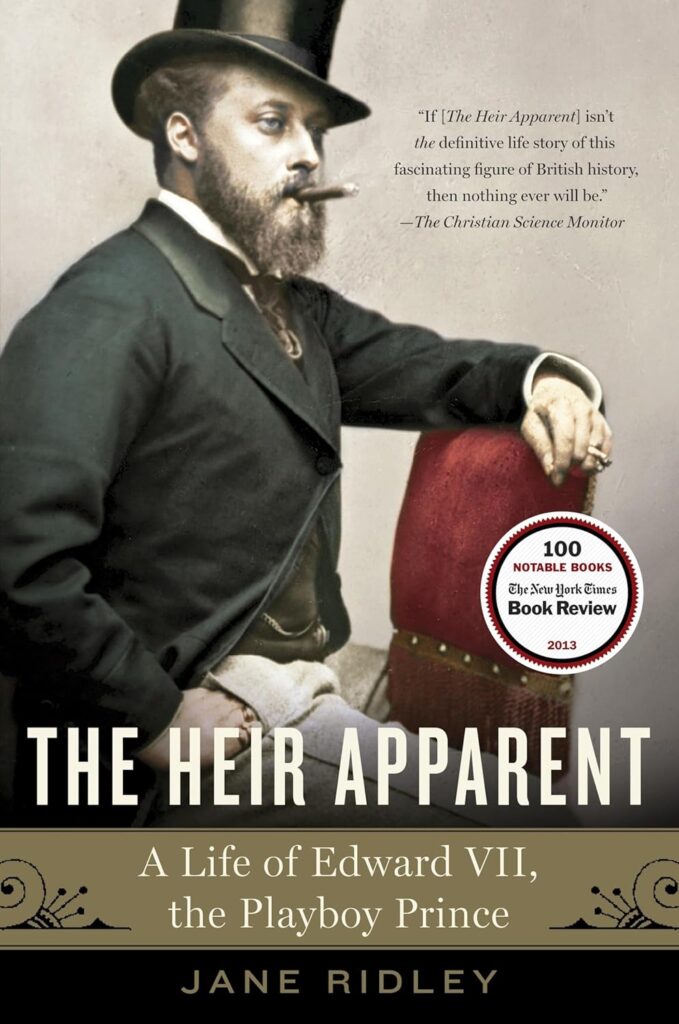
Being Queen Victoria’s son was not a blessing for the young Albert Edward (1841-1910), Prince of Wales and ultimately King of England. Jane Ridley’s scholarly yet entertaining biography shows how Queen Victoria dominated him, both as mother and sovereign.
Exceptionally close to her first child, Princess Vicky, and fixed on her Prince Consort, Victoria kept the boy known as Bertie at a distance, apparently making little effort to prepare him for kingship. Following Prince Albert’s death, Victoria was especially withdrawn and resentful. Ridley writes of the “feminization” of the monarchy during her reign and Bertie’s “marginalization and emasculation.” Amazingly, he survived to become a very effective and popular monarch.
Does that summary suggest anti-Victorian prejudice on Ridley’s part? On the contrary, she highlights the strengths of late-Victorian society. She eschews revisionism as well as uncritical feminism, which distorts much historical and biographical writing. Neither does she overemphasize psychology, nor does she let the sense of inevitability dominate her narrative. She exposes without melodrama or sensationalism Bertie’s dissolute youth and bad habits, some lifelong—gambling, womanizing, “hopeless frivolity”—but does not indulge in today’s widespread tolerance, even celebration, of dissipation and addiction. Bertie narrowly escaped death from typhoid just before his coronation, saved only by new medical advances.
Ridley emphasizes the importance of the rivalry between the British monarchy and Prussia in Edward VII’s life. His marriage to Alexandra of Denmark was politically crucial, as the Danes detested German power following the 1864 war. The hostility produced Britain’s alliance with its hereditary foe, France, as well as Russia, whose czar was Alexandra’s brother-in-law. Ridley takes advantage of recently unearthed sources, including letters between the queen and the czarina. Ridley’s style is sensitive yet straightforward, honoring good scholarly English.
Edward VII had a particular dislike of German Kaiser Wilhelm II, his eldest sister’s son. On his deathbed in 1910, he predicted trouble ahead for Europe, writing, “I have not long to live and then my nephew
will make war.”
—Catharine Savage Brosman
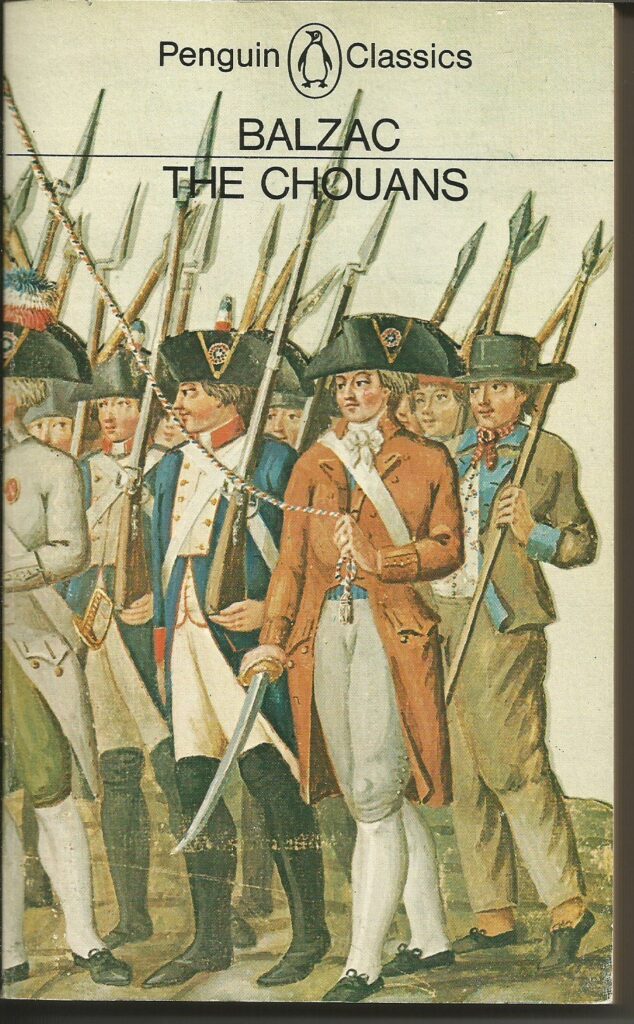
Balzac was the towering titan of French literature, to whose accomplishments even other giants such as Flaubert and Zola aspired.
The Chouans is a love story set during the Royalist revolts against the French Revolution on the country’s northwest coast. Marie de Verneuil, the widow of Danton, is enlisted by Republican military officials to entrap the crafty Chouan leader, the Marquis de Montauran, through romantic intrigue. But Marie is captivated by the dashing Marquis and falls in love with him.
The book is not among Balzac’s greatest novels. Even titans need time to develop, and he wrote this in his twenties. The scenes are too often contrived, and the dialogue unnatural. The work is redeemed and worth reading as a social commentary, however, because of Balzac’s astute description of the tenacity and spirit of the Chouans’ fight to resist the atheist and radically democratic thrust of the Revolution.
The novel’s single greatest scene is not any of those illustrating the romance of the Marquis and Mademoiselle de Verneuil, though there is a lovely reference to their marriage praising this “most hallowed institution” as a fundamentally religious rite lovingly embraced by the anti-revolutionary rebels even in the midst of the Revolution’s efforts to pulverize it. It is in the scene of a celebration of Mass “in the depths of the forest” by the Chouan guerrilla fighters, and in the homily delivered by the Abbé Gudin, that we get the most trenchant insights into the fervor of the resistance to the Revolution.
The sylvan Mass is first compared to the “simple self-forgetful devotion that marked the earliest era of the Christian faith.” Soon, though, the Abbé connects the faith directly to the ongoing war and calls on the soldiers to raise their guns in defense of the king, praying “Domine, salvum fac regem!” (“Lord, save the king!”) Balzac duly notes that this might seem a contradiction, that “Christ’s peace-bringing Cross [would] become an instrument of war,” but he has Marie, who witnesses the religious event, testify to its “prodigious effectiveness [and] the influence the clergy exerted throughout the rural districts.”
The Chouans are a simple people, and this is no defect in their characters. They fight with ferocious bravery. The Marquis is presented in the novel as clearly the most admirable male character, towering over all the Republican male figures who oppose him. This is why Marie loves him.
Balzac took on the task of depicting human morality realistically, not with the aim of a propagandist but with that of a dedicated analyst of human realities as they exist. The Church’s role in the resistance to the Revolution is undeniable, and the royalist Balzac gives us a lovely account of its emotional nuance.
—Alexander Riley
Leave a Reply