Directed by Brett Ratner ◆ Produced by Muse Films, New Element Media, and RatPac Entertainment ◆ Distributed by Amazon MGM
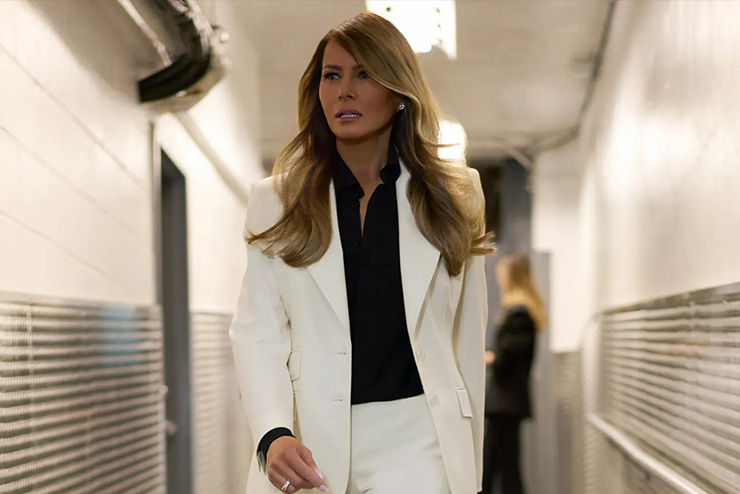
Melania, a documentary about the first lady billed with the subtitle “Twenty Days To History,” opens at Donald J. Trump’s second inaugural, where the first lady busily interrogates Secret Service and various staffers on the details of the event. She is not a passive observer, just along for the ride, but a major force behind and in support of the leader of the free world.
This was no ordinary inaugural ceremony, as Mrs. Trump, accompanying her husband, was returning to her role as first lady of the United States for a second nonconsecutive term. That had happened only once before in American history, in 1893, when Frances Cleveland returned to the role after a one-term hiatus, accompanying her husband Grover when he resumed the presidency.
One hundred and thirty-two years later, Trump’s second inauguration was also historically disrupted by winter weather so cold that the swearing-in ceremony—the official transfer of power—had to be relocated from its normal location on the Capitol steps, where hundreds of thousands of people were expected to watch it, to the much small indoor space of the rotunda, which could only accommodate about 2,000 spectators. An adjoining spillover room held hundreds more. Another 20,000 or so—hefty donors all—were redirected to the Capital One Arena, where the ceremony was broadcast on a giant screen.
Ronald Reagan’s second inauguration in 1985 was the last that was moved indoors due to inclement weather. The organizers of Trump’s smaller ceremony had just 72 hours to make changes. Their Herculean tasks included the 2,000-person candlelight dinner held at the National Building Museum the evening before the inauguration and the three official inaugural balls held in various locations the evening following it. These would have been challenging in any circumstances and were far from perfect in execution. Nevertheless, the 12 separate film crews who worked in Washington on Melania rolled with the punches and delivered a tasteful and intimate portrait as she returns to the White House, alongside substantial scenes in New York and Palm Beach.
The film, which was conceived at the president’s Mar-a-Lago estate in the heady days after his 2024 electoral victory, is not a biopic-style documentary but rather a slice of Melania Trump’s busy life over the 20 days between New Year’s 2025 and the Jan. 20 inauguration. Americans of all political stripes are fascinated by the presidency and the many details behind it. Consider, for instance, the meticulous attention to White House personnel, protocol, and procedure documented in The West Wing, House of Cards, and innumerable films going back decades.
The first lady’s role comprises a key part of that fascination. Indeed, there exists a vast corpus of media delving into the lives of Eleanor Roosevelt, Jacqueline Kennedy Onassis, Pat Nixon, Nancy Reagan, Hillary Clinton, and Michelle Obama, to cite the most represented among them. The Smithsonian’s National Museum of American History has maintained a dedicated first ladies exhibition that has appeared in 10 incarnations dating back to 1912.
As the wife of Donald Trump in a media universe that hates him, Melania has been given short shrift, though she is by many accounts a very private person whose main concern has been raising her teenage son. Still, fashion magazines that enthusiastically profiled older and far less glamorous first ladies as a matter of course notoriously snubbed Melania despite her stunning looks, style, and independent success as an international fashion model. (Her identity as an immigrant should have been a selling point for the media as well—but she’s apparently the wrong kind.) As recently as August 2025, the staff of Vanity Fair threatened a “mass exodus” if their publication profiled Mrs. Trump. When Melania invites the public to view her new film with the lines, “Everyone wants to know, so here it is,” she is acknowledging her purposeful exclusion as much as confessing any reticence she may have had.
The film moves briskly as Melania balances her private concerns with the demands of her position as a returning first lady. Reprising her role as the most watched woman in the world requires insight into couture and foresight as to how she will appear on her first day back. As the nation’s most important hostess, she also has to liaise with the inaugural dinner’s event planner to create a stunning and memorable evening.
While planning all these events, she also begins rebooting her “Be Best” campaign to promote children’s well-being, especially amid such newer concerns as cyberbullying, opioid addiction, wellness, and psychological distress. Melania’s highly intelligent discussion of those issues involves sophisticated conversations with other women world leaders, including a home visit at Mar-a-Lago with Queen Rania of Jordan and an exchange in fluent French with France’s first lady Brigitte Macron.
Melania’s preparatory actions demand so much of her time that we do not hear from President Trump until he calls to ask if she saw the congressional certification of his electoral votes—and finds out that she did not have time to tune in. Whenever he reappears, he is full of awe and praise for his wife.
Duty calls before Trump is even sworn in again. Just days before the inauguration, former president Jimmy Carter’s sudden death required Melania’s sudden departure from New York to Washington for his state funeral. The date turns out to be a tough one—it is also the second anniversary of her mother’s death. She goes to St. Patrick’s Cathedral to pray, an otherwise simple act but one that even before the inauguration demands multiple Secret Service vehicles, a police escort, the presence of multiple bishops, and a crowd of onlookers.
As a wife and mother, Melania must reconcile familial instincts with the demands of office and ceremony. She questions the Secret Service on whether it will be safe to exit the presidential vehicle to greet spectators on the way from the White House to the Capitol. She considers the advisability of moving the swearing-in ceremony inside, given that her husband had been the target of at least two assassination attempts in the prior seven months. Balancing these tensions can only reveal grace under pressure in the most human sense.
The film so rarely addresses President Trump’s policies that the film’s main subject could conceivably be a first lady of either political party, were it not for a panning shot that reveals a visibly annoyed Vice President Kamala Harris checking her watch as the swearing-in proceeds.
The honor of making the film was opened to bids from major entertainment corporations with a lot to make up for after hewing to the radical left during the Biden administration and before. Disney, which cast an initial bid of $14 million, had followed a policy to present more LGBTQ+ themes and characters into its programming, directed mainly at children. Netflix and Paramount, other corporate woke offenders that have tried to clean up their acts, also reportedly made offers before being surpassed by Jeff Bezos’s Amazon, which paid $40 million for the film rights and pledged an additional marketing budget to promote the film. Some reports claim the marketing funds reached an additional $35 million, but this figure is disputed. The film was unveiled at a White House dinner screening for seventy celebrity guests before its official premiere at the newly restyled Trump Kennedy Center.
The usual suspects slammed the project from the beginning, with leftist commentators, including the temporarily disgraced late-night talk show host Jimmy Kimmel, calling it an outright “bribe” offered by Bezos to the Trump administration. Mrs. Trump, who reportedly received a $28 million personal payment for her participation, was also named as one of the film’s producers, giving her significant control over the final product, in which her colleagues have said she invested considerable insight from her modeling career.
Melania’s director, Brett Ratner, best known for the Rush Hour franchise, was making his return to the big screen eight years after sexual harassment allegations derailed his Hollywood career. According to media reports, Amazon employees were not allowed to opt out of working on the film for political reasons, and about two-thirds of its New York film crew requested that their names not be credited. Even before the film was released, hundreds of users flooded Letterboxd, an online film cataloguing service, with negative reviews. According to the film review aggregator Rotten Tomatoes, only 11 percent of film critics gave Melania a positive review.
Curiously, the institutional left cannot seem to agree on why Melania deserves a negative response. Some indulged their Trump Derangement Syndrome to argue that the film is—despite its lack of political and racial content—fascist propaganda in the mode of Leni Riefenstahl’s movies for the Nazis or a right-wing racist tract in the abhorrent tradition of D. W. Griffith’s The Birth of a Nation. Other leftist critics contradictorily judged it a dull, trivial film that reveals too little about the first lady to interest them. Still other reviews smacked of good old-fashioned envy at Melania’s rise to wealth and power.
Casual viewers appear to disagree broadly, however. In its first weekend, Melania was the third-highest-grossing new release in America and the most successful nonmusical documentary film to open nationally since 2012. Its opening day receipts nearly tripled the expected $1 million, which is itself high for a documentary. CinemaScore, which compiles audience reactions, polled first-night audiences who gave it a grade of “A” on the standard academic letter grade scale of A+ to F. A PostTrak survey of filmgoers’ attitudes found that 89 percent of those who saw it would recommend it to a friend.
Ultimately, one’s reaction to Melania is likely to reflect their view of her husband, but a rare objective viewer will see that the first lady is a smart, graceful, and elegant lady who sincerely cares about our country.
Leave a Reply