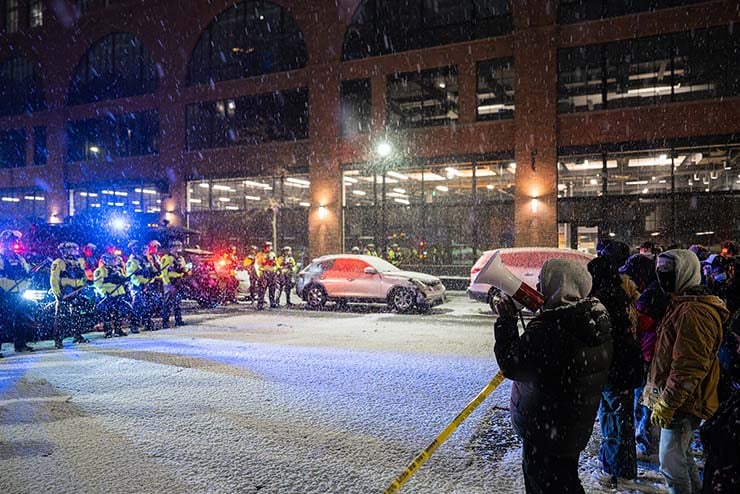
The surge of left-wing violence against immigration officers in Minneapolis is entirely different than the situation leading up to the U.S. Civil War.
Organized anti-ICE violence in Minneapolis and other cities is an effort to overturn the 2024 presidential election and duly enacted immigration laws. Donald Trump won the election, in large part, based on his promises to regain control of America’s southern border and to deport millions of illegal aliens. The national legislature has armed him with no new immigration laws. Trump is simply enforcing statutes that the prior administration ignored as it attempted to radically transform American society.
The Department of Homeland Security reports that immigration enforcement officers
are now facing an 8,000% increase in death threats against them and a more than 1,300% increase in assaults against them while they put their lives on the line to remove murderers, pedophiles, rapists, gang members, and terrorists from American neighborhoods.
The mainstream media portrays the demonstrations and anti-ICE violence as the reaction of honorable people pushed to the breaking point by aggressive law enforcement tactics. Renée Good and Alex Pretti, they tell us, are martyrs slain at the hands of an American Gestapo. All Good and Pretti wanted is “due process” for illegals. Enforcement of immigration law is portrayed by organizations such as Indivisible.org, a progressive group at the center of the disturbances, as “racial suppression and political control. It’s grounded in a white supremacist vision of America.” Protestors demand open borders as they chant, “From Palestine to Mexico, all the walls have got to go.”
This is balderdash. Due process is not the issue: Trump’s slowing or undoing of the Great Replacement is the real concern.
Mobs following ICE agents, scuffling with them, and alerting illegals to ICE’s presence have made it impossible to enforce immigration law in many cities. Federal detention centers have faced attacks across the country—with Democratic politicians such as Tim Walz applauding efforts of the mobs to cause “good trouble” for federal agents.
What legal steps can President Trump take to quell the mob violence? One alternative is the invocation of the Insurrection Act, a collection of statutes that permit the president to deploy regular military and National Guard forces to suppress domestic unrest.
This statutory scheme is grounded in congressional power “to provide for calling forth the Militia to execute the Laws of the Union, suppress Insurrections and repel invasions” and the president’s designation as commander-in-chief of the armed forces and of the militia “when called into actual service of the United States.”
At the Virginia ratifying convention, James Madison defended Congress’s power to use force when resistance arose to federal law: “There might be riots, to oppose the execution of the laws, which the civil power might not be sufficient to quell.” At the first Congress, Madison supported legislation that delegated to the president the power to call out the militia. Such legislation was feasible inasmuch as Congress enjoyed lengthy breaks between sessions and the president remained on the job throughout the year.
The Insurrection Act has existed in some form since 1792, although it has been amended over the years. The most relevant portion as applied to current events is 10 U.S. Code § 252, “Use of militia and armed forces to enforce Federal authority.” It provides that when combinations of persons make it impracticable to enforce federal law, the president “may call into Federal service such of the militia of any State, and use such of the armed forces, as he considers necessary to enforce those laws or to suppress the rebellion.” Prior to using the militia or regular forces, the president must issue a proclamation demanding that the troublemakers “disperse and retire peaceably to their abodes within a limited time.”
According to the Supreme Court, the president has the authority to determine whether an exigency exists that would allow him to call forth the militia (today the National Guard), and such presidential determination is conclusive upon all other persons.
Other statutory provisions allow the president to send federal forces into a state at the request of the governor or the legislature in the case of insurrections. The president may also deploy federal forces if a combination of individuals hinders citizens’ exercise of fundamental rights.
Modern invocations of the Insurrection Act include President Eisenhower’s 1957 deployment of troops to further desegregation efforts in Little Rock, Arkansas; President John F. Kennedy’s 1963 use of the National Guard to end Governor George Wallace’s stand at the school house door in Alabama; and President George H. W. Bush’s 1992 use of the military to restore order after the Rodney King riots in Los Angeles.
Without question, President Trump can invoke the Insurrection Act to stop resistance to the enforcement of immigration laws. Such a decision is not subject to judicial review, and the present circumstances fit squarely into the statutory language of § 252.
Of course, we would not be discussing the Insurrection Act if state and local officials voluntarily cooperated with federal authorities in enforcing immigration law. In saner locales in the union, state police officers, say, arresting a drunk driver and discovering that he is an illegal alien, will hold the criminal and notify ICE to pick him up. Minneapolis is a sanctuary city where Mayor Jacob Frey refuses even the modest cooperation described with the hypothetical drunk driver. In Minneapolis, the inebriated illegal alien will be released back into the community.
The only reason federal agents are so active in Minneapolis is the city’s sanctuary status. Without the cooperation of local cops who encounter myriad illegals in their daily activities, ICE agents are enforcing immigration laws by themselves. Of course, local officials are not required to help ICE—they cannot be commandeered to carry out federal law. But in a less ideologically crazed world, most state officials gladly collaborate with federal officers to remove criminals from the streets and thus make communities safer. Minneapolis and other Democrat-run cities prefer virtue signaling when it comes to criminals who are racial minorities; hence, we have the current disorder.
Even Conservatism Inc. should be able to offer sound criticism of the lunacy exemplified by Minnesota’s lawlessness, right? Wrong. The usual suspects insist on applying lessons from the Righteous Cause and casting Trump as Saint Abraham Lincoln and Minnesota’s elected officials as sinister Confederates.
“In today’s America,” writes Jeffrey Lord of the American Spectator, “there is Minnesota’s Democrat Governor Tim Walz following the path of Jefferson Davis, marshaling the forces of violent anti-federal government ICE protestors to fight federal government ICE employees led by another Republican president, Donald Trump.”
Newsweek’s Josh Hammer sings the same tune. “In echoing the discredited theories of yesteryear … Minnesota Gov. Tim Walz, Minneapolis Mayor Jacob Frey, Rep. Ilhan Omar (D-Minn.), and the rest of the state’s top Democratic brass have emerged as modern reincarnations of Jefferson Davis.” Minnesota Democrats demanding “ICE out,” according to Hammer, spew an “updated version of John C. Calhoun’s vile life outlook.”
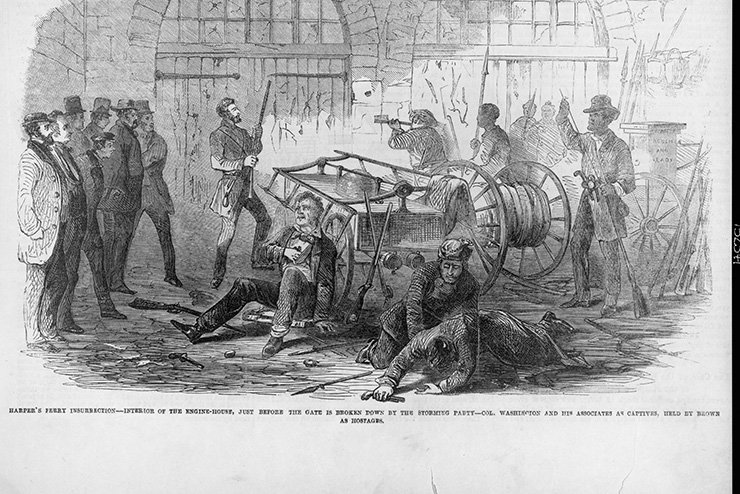
If historical examples must be drawn, a more apt comparison is John Brown’s raid on the federal arsenal at Harpers Ferry, Virginia. Rather than accept that the federal Constitution left the matter of slavery to the states, the radical abolitionist and a group of supporters seized the federal armory with the hopes that slaves would join them, use weapons from the arsenal to murder Southern families, and that a massive rebellion would result. The slave rebellion never materialized; Brown and his co-conspirators took refuge in the facility’s engine house. The War Department sent Colonel Robert E. Lee and a detachment of Marines to restore order. Brown refused to surrender, and the Marines stormed the building. Brown and his raiders killed one marine and wounded another before being captured.
Minnesota mobs and politicians will not accept that federal law places restrictions on immigration and allows for the deportation of illegal aliens. Like Brown, they attack federal property, assault federal agents, and incite violence against those sent to restore order.
Jefferson Davis loyally served the United States until his state of Mississippi, through a duly called convention of the people, voted to withdraw from the union. A belief in secession was practically universal in the early American republic. The celebrated American historian Robert Remini has noted that Andrew Jackson in the 1830s was “the first and only statesman of the early national period to deny publicly the right of secession.” As Thomas Jefferson, author of the Declaration of Independence, noted in 1816, “if any state in the union will declare that it prefers separation … to a continuance in union … I have no hesitation in saying ‘let us separate.’” Alexis de Tocqueville, after his study of American government, came to the following conclusion: “If one of the states chose to withdraw its name from the contract, it would be difficult to disprove its right of doing so.” Consequently, we should not be surprised that Davis and many others viewed their allegiance to the United States as ended with the adoption of secession ordinances.
As president of the Confederacy, Davis did not actively make war on the Union. Instead, he pleaded with the North to recognize the right of secession and to let the South go in peace. Lincoln, believing himself to be a better constitutionalist than Jefferson or Tocqueville, chose war. Davis simply defended his newly formed country when it was attacked.
Walz, Frey, and Omar are in an entirely different situation from that of Davis: they are citizens of a state that remains attached to the union. They don’t even allege that federal immigration law is unconstitutional and can be nullified, à la Calhoun and the protective tariff. They simply do not like that a federal law allows the removal of illegal aliens, whom they see as prospective Democratic voters and recipients of bribe money garnered from fraudulent aid schemes and kicked back to Minnesota politicians.
The chaos in Minnesota and elsewhere is a textbook example of why we have an Insurrection Act. After a proclamation ordering a dispersal of the mob, the president may use federal troops to quell the unrest and protect ICE agents. Such a presidential action should be easy for all conservatives to rally behind. The comparison of this situation to the action of Southern secessionists in 1861 distorts history grievously and is not helpful in confronting the radical left.
Leave a Reply