In frosty Helsinki, the machinery of the Finnish state has churned out a ruling that should chill the heart of any defender of free speech. The Finnish Supreme Court, in a decision issued March 26, convicted Päivi Räsänen, a physician and long-time member of parliament, and Juhana Pohjola, a bishop in the Lutheran Church, for the crime of expressing a theological conviction the state has deemed scientifically “false” and socially “insulting.”
The case serves as a cautionary tale of what happens when a government decides that amorphous concepts like “human dignity”—defined by an authoritarian and censorious elite—must be protected at the cost of silencing dissent. Moreover, it serves as a reminder, during our nation’s 250th anniversary, of the durability and necessity of our founding promises.
At the heart of the controversy is a tweet and a pamphlet. The tweet, posted by Räsänen in 2019, quoted Scripture to question her church’s decision to sponsor the Helsinki Pride Parade. The pamphlet, authored by Räsänen in 2004 and published for the church by Pohjola, was titled “Male and Female He Created Them” and simply expressed her views on sexual morality at a time when Finland was considering redefining marriage.
The Finnish jurists, performing a “case-by-case balancing of interests,” determined that while Räsänen’s social media post was protected by a high bar because punishing it would be interfering with religious speech, her 20-year-old pamphlet was not. The Finnish Court, by a 3-2 vote, found her and Pohjola guilty of insulting a group—not because they called for violence (they did not), but because they disseminated what the court deemed “false and offensive” claims.
For this, Räsänen was fined 1,800 euros and Pohjola 1,100 euros. Moreover, the court ordered the deletion of the “unlawful” portions of the text.
The Finnish Court’s ruling was a paradigmatic example of ideologically motivated reasoning. The court found that because modern psychiatry has diverged from the 1980s-era medical textbook definitions used by Räsänen in her pamphlet, her speech was factually “erroneous” in a way that “constitutes an insult to homosexuals as a group.” It argued that Räsänen’s status as a physician and politician served to “bolster the credibility” of her claims, thereby increasing their “potential for harm.” Finally, the court observed that, although Räsänen’s statements were made in the context of discussing matters under “political and social debate,” which affords them greater protection, “it is possible to participate in the debate without using expressions that insult homosexuals as a group on the basis of their sexual orientation.”
Across the Atlantic on our shores, such a verdict would not be unlikely; it would be unconstitutional. In 1919, U.S. Supreme Court Justice Oliver Wendell Holmes famously observed that the “theory of our Constitution” holds that “the best test of truth is the power of the thought to get itself accepted in the competition of the market.” Accordingly, “we should be eternally vigilant against attempts to check the expression of opinions that we loath” with government power, for “time has upset many fighting faiths.”
This core commitment to conversation—even rough-and-tumble conversation—has informed constitutional jurisprudence ever since. In Brandenburg v. Ohio, the Supreme Court found that the Constitution even protected speech advocating for the use of force or the violation of law, unless “directed to inciting or producing imminent and lawless action.” In Snyder v. Phelps, the Court concluded that, in the context of public debate, “insulting, and even outrageous, speech” must be protected in order “to provide adequate breathing space” for First Amendment freedoms. And in U.S. v. Alvarez, the Court found that mere false statements of fact were not excluded from First Amendment protection.
These precedents easily would have protected Räsänen’s speech—had she spoken in the U.S. The Finnish Court readily admitted that Räsänen’s text “did not contain incitement to violence.” Far from the vulgar—and constitutionally protected—protests of military funerals at issue in Snyder, the Finnish Court noted that Räsänen’s pamphlet nowhere claimed that homosexuality is “an unambiguously condemnable trait or identity.” And far from the brazenly false claims at issue in Alvarez, where at issue was a false claim of the defendant to have earned a Medal of Honor, the Finnish Court readily conceded that Räsänen’s pamphlet contained a mix of religious and medical argumentation, condemning only the latter as “erroneous” because of updates to medical textbooks.
The Finnish ruling is a victory for those who believe the state’s primary duty is to preserve imposed political orthodoxies at the expense of fundamental rights. By criminalizing speech that is “unjustifiably offensive,” Finland has created a regime in which a doctor and parliamentarian’s opinion on a matter of social and religious debate is legally valid only if it aligns with the political and moral view of a government institute.
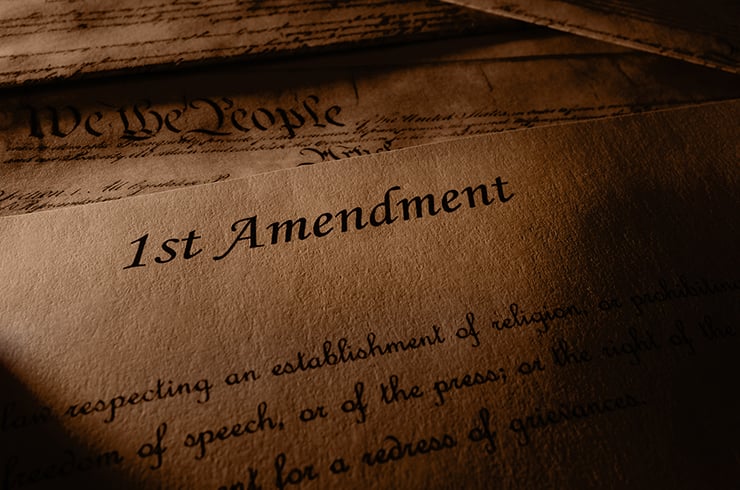
The First Amendment, on the other hand, protects the right to challenge the moral and scientific certainties of the hour, and even the right to be wrong and offensive in doing so. As we celebrate the 250th anniversary of the founding of our nation, we will do well to remember the enduring freedoms our Founders won those many years ago—and which we must preserve today.
Lessons From a Finnish Attack on Free Speech
Leave a Reply