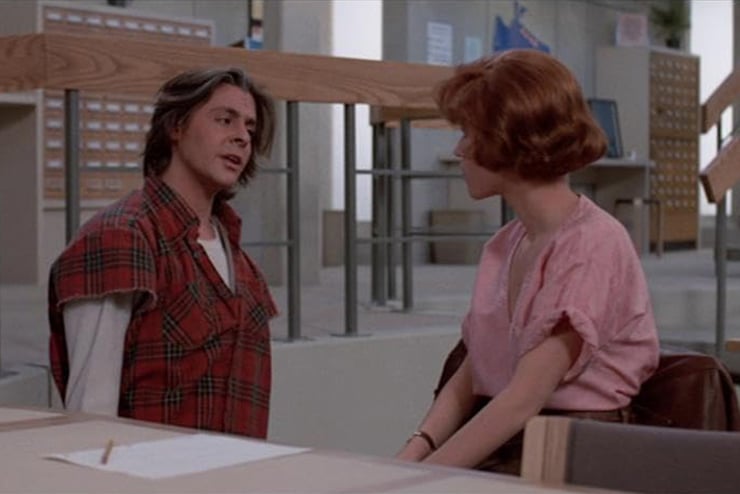
The Breakfast Club (1985)
Written and Directed by John Hughes ◆ Produced by Ned Tanen ◆ Distributed by Universal Pictures
Quadrophenia (1979)
Directed by Franc Roddam ◆ Produced by Roy Baird and Bill Curbishley ◆ Distributed by Brent Walker Film Distributors
The Criterion Collection, the curator of the best and most influential films through the history of cinema, has just announced that in November they are releasing a special anniversary edition of The Breakfast Club, the 1985 teen comedy and drama. As Variety put it, the film
defined a generation of high school films with its mix of angst, comedy and unlikely camaraderie among five students in Saturday detention. The new edition features a 4K ultra-high-definition restoration, cast interviews with Molly Ringwald and Ally Sheedy, commentary from Anthony Michael Hall and Judd Nelson, and nearly an hour of deleted and extended scenes.
That’s a lot of bells and whistles for a film that is good, but not great. Unfortunately, The Breakfast Club is overrated. The greatest film about adolescence was made in London six years earlier, Quadrophenia. That film, an adaptation of a rock opera by the band The Who, is also available in the Criterion Collection, and movie fans can compare the two productions.
The Breakfast Club posits that the world of adults and authority is a hypocritical, phony world, and that teenagers, if forced into group therapy for a day, can overcome it. It’s a very American message. Quadrophenia offers something like the opposite. The teenagers in the film are rebellious, and the adults are depicted as out of touch and hypocritical. Yet, in the end, Quadrophenia shows how all the teen angst and attitude cannot let you avoid the adult world and its rules and compromises. In The Breakfast Club, the teens slowly come together in the course of a day. In Quadrophenia, they explode apart over the course of weeks.
Quadrophenia is set in England in 1964. A teenager, Jimmy Cooper (the alter ego of Who band leader Pete Townshend), has been diagnosed as schizophrenic, but he claims he is actually “quadrophonic,” or having four personalities. Quadrophenia is a metaphor for the quartet of different personalities adolescents adopt to fit in: jock, rebel, nerd, and clown. The film treats these identities as artificial and inadequate, emphasizing the teen anxiety about not knowing exactly who they are. This could have been a clumsy, self-pitying conceit, but in Townshend’s hands it becomes deeply affecting art.
In The Breakfast Club, however, the teen archetypes of jock, rebel, preppy, nerd, and loner are implacable identities: each character is a perfect representation of their type. The film’s ending epiphanies occur when each character crosses lines to make friendships and romantic attachments with kids in different tribes. The film ends with Judd Nelson’s character John Bender, the rebellious working-class rock and roller, pumping a triumphant fist in the air after kissing the preppy daddy’s girl, Molly Ringwald’s character Claire Standish.
Quadrophenia begins with its ending. Like The Breakfast Club, it features a main character walking towards the camera. We are looking into the brilliant reflection of the ocean above the White Cliffs of Dover. Cooper has been visualizing suicide, going so far as to drive his scooter along the edge of the cliffs to contemplate plunging off. The sea in Quadrophenia is a dangerous elemental force that seemed to birth Jimmy in all his craziness, but also a place of healing and baptism. Cooper veers away from the abyss in the film’s opening shot and walks back into the challenges of coming adulthood. Unlike the change in Bender, it is not a triumphant moment, and his future is uncertain.
Cooper has a boring postal job and lives with his parents, with whom he constantly clashes. He does drugs and finds his identity with the Mods, a group of young, sharply dressed kids who love rock and roll and drive scooters. Their rivals are the Rockers, a leather-wearing gang of motorcycle riders. The Mods and Rockers finally clash in the coastal town of Brighton during a terrifying and yet ecstatic moment in Jimmy’s life, one he constantly seeks to recapture. The other kids have moved on, however, and Jimmy finds himself becoming increasingly desperate and disillusioned.
Quadrophenia captures with more passion, insight, and humor than any other film the roiling adolescent tension between wanting to fit in and to be respected for one’s individuality. In the Criterion edition’s commentary, director Franc Roddam and cinematographer Brian Tufano explain how they made such a powerful and timeless film out of what seemed little more than a rote melodrama of teenage rebellion.
Roddam described his direction of the film’s set pieces as “choreography,” and indeed, the scenes of parties, dances, and clubs in the film are brilliantly dynamic and gorgeously fluid. Teen life appears on screen as a living ecology. In the months leading up to shooting, Roddam had the entire cast, even those with bit parts, create backstories for the parts they were playing. He wanted the social scenes to come across as electric, organic, and flowing. The impression on the audience is that the background action depicts genuine life.
This stands in contrast to John Hughes’ direction of The Breakfast Club, and indeed his entire oeuvre of teen movies, which take a formulaic approach to the genre.
Hughes was a political and social conservative, as Vanity Fair writer Bruce Handy describes in a chapter on the director in his insightful recent book Hollywood High: A Totally Epic, Way Opinionated History of Teen Movies. Handy characterizes Hughes as “an uxorious family man and a confirmed Midwesterner who felt out of place in Hollywood.”
His films, despite their feints at anarchy, pay deference to wealth, class, and social convention in a way that was very much in sync with prevailing trends in the 1980s—and which may or may not leave a bad taste in your mouth. Sixteen Candles, beneath its sometimes snarky, sometimes subversive, sometimes mean-spirited and racist comedy, is a fairy tale about an upper-middle-class girl being courted by a rich boy who lives in something approaching a small castle and can afford to shrug off the potential trashing of his dad’s Rolls-Royce convertible. It’s a fantasy, sure, but what’s being fantasized about is telling. Further down the socioeconomic scale, John Bender, The Breakfast Club’s “criminal” played by Judd Nelson, is a working-class provocateur who bullies, baits, and sexually harasses Ringwald’s “princess”; he’s obsessed with her privilege, and when she inexplicably makes out with him at the end of the film, it’s unclear whether she does so out of genuine affection or noblesse oblige.
Handy adds that while “most movies would prompt you to feel for the one poor character, Hughes, with aid of Nelson’s abrasive performance, “keeps Bender at arm’s length.” Hughes “wants us to sneer at the teacher running Saturday detention, not only because he’s nasty and small-minded and, of course, the Man, but also because, as he confesses to the school’s janitor, he’s worried about losing his job and his $31,000 a year if he doesn’t ride hard on his charges.”
Instead of humanizing a teacher, the movie “wants us to disdain him for clinging to his lousy public-school salary. He’s officious and tacky,” Handy writes. Ferris Bueller’s Day Off shows contempt for Jeffrey Jones’s vice principal “by emphasizing his cheap suit, cheap shoes, and cheap Chrysler sedan; one shot inexplicably, even fetishistically lingers on the car’s grille with the Chrysler logo in close-up. (If it’s product placement, I don’t think the automaker got fair value.)” We are meant to love Ferris “when he complains early in the picture about not having his own car, while lounging “in a bedroom graced with a stack of high-end stereo equipment.”
Handy writes that Hughes’s movies blast stereotypes and sexual situations that make modern viewers wince, as well as being movies that can “sprawl tonally. They can be tender yet nasty, acerbic yet corny; they punch up one moment, punch down the next. But that, too, might be part of their appeal: in their contradictions and confusions, they’re a lot like teenagers.”
It’s a shame that Handy doesn’t mention Quadrophenia in his book. Nor does he discuss The Wild Life, another teen film vastly superior to The Breakfast Club, which came out in 1983. The Wild Life was written and produced by Cameron Crowe, who also wrote Fast Times at Ridgemont High. It was directed by Art Linson, who produced Fight Club, The Untouchables, Sons of Anarchy, and Yellowstone.
The Wild Life is a kind of shadow version of Fast Times, taking place mostly at night in Los Angeles, and the characters aren’t as pampered or fixated on status as the teens in John Hughes movies. The kids all have summer jobs, and while there’s talk of marriage, no one mentions going to college. Wrestler Tom Drake and his more mature and motivated friend Bill Conrad work in a bowling alley. Bill gets a nice apartment in a swanky singles complex and asks Tom to be his roommate. Whereas the surfer Spicoli in Fast Times is cute and cuddly, Tom Drake, as one critic put it, is “the Spicoli you would know in real life—he’s a force of destruction who is actually dangerous and insane.” Much more so than Fast Times, The Breakfast Club, or Ferris Bueller, The Wild Life predicted the working-class concerns that led to the class populism of the Trump years. Like Quadrophenia, it never sprawls tonally. Like the kids it depicts, it knows what it is.
Leave a Reply