The last 20 years have seen the proliferation of a machine that stores, organizes, and retrieves information: the computer. It can perform repetitive tasks without error or fatigue, analyze problems too complex for the human brain, and collate great quantities of information. The power of the computer, however, has its drawbacks—among other things, it allows governments to monitor in detail...
Visionary Fiction
Susan had set up the ironing board in the kitchen and upended the iron there while she sprinkled her blouse. I could not detect the heat waves rising from the face of the iron, but the morning sun showed them clearly on the refrigerator door, curling and uncurling in hypnotic arabesque. That became my image for visionary fiction: the play...
Rescuing Story From History
By the end of the 18th century, the novel had already begun to replace the rich variety of narrative genres that preceded it. This is a familiar theme in the history of the arts in the modern period. One particular artistic form comes to be preferred for its freedom; it crowds out the other forms, which are disdained for their...
A Chesterton Adventure, Protestantly Considered
The last speaker ended at 10:30, Saturday night. I was at St. Michael’s College in Toronto for the 50th Anniversary Conference, commemorating G.K. Chesterton’s death. A memorial Mass was scheduled for the morning with Gerald Emmett Cardinal Carter; but as a Biblical and Reformed Christian (that’s evangelical-speak for Protestant), I thought I might leave without disturbance. No loss of acquired...
Just One More Drink of Water
A recent Time article reported an astonishing new find. Researchers at the Monell Chemical Senses Center and the University of Pennsylvania School of Medicine have discovered that men are good for women. Actually, there’s more to it than that—what they really found out, or think they found out, is that regular relations and, more specifically, male body odors have a...
On the Road Again
“We would rather run ourselves down than not to speak of ourselves at all.” —La Rochefoucauld It is a signal of things to come that Gerard Thomas Straub opens his book Salvation for Sale: An Insider’s View of Pat Robertson’s Ministry with a list of quotations that begins with Miguel de Unamuno and winds up with Woody Allen. It is...
The Three Sisters
Crimes of the Heart written by Beth Henley directed by Bruce Beresford De Laurentiis Entertainment Group When Perseus went to slay the monster Medusa, advice and presents from Minerva and Mercury were not enough; he had to seek out the Graeae—three crones with but a single prized eye they shared between them, which Perseus snatched in order to force them...
A Child’s Joke: A Story
The sea, warm and quiet, lay in front of me. Dusk was falling, and there was a strong smell of brine and kelp in the air. I was sitting on a piece of a ruined ancient column on the shore of the Black Sea and couldn’t quite believe that just a few hours earlier I had been in cold and...
Martyrs Inc.
“When I must define my own views,” writes Milovan Djilas in his latest book, Of Prisons and Ideas, “I identify them as ‘democratic socialist.'” For those who find this oxymoronic, Djilas’ whole book may seem like an exercise in contortion. True to his earlier autobiographical works, Djilas clings to the purity and the intensity of his motives as proofs of...
Poker Lessons
(I didn’t write this month’s letter. My poker and fishing buddy Peter Donaldson did. Peter’s an Irish Catholic boy from Brooklyn, but a fast learner. After he moved from North Carolina to Occupied Virginia, to take a job in DC, he sent back to the Chapel Hill Newspaper some reflections on what he missed. I couldn’t have said it better,...
Smile When You Say ‘Psychiatrist’
I did not mean to harm anyone when I bought a Bachelor of Arts degree in Child Psychology for $100. I meant it to be a bitter joke on myself I was going to hang it up in my room, much as an important man might hang a Playboy cartoon on a wall in his home. I had had a...
Thrice-Told Tales
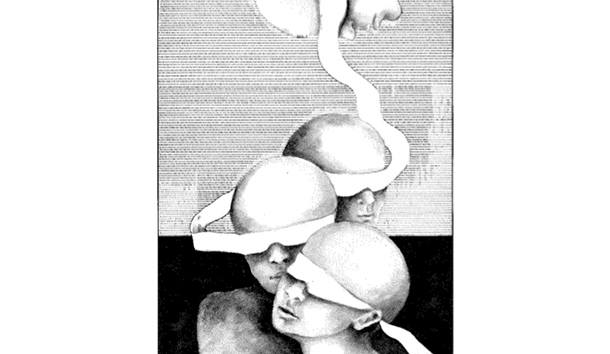
Politics and tale-telling are virtually inseparable activities. Great political events—wars, rebellions, social crusades—do not exert their full measure of influence until they are whittled into legends. More than one British statesman has derived his understanding of the Wars of the Roses from Shakespeare’s Histories, and in the United States the stories of Washington at Valley Forge, Lincoln the man of...
Some Thoughts on Being A Writer
The following is the text of Mr. Naipaul’s speech at the 1986 Ingersoll Prizes Awards Banquet. I do not really know how I became a writer. I can give certain dates and certain facts about my career. But the process itself remains mysterious. It is mysterious, for instance, that the ambition should have come first—the wish to be a writer,...
Empire Strikes Back
” . . . To sit in darkness here hatching vain empires.” —Milton During his discussion of the overthrow of feudalism by the bourgeoisie in his classic Capitalism, Socialism and Democracy, Joseph Schumpeter asked whether “in the end such complete emancipation was good for the bourgeois and his world.” He concluded that it had not been. Capitalist society needs the...
Is Old Bob McNamara Still Teaching at Harvard?
I had the distinct feeling I had seen the book somewhere before. It was almost like the old cinematographic cliche: close-up of the Treblinka torturer’s face in a dream sequence, a faded photograph shot in sepia tones, men running through the courtyard. The title was respectable enough, The Faber Book of Contemporary American Poetry, Faber and Faber, 3 Queen Square,...
Republican Vices
For some 73 years, since November 1914, The New Republic has been the self-constructed soapbox for the best ideas and insights proffered by the liberal intellectual community (which may explain why the magazine is always so thin). Some of the most important names in American liberalism have graced the magazine’s pages as it has laid out its plan for a...
Harvard Goes South
“Ce sonts les modernes qui font des progies. Nous sommes betes une fois pour toutes.” —Péguy This curious big book is an amalgam of left-wing scholarship and commercial panache. On the one hand, the author, a Harvard Ph.D. in American Civilization and a missionary to South Carolina, seems to have enjoyed extended foundation support during the production of this book,...
Nil and Void: Beckett’s Last Gasp
During the ongoing, international celebration of Samuel Beckett’s 80th birthday, which commenced last spring, much is being said, written, and done to reiterate unequivocally his position as the preeminent playwright of our century. There is no debate, really, so much as an affirmation and an exploration of his unquestioned significance. The irony, of course, is to be found in the...
Desire & Death
Back in the days before OPEC became a notable force on American street corners, high school, for most of us growing up in Detroit, meant one thing: a driver’s license. All we had to do was spend 12 weeks with a shop instructor, who was looking for a way to pick up a few extra bucks, in a Rambler Hornet,...
The German Swindle
To walk along a narrow ridge or cliff path, German-speakers will tell you, you have to be schwindelfrei. The French word vertige exists in English (vertigo), but we would be more likely to say “dizziness.” The German word is for vertige or dizziness der Schwindel, but Schwindel also can mean what it does in English—swindle. “Mir schwindelt’s“: I am dizzy;...
A Month of Woes
“Evening must usher night, night urge the morrow, month follow month with woe, and year wake year to sorrow.” —Shelley The Book-of-the-Month Club, now in its 60th year, is an American success story in the grand manner—its financial success demonstrated by listing on the New York Stock Exchange and later acquisition by Time, Inc., its merchandising skill by some two...
Reenchanting the World
“Do not seek to become a god.” —Pindar Once we begin to see that we are all God, that we all have the attributes of God, then I think the whole purpose of human life is to reown the Godlikeness within us; the perfect love, the perfect wisdom, the perfect understanding, the perfect intelligence, and when we do that, we...
Gatekeeping Functions and Publishing Truths
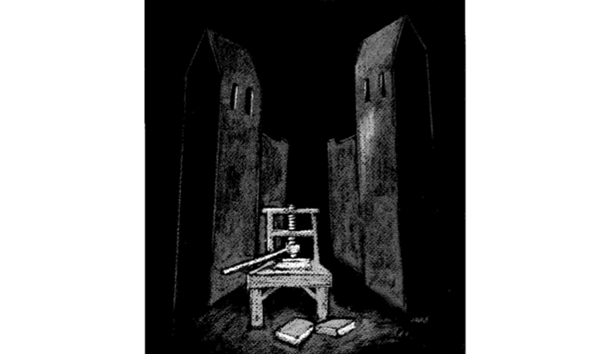
When a forgery is uncovered or a plagiarized volume appears or a fake letter is adduced to support a mediocre manuscript, cries are sent forth that there is a need for tighter security by publishers. This is often coupled with a complaint that authors should scrutinize themselves more carefully. The burden of my remarks is quite the reverse: that the...
Dakota Days
It was their ordinariness that made them matter. . . . Individual life was by its very nature a tragedy; it came to an end; for all of us it was going to be a short way to that grave. But the ordinary life of a society was a comedy that just kept going on. What was at the heart...
Who’s Wearing the White Hat?
In the heartland’s fiercest modern-day shoot-out—farmers versus lawyers and bankers—it’s hard to tell the good guys from the bad. Charles Niska, farmer and father of eight, is serving two consecutive one-year sentences in the North Dakota State Penitentiary for illegal practice of law and jumping bail. Niska got into trouble helping his neighbor Richard Schmidt try to outwit two local...
Old Times There Are Not Forgotten
I’m sure some readers of these letters are tired of hearing what a special place the South is. So I’ll warn you: I’m going to say it again. And I’m going to quote all sorts of other people who say it, too. Come back next month if you can’t take it. The South is a very special place. For starters,...
U.S., A Captive Nation
Benjamin Ginsberg’s The Captive Public is a breath of fresh cynicism. With insight and illustration, it argues that mass opinion and majority will are not necessarily the nemesis of Big Brother. In modern society, Ginsberg argues, the Orwellian state can adapt and even mold them for its purposes. Nor is this a new development. Ginsberg maintains that the emergence of...
Ask Dr. Grants
How do I get a grant? You first must get an application. Forget about those grants for which you cannot apply, such as MacArthur Fellowships, which are essentially designed for people already known, which is to say celebrities, or incipient celebrities. Once you get the application, read its guidelines carefully to make sure you qualify and, if you do, then...
Mistress of Deceit
Oxford University Press advertises its Past Master series (of which this book is one) as being “a noble encyclopaedia of the history of ideas” in which “lucid and authoritative” modern critics introduce us to the best of what has been thought and written. Oxford seems to have dropped a brick on this one. Lucid? Here are some passages which may...
Outside the Law
“This is a wonderful country, my boy, but our legal system doesn’t work the way it’s supposed to.” —Harold Smith, in Remo Williams, The Adventure Begins America’s “major” film critics have been very busy—and very worried— lately. They have a lot to worry about; the movies just aren’t going their way anymore, which ought to make the rest of us...

Having Opinions
“The public buys its opinions as it buys its meat, or takes in its milk, on the principle that it is cheaper to do this than to keep a cow.” —Samuel Butler When opinion polls are conducted on some urgent matter of the day (the character of Colonel Qaddafi, or the compatibility of some soon-to-be-married royal couple) those polled are...
Literacy Before the Revolution
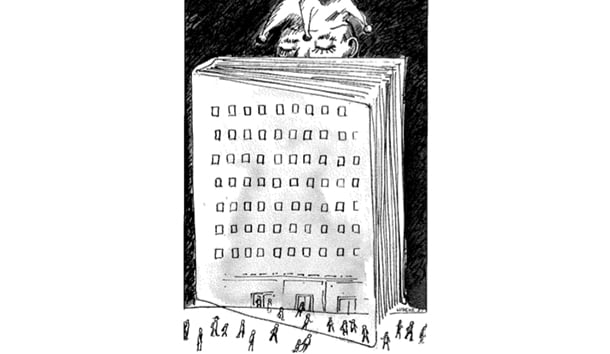
Publishers Weekly must be the most depressing magazine published in the United States. Oh, there are others like Esquire that make us despair for the affluent numskulls who swap life-styles as if they were wives, or The New Yorker that makes us remember how really boring New York can be. But for the sick feeling in the stomach that threatens...
About the University and Its Curriculum
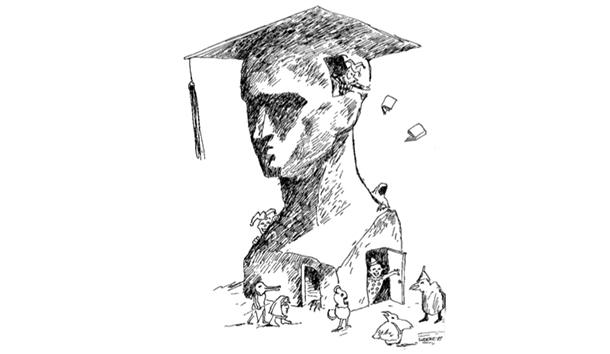
The sociological thesis that education is “for society” is acceptable today because in this statement, “society” is a sufficiently vague term to prescribe fewer and fewer binding guidelines as we ascend from lower to higher education. The thesis becomes unacceptable when an ideological restriction is added: The school must be a small replica of society. Formulated as policy, the statement...
Time Will Tell
As if he still had somewhere to get to, Neil Simon finally arrived in 1986: 25 years after his first play, Come Blow Your Horn, opened on Broadway 1 or 18 plays and four musicals later. With more than a third of the decade remaining, Time magazine had the audacity to proclaim Broadway Bound “the best American play of the on its...
The Latin Invasions of English
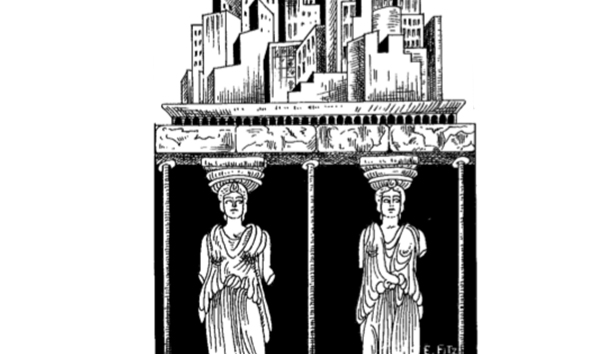
“When all is said and done, something sticks in the Barbarians.” —Rudyard Kipling We need a practical education, an education that will be valid in the unforeseen and unforeseeable future. There are many possible forms, but all must include mathematics and Latin. Of the 100 most commonly used words in English, only 10 or so come from Latin. Of all...
A Fool in the Forest
“Shall they hoist me up and show me to the shouting varletry of censuring Rome?” —William Shakespeare The true facts of the case will lie hidden in time forever. For our purpose here, we can accept the official version; that the emperor Augustus in the year 8 A.D. exiled the poet Ovid to Tomis, a harsh and barbarous town on...
Doctors of Education?
A recent issue of Forbes contained the truly wonderful news that a corporation is now selling a video encyclopedia of the 20th century. This is sure to be a hot item in the “education technology” business. Today’s students, who dislike ordinary encyclopedias because they must be read, can now “tap into the visual side of their brains” and get their...
Traveling in the Black
“I never save less than $400 on a round-trip ticket Kennedy-de Gaulle,” said the 40ish, balding businessman in the paneled bar of his Manhattan club. “I fly Concorde to Paris once a month. My secretary buys my New York-Paris ticket, which is presently around $1,200, and books my return. In Paris I change dollars at a premium and buy the...
Epictetus In Uniform
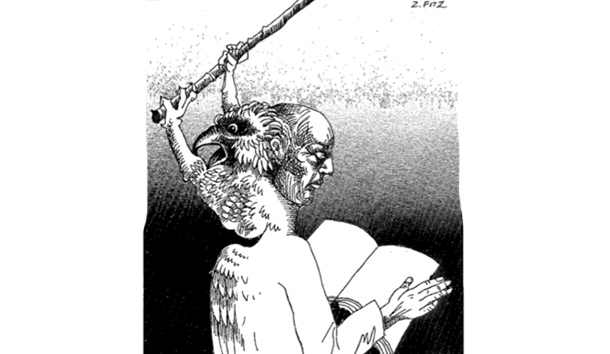
I was all of 38 years old when I first encountered the classic text that would influence my life. The year was 1962, the book was Epictetus’ Enchiridion, and we got off to a very unpromising start together. I could not bring myself to see how what that old coot Epictetus had to say bore any relationship to my life...
Just the Way We Are
Zig Ziglar came to Bismarck recently. (My husband, who doesn’t do aerobics, likes his finger of Cutty before bed, and is understandably paranoid about his decadent life-style, says it feels to him as if Zig comes here once a month.) A lot of people I know went to the performance, and many bought Zig’s books and tapes right there on...
Does Anyone Feel a Draft?
I grew up in the Volunteer State of Tennessee, so called because of its citizens’ enthusiastic response to the First Mexican War. Maybe growing up there colors my view that wars ought to be fought by folks who want to fight them-and it certainly in creases my estimate of the number of young men who enjoy that sort of thing....
The Mythological South
Jim Jarmusch’s Down By Law opens with rolling shots of New Orleans townhouses) tenements, the down and out on a crummy side-street. From there we enter into two variations on the theme of domestic disharmony, Jack’s and Zack’s, and on to a story set in a South that never was, by a film maker who, until the film was written...
Ezra Pound’s ‘Language of Eternity’
What (to ask one bizarrely unfashionable question) is civilization? Set aside geography, climate, genetics, and luck. The high classical civilizations are marked by certain indispensible accomplishments: a serious respect for facts; related to this, a steady application of work toward stable wealth; a conception of justice moving in two directions, toward society as a whole and toward individuals, implying also...
Best Western Civ
“Sic omnia fatis in peius ruere ac retro sublapsa referre.” (All mortal things are subject to decay.) —Vergil This is a handsome book in all pertinent respects. It is stately of subject, nicely written, well-edited, and eye-winning in cover—especially the jacket. Roberts, a well-known British historian and university chancellor, has written the book, we are told, to accompany a 13-part...
A Peek at Burghley
William III took one look at Burghley House (the Elizabethan residence of the Cecil family) and declared it “too great for a subject.” Four hundred years old in the democratic year of 1986, Burghley is exposing some of it s treasures to the prying eyes of ordinary Americans. The Burghley Porcelains went on view at New York City’s Japan House Gallery...
What Is the Good?
“We know the good but do not practice it.” —Euripides These two unusually interesting collections of studies are in sharp contrast to the contemporary Anglo-Saxon style of academic scholarship. Both authors take seriously the pertinence of classical thought to contemporary discussions of the good. Strauss is even less professorial than Gadamer in that he takes the central issue of our...
The Great Spirit of Form
Malcolm Bradbury describes Peter Handke as “unmistakably one of the best writers we have in that selfdiscovering tendency in contemporary writing we have chosen to call postmodernism.” And, true enough, Handke is eminently skillful at what he sets out to do. Poet and playwright as well as novelist, he is concerned above all with exploring the alienated individual’s struggle with...
No Latin, Much Less Greek
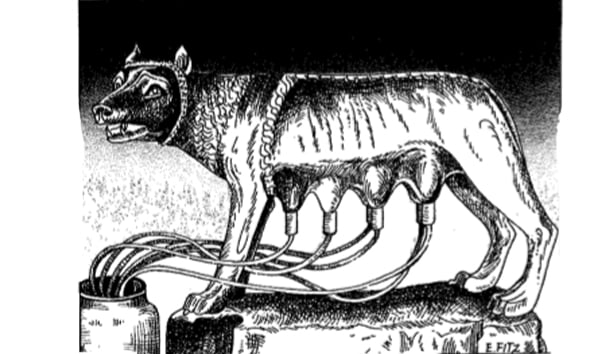
In pondering where the modern age went wrong, writers have pointed to as many answers as there are systems of thought. For conservative editorialists, the problem is Marxism or its lifeless reflection, liberalism. Irving Babbitt blamed the Romantics, while Richard Weaver nailed his thesis on the door of nominalism; and there are still literary scholars who pepper their hermeneutic exercises...
Rice Paddies and Tea Houses
The schedule is rather monotonous for a lecturer invited to the big cities where universities are usually located. First comes the airport, then the car with the polite, smiling young man as a guide, then hotel room and restaurant, podium, introduction, photo graphs, the lecture itself-then the whole thing in reverse order the next day. Occasionally, the routine is broken...
Still At the Still Point
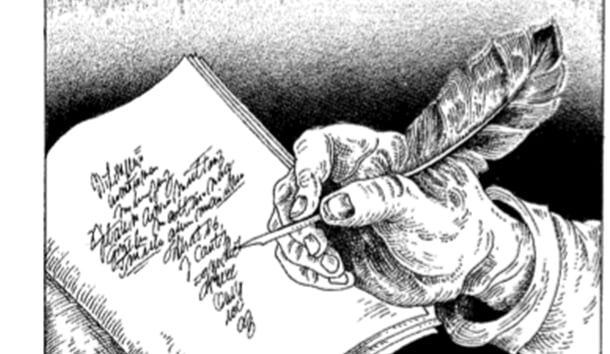
Thirty-one years ago, when I had aspirations as an up-and-coming critic in the Catholic press, I wrote an essay on T.S. Eliot that was published in the Jesuit weekly, America. I thought it daring to suggest that the major poet of our time was something less than the robust Christian figure which an effective propagation of the faith then clearly...