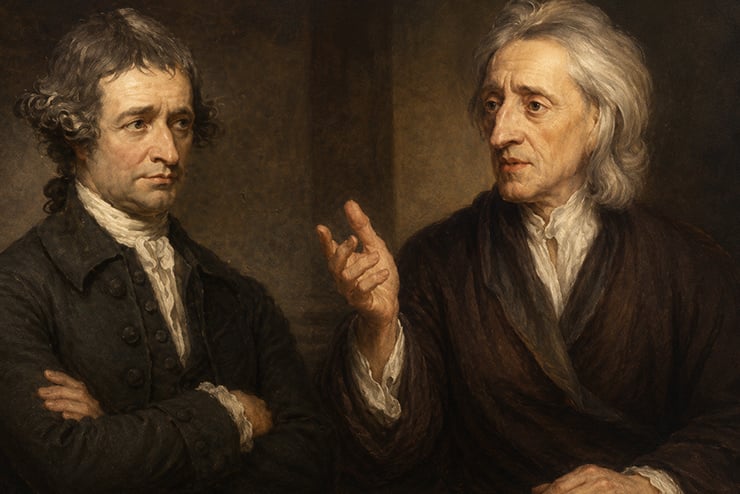
Clarence Thomas has defended America’s constitutional morality better than any other Supreme Court Justice in recent memory, but he subscribes to a chimerical notion of rights—so-called natural rights—that threatens this moral framework. This magazine, in our June issue, rightly praised Thomas for his fidelity to the original meaning of the Constitution, but, as the editor of paleoconservatism’s flagship publication, I must clarify that my fellow paleoconservatives generally do not believe in natural rights—and for good reason.
Deep-seated skepticism about the existence of pre-social, individual rights (natural rights) was generally characteristic of the first generation of the post-World War II conservative movement. Russell Kirk, James Burnham, Richard Weaver, Robert Nisbet, George Carey, and Willmoore Kendall (the list could go on and on!) all viewed rights in a Burkean or Aristotelian fashion, as arising from lived traditions and belonging to settled communities. The belief in inborn individual rights was, then, more typical of libertarians than mainstream conservatives. But all that changed after the West Coast Straussians, under the influence of Harry Jaffa, came onto the scene.
The Claremonters (as they came to be called) turned their beliefs in natural rights and equality into predominant conservative dogma, and this process was largely complete by the 1980s. By the 1970s, William F. Buckley had already declared his conversion to Jaffa’s understanding of the American founding. Soon, National Review’s conservative pantheon began to change: Abraham Lincoln and various civil rights icons were ushered in, along with Jaffa’s personal hero, Winston Churchill, while Southern conservatives and others who resisted the civil rights revolution then underway were eased out.
Although neoconservatives and Claremonters were not entirely the same, and although tensions developed between these groups, particularly after Donald Trump became a presidential contender, both have happily accepted the Jaffaite reordering of the American right. While the two groups drew markedly different conclusions about where democratic equality and natural rights should lead us, they have held some of the same philosophical premises. This came about, as far as I can determine, because the neocons at some point in the 1970s took over Jaffa’s ideas about natural rights and his version of the historical struggle against inequality. (Allow me, however, to note that the Claremonters, in contrast to neoconservatives, have always been outspokenly critical of the managerial state since its inception in the Progressive era.)
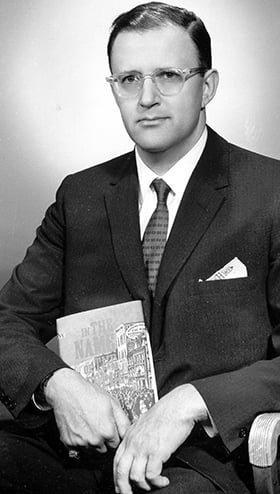
Harry V. Jaffa
(Wikimedia Commons)
The paleoconservatives never welcomed the new dispensation, largely because the right’s metamorphosis took place at their expense. Moreover, their increasingly isolated camp was left with the thankless task of defending a more traditional form of conservatism in a society that was moving (or being pushed) leftward. For the last 40 years, the Old Right has been holding a bad hand, but one they have played with determination and polemical skill.
Paleoconservatives have generally been correct in their understanding of rights, even if they unconvincingly try to read natural rights entirely out of American history. Perhaps I needn’t identify where I stand, since I have vigorously defended paleoconservative ideas. But even this has not convinced some members of the paleoconservative old guard that I’m on their side. A few years ago, there were grumblings on the Chronicles board that I had “sold out” to the Jaffaites because I was working to build closer working ties with the Claremont crowd. Despite my annoyance at the time, I understood why my critics were so incensed. They lost ground in a lopsided contest for control of the right, in which they have labored without resources in the face of massive opposition.
Furthermore, I agree with their arguments against natural rights theory, as both a historian and a political thinker. I’ve no idea how pre-social rights inhere in human fetuses independently of families and communities, although I can understand the appeal of this thinking in the past. As a historian, I can grasp why in the 16th and 17th centuries Scottish Presbyterians resisting an Anglo-Catholic monarchy embraced natural rights arguments. I can also understand why John Locke produced his two Treatises of Government in 1680 and 1681 in defense of natural rights and why these disquisitions were trotted out to justify the Glorious Revolution of 1688. I can likewise see why English Levelers read John Locke’s writings on government with relish. He was defending small property-holders who toiled with their hands, which is what Levelers often were, in the face of a hostile royal establishment. Moreover, this political-religious minority had already adopted natural rights thinking well before Locke presented his theory on the origins of civil society.
I shall also admit that the ultra-Tory jurist William Blackstone was among those who believed that human beings shared a natural right to property, although Blackstone also thought that natural rights had already been incorporated into English Common Law and therefore had become to some extent irrelevant. Obviously, Thomas Jefferson, James Wilson, and many early state constitutions invoked natural rights, and the historian Bernard Bailyn won a Pulitzer Prize in 1968 (when that award meant something), for his book arguing that the entire American struggle for independence was driven by an ideological commitment to natural rights.
For all these reasons, it may be necessary to caution traditional conservatives who argue against natural rights not to minimize their importance in early American civic documents. Political luminaries of the time cite it repeatedly to justify the formation of government and to validate positive law. Natural rights are not something that 20th-century Straussians pulled out of a magician’s hat and then anachronistically attributed to America’s founders. The idea has been around for centuries and has had many influential exponents during the founding of the American Republic.
My traditional conservative friends and colleagues should therefore approach the concept of natural right less dismissively. Their standby argument that America’s founders really meant “old Whiggish practices” or customary law when they spoke about natural right doesn’t hold water. Those who appealed to natural right would have said something else if they were not referring to what they said they were. The fact that they speak of natural rights and enumerate them strongly suggests that early American leaders believed in their existence and thought that other Americans did as well.
Still, by the early 19th century, the natural rights ideology of early American leaders was altered by other commitments and interests, such as Protestant religious revivals. Debates over slavery, not at all surprisingly, came to center on biblical and theological questions, especially among Presbyterians, Methodists, and Baptists, and by the 1850s, slaveholders were making at least marginal references to biological theories about race. While the question of natural rights did, in fact, enter debates about slavery, so did lots of other things. Most importantly, however, these debates featured differing interpretations of relevant biblical passages featured in Protestant polemics.
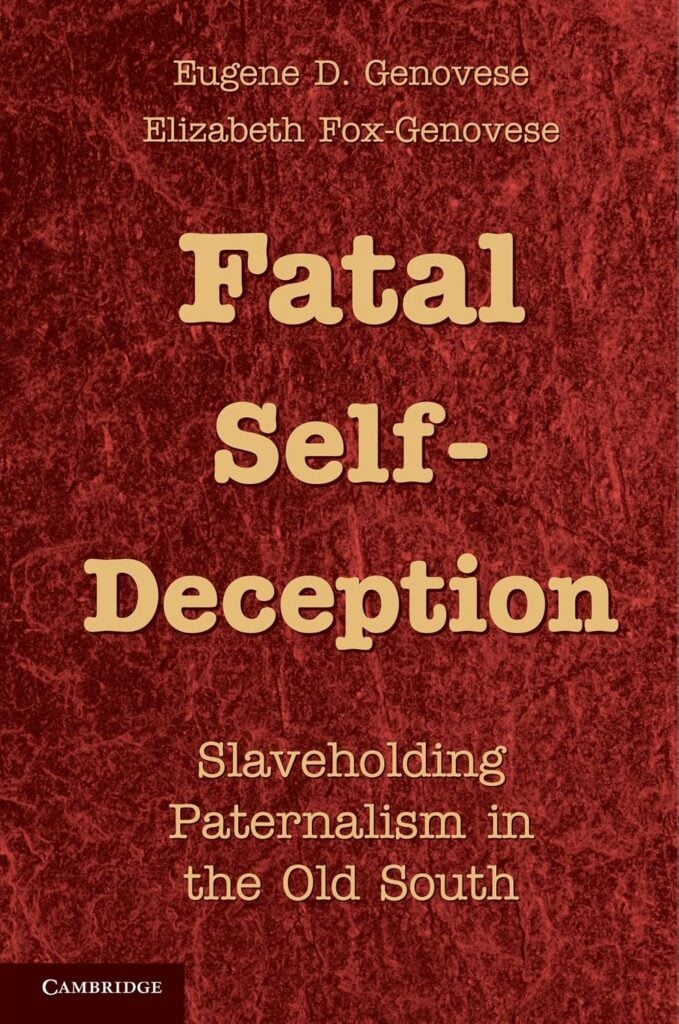
John Brown and his followers went on a rampage against slaveowners, not because of the “all men are created equal” passage in the Declaration, but as Bible-driven abolitionists. The Union’s beloved song “Battle Hymn of the Republic” is full of biblical images and references, even if the composer, Julia Ward Howe, was a Unitarian rather than a Trinitarian. The monumental final work of Eugene Genovese and Elizabeth Fox Genovese, Fatal Self-Deception: Slaveholding Paternalism in the Old South (2011), examines in detail Southern Protestant theologians’ efforts to find biblical justifications for their peculiar institution. Afterward, Protestant Christians tried to understand the defeat of their cause by referring to the Good Book once more. Apparently, neither Julia Ward Howe nor the Southern Presbyterian theologians quoted by the Genoveses took their positions about the great American struggle of the 1860s based on natural rights.
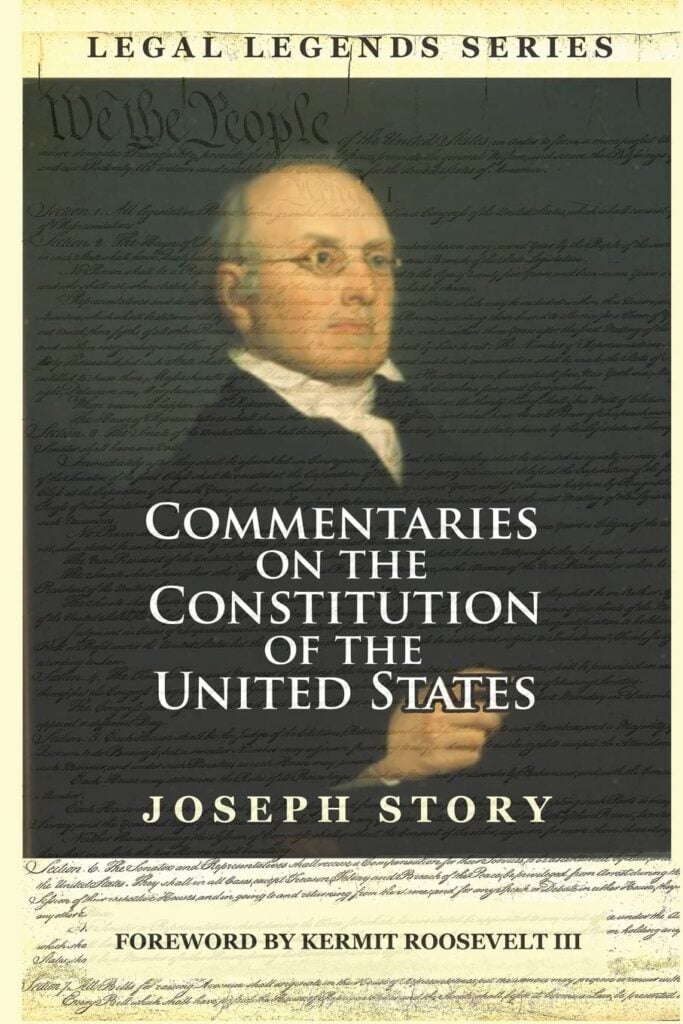
Early American legal scholar and judge Joseph Story (1779-1845), in his Commentaries on the Constitution of the United States,upheld a natural right to property, but he also referred to an older tradition of natural law and set out to show the compatibility of the American constitutional regime with English common law. While natural rights were a recurrent theme in early American legal thought, they often appeared alongside other legal and moral authorities in writings and speeches. Singling out natural rights as the moral and political bedrock of the American experience in self-government, therefore, involves oversimplification.
American thinking about rights has been more variegated than Jaffa and his disciples maintain, even if their ideas on the subject have been longer-lived than those of their competitors. It is true that their concept of natural right presently resonates with the conservative establishment. But while natural rights have furnished a framework of discourse for this group, a conservative approach to constitutional questions does not require embracing this particular understanding of rights. Justice Thomas’s originalist approach allows him to interpret the Constitution by looking at the clear meaning of texts together with the expressed intention of their authors. Other originalists, such as Robert Bork and Antonin Scalia, used the same hermeneutic without claiming that their interpretations were shaped by natural rights.
Moreover, while Progressives such as Herbert Croly and Woodrow Wilson challenged natural rights as the ideological cornerstone of the American experiment, they were really targeting the idea that individuals have an inborn right to property. Only to the extent that natural rights were linked to what Croly called “the aristocracy of wealth,” did they become a stumbling block for government consolidators. The Progressives were delighted with the atomistic notion of individuals implicit in natural rights theory because, as Robert Nisbet persuasively argues in his studies of the modern nation-state, public administration can deal more easily with solitary individuals than with members of preformed communities.
The most well-known advocate of America’s “liberal founding,” Louis Hartz, prefigured Jaffa’s thematic emphasis on America’s enduring Lockean influence. But this did not keep Hartz from praising the Progressives and New Dealers as the perpetuators and perfecters of this country’s “liberal tradition.” Researching a book on liberalism in the 1990s, I was amazed by how often welfare state advocates and even outright socialists invoked a Lockean natural rights heritage. Although present-day Lockeans on the political right claim they, not their leftist competitors, are the true defenders of natural rights, as an outsider, I shall leave it to those who believe in natural rights to resolve this quarrel.
While I wouldn’t assert that natural rights inevitably morph into “human rights,” the two are not totally unrelated. The attribution of abstract, universal rights to every individual by virtue of mere existence has, over the centuries, led to a much longer laundry list of rights than the one that Jefferson, in the Declaration, drew from Locke’s Second Treatise of Government. Although some of us may not like this proliferating glut of individual rights emanating from globalist institutions, once we start manufacturing pre-social rights, the list will necessarily grow, as has inevitably happened since the 1680s.
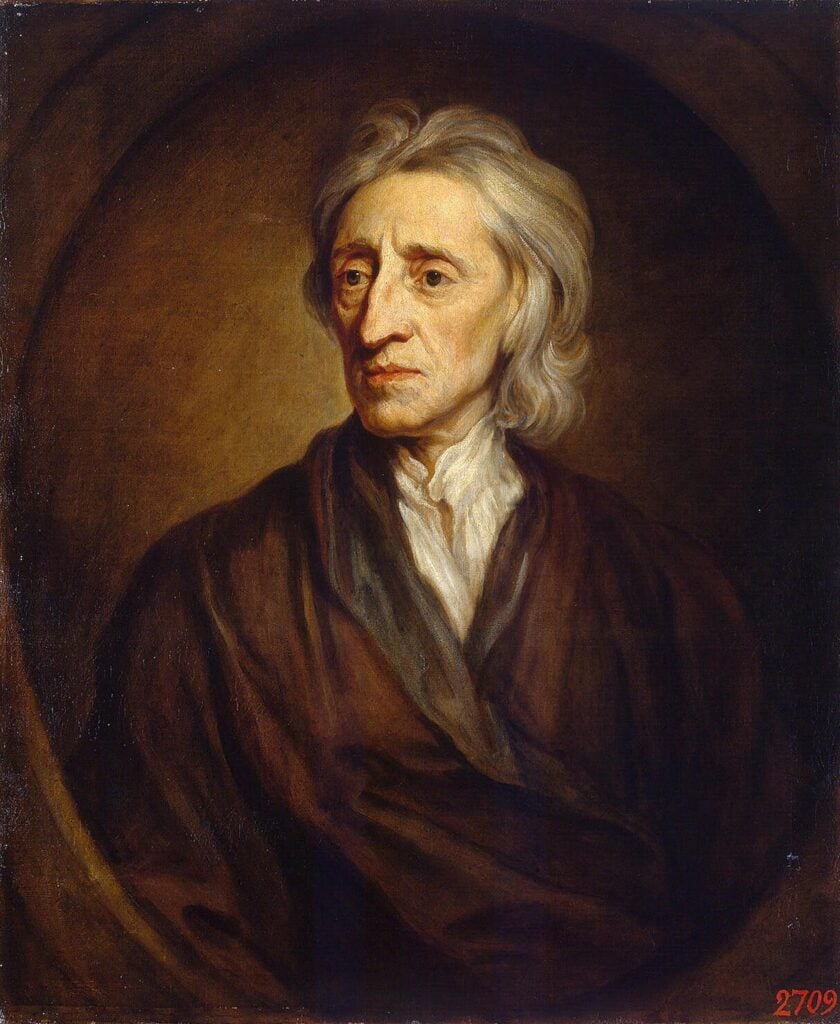
Portrait of John Locke
by Godfrey Kneller
(public domain / Hermitage
Museum)
Mind you, I am objecting to a particular understanding of how rights come into existence, not those rights that Clarence Thomas or William Blackstone have treated as inviolable. I’m all in favor of property rights and the right to bear arms. But I would rather defend something like the Second Amendment without invoking natural rights. In this case, we mean a right that has belonged to all freemen since the early Middle Ages, and that enables us to protect ourselves and our families. Indeed, the right to bear arms has been a hallmark of freedom in the Western world for a very long time, and those who want to strip us of it are quite knowingly trying to take away our political legacy. They are also leaving us vulnerable to criminals, and even more so since those who wish to take away our guns typically favor the lenient treatment of those who threaten our safety.
I may be presumptuous in sketching arguments against natural rights that the Catholic philosopher Edward Feser and the Sorbonne legal scholar Michel Villey have both made with considerably more detail. Disbelief in natural rights is not tantamount to moral relativism; one can find more credible sources of morality. It is also reasonable to wish to limit arbitrary government power, but this doesn’t require us to attach our preferred list of rights to each newborn baby independently of a social context. The idea that political authority exists to protect us is both ancient and medieval and does not require, for its validation, the belief that everyone enters this life with inborn rights. As Feser has argued, parents have a duty (rather than a “right”) to care for their children, and this obligation persists even if one rejects natural rights.
I readily admit that such arguments become difficult to defend in the current political and cultural environment. We paleoconservatives have been weakened by years of assault and marginalization by both the conservative establishment and the entire left. We therefore lack the means of making our critical views about natural rights prevail. Although this doesn’t mean we shouldn’t try, especially given the compelling case we can make for our side.
Leave a Reply